
Each month, Ms. provides readers with a list of new books being published by writers from historically excluded groups.
Wishing you a powerful, inspired and liberatory Women’s History Month!
Check out this month’s list of 24 books.


More Than A Magazine, A Movement

Each month, Ms. provides readers with a list of new books being published by writers from historically excluded groups.
Wishing you a powerful, inspired and liberatory Women’s History Month!
Check out this month’s list of 24 books.

An exciting new anthology, Feminist Pedagogy for Teaching Online synthesizes decades of experience and pushes forward dynamic conversations about feminist pedagogy and remote learning, offering a meaningful and much-needed contribution to this area of research and teaching.
Overall, the collection strives to explore how online education can “align more thoughtfully with intersectional feminism and practices of social justice education.”
Feminist Pedagogy for Teaching Online, in print and as an electronic book, was preceded by the FeministsTeach.org website. The website went viral in August 2020 when large numbers of college professors were grappling with how to teach online. Two of the anthology’s coeditors compiled resources for colleagues at the Newcomb Institute at Tulane University for online teaching.

I thought I was mentally prepared to read Virginia Roberts Giuffre’s posthumous book, Nobody’s Girl. I was wrong. If reading the book was gut-wrenching, I can’t imagine what it was like for her and other girls and women who experience the horrors of being trafficked.
In the final paragraph of the book, and perhaps in some of the final sentences she ever wrote, Giuffre tells that she will have achieved her goal with Nobody’s Girl if “just one person” is moved to create “a world in which predators are punished, not protected; victims are treated with compassion, not shamed; and powerful people face the same consequences as everybody else.”
Although she never lived to see this day, her book, her courage and her rage compel us to fight for this goal in the name of all victims and survivors of sex trafficking.

Each month, Ms. provides readers with a list of new books being published by writers from historically excluded groups.
I hope you find something on this list of 20 that fuels your feminism and reminds you of the power of our collective stories.

Russia’s hostility to feminism today stems not from its foreignness, but from memory. A century ago, it was Russian women who lit the first sparks of revolution. On International Women’s Day in 1917, factory workers filled the streets of Petrograd demanding bread, peace and equality—an uprising that toppled the Romanovs and pulled the world into modernity. Under the Bolsheviks, women won the right to vote, divorce became accessible and abortion was legalized. For a brief, radical moment, the Soviet experiment made women’s liberation a pillar of the state.
Julia Ioffe’s book, Motherland: A Feminist History of Modern Russia, from Revolution to Autocracy, reminds us that today’s Russia rejects feminism precisely because it once knew what it could do: ignite revolutions, upend hierarchies and reimagine power itself.

On a cold Sunday morning in January 2021, Qadria Yasini, a judge on the Supreme Court of Afghanistan in Kabul, set out for work with her colleague, Zakia Herawi. As they rode in the back seat of a government-provided car, they were gunned down in broad daylight by three assassins, who then fled on foot and by motorcycle. When Yasini’s possessions were returned to her family, a Mother’s Day greeting from her two teenage sons was found in her handbag, riddled by bullets.
This heartbreaking story opens British journalist Karen Bartlett’s deeply reported, troubling new book: Escape From Kabul: The Afghan Women Judges Who Fled the Taliban and Those They Left Behind.
But Bartlett’s narrative also provides an inspiring tale of resilience.

Tracing the source of disempowerment for all American women is a tall, if not impossible, order. But in ‘Girl on Girl,’ it becomes instantly clear that porn has played a pervasive role—“We are all living in the world porn made,” writes Gilbert—an argument that has critics raising an eyebrow on all sides.

Partnering with ProQuest’s powerhouse archive platform, Ms. is releasing more than 50 years of ground-breaking articles, thought-provoking essays and history-making journalism. The Archive features intuitive navigation, fully searchable text and archive-level metadata, including article titles, authors and dates.
Cover-to-cover, full-color digitization preserves Ms.’ impactful graphic design, which functioned as the conduit and amplifier of the magazine’s content through engaging photographs, illustrations and layouts.
The revelatory rollout of this comprehensive digitized archive of contemporary feminism arrives at a germane moment as women’s hard-won gains are being pushed into the past. But it was in the past when women first won these battles, making the Ms. Magazine Archive an indispensable guide.

“Pills have become the frontline of the battle for abortion access,” writes professor and Ms. contributor editor Carrie N. Baker in her new book Abortion Pills: U.S. History and Politics—the first to offer a comprehensive history of abortion pills in the United States.
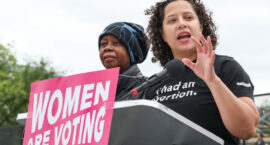
Renee Bracey Sherman and Regina Mahone recently released their co-authored book, Liberating Abortion: Claiming Our History, Sharing Our Stories, and Building the Reproductive Future We Deserve. In it, they offer a new perspective on the history of abortion and imagine a future where reproductive justice is realized.
Bracey Sherman and Mahone ask us to build a better future that begins with building community around abortion and reproductive freedom now.
Ms. sat down with Renee Bracey Sherman to discuss her new book, Liberating Abortion, the history of abortion and where we go from here.