Feminists and Friends Reflect on Pat Schroeder’s Legacy

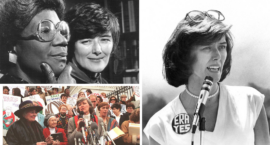
Since the news broke about Pat Schroeder’s death on March 14, there have been thousands of tributes, obituaries, tweets and social media postings in her honor. They described her as a maverick, pioneer, feminist champion, trailblazer, fearlessly independent politician, and an icon and role model for many elected officials, men and women. We agree—but for the feminist movement, Pat Schroeder was much more. On March 22, 2023, the House of Representatives will honor Schroeder with a moment of silence. In honor of this one minute—60 seconds—of silence, we’ve compiled 60 stories from people who knew and admired Pat Schroeder.

“Pat was best known for being a fierce advocate for women. And many young women asked her for advice. She told them to make sure women were in rooms where decisions were being made. And if they were not, to kick the door down and hold the door open for those behind them.”


Menopause Went Prime Time at the Super Bowl. Now the Federal Government Must Step Up

Menopause has been sorely neglected by the mainstream medical establishment, by lawmakers, by employers and by just about everyone. As a result, millions of women are left to navigate its most debilitating symptoms with little support.

Menopause is clearly having a prime-time moment—and we think that’s worth cheering. We challenge the National Institutes for Health to design and launch a modern initiative to assert the long-term benefits of hormone therapy and accurately assess its risks.

The Abortion Pill Court Case We’re All Waiting For

A Trump-appointed federal district court judge in Texas will soon rule in a case that could have drastic consequences for abortion access and miscarriage care nationwide. 

The lawsuit claims that the FDA did not have sufficient proof of mifepristone’s safety—and that the FDA unlawfully fast-tracked its approval—despite the fact that there is extensive evidence showing that abortion pills are safe and effective.

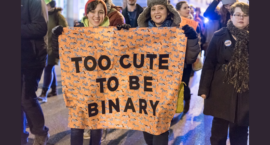
Anti-Trans Legislation to ‘Protect Children’ Harms LGBTQIA+ Youth—Both Now and in the Future

Already, 150 bills aimed at LGBTQ youth have been filed or introduced in 25 states, from restrictions on drag performances, to bans on pronouns teachers can use in the classroom, to mandates that schools ‘out’ trans students to their families.

As a multiracial queer mom to a nonbinary Jewish child, these issues are both personal and political. 

‘Spy Daughter, Queer Girl’: Part Memoir, Part Spy Thriller, Part Mini-History of Being Young and Gay in the ’80s

Leslie Absher’s new memoir Spy Daughter, Queer Girl isn’t a story about secrets, but rather a testament to what happens when one commits to unwinding those secrets. The very nature of memoir is to reveal and make vulnerable—which is a perfect subversion of another type of work: spying for the CIA.

Why Military Women Are at Greater Risk of Breast Cancer

Millions of troops and their families stationed on contaminated military installations were exposed to a deadly combination of toxins responsible for triggering fatal illnesses. North Carolina’s Camp Lejeune is perhaps the most notorious example of widespread contamination affecting U.S. army bases.

Congress passed the Honoring Our PACT Act in August to facilitate veterans’ access to improved benefits through the V.A. for service-connected toxic exposure. The bill recognizes 23 new diseases as presumptive conditions—but breast cancer still isn’t one of them.

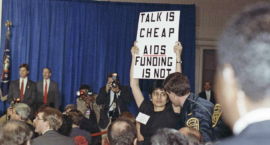
Rest in Power: Urvashi Vaid, the Queer Movement’s Legendary Firebrand

There has never been a queer leader like Urvashi Vaid. Until her death of metastatic breast cancer on May 14 at age 63, she spent the better part of five decades fighting injustice. Principle drove Urvashi in almost everything she did. She exploded onto the scene with a dynamism that has never been equaled since.

“The lesbian agenda is the reconstruction of families … the reimagining of power … the reorganization of the economic system … the reinforcement of civil rights and dignity for all people … the end of the oppression of women, the end of racism, sexism, ableism, homophobia … the reestablishment of a proper relationship to our environment. … When I list this laundry list of oppression, it does not overwhelm me; it tells me how far I have to go in my struggle; it tells me who my allies are.”

The Pregnancy Test: Cancer Treatment in a Post-Roe America

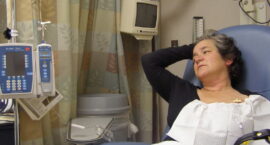
On the morning of May 2, hours before the leaked Supreme Court draft striking down Roe v. Wade, I sat waiting for an infusion of Herceptin, an essential drug I was prescribed when diagnosed with breast cancer. Herceptin has saved countless women’s lives since 1990, but it can cause fetal harm.

I was denied medical care until I could prove I wasn’t pregnant. Where was my agency in this situation? And what if I had been pregnant? Would I have been denied the very drug that saved my life and which protects my future—which ensures that my young children will continue to have a mother—in order to protect a pregnancy I did not want or plan to keep?