Keeping Score: Trump Attacks Iran, Pressures Senate Republicans to Pass ‘Show Your Papers’ Voter Registration Bill; States Expand Access to Childcare and Paid Leave

In every issue of Ms., we track research on our progress in the fight for equality, catalogue can’t-miss quotes from feminist voices and keep tabs on the feminist movement’s many milestones. We’re Keeping Score online, too—in this biweekly roundup.

This week:
—Dolores Huerta breaks her silence at 96: “I have never identified myself as a victim, but I now understand that I am a survivor.”
—Trump pressures Senate Republicans to pass the SAVE America Act, a “show your papers” policy that would require U.S. citizens to show a passport or birth certificate in order to register to vote.
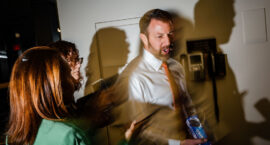
—A performative personnel exchange at DHS: from Kristi Noem … to Markwayne Mullin?
—The U.S. and Israel launched strikes on Iran, killing at least 1,332 people.
—March 10 is Abortion Provider Appreciation Day.
—DHS Secretary Kristi Noem was fired, as ICE reports 32 deaths in detention facilities in 2025.
—Access to early prenatal care is declining in the U.S., especially in states with abortion bans.
—A record one-third of American workers not have access to government-mandated paid leave.
—The U.S. deported a gay woman to Morocco, where her sexuality is illegal and she faces violence from her family.
—Texas Attorney General Ken Paxton claimed gender-affirming mental healthcare for trans youth is “child abuse.”
—New Mexico and New York take steps towards free universal childcare.
—Jessie Buckley took home the Academy Award for Best Actress in a Leading Role for her role in Hamnet. The film was directed by Chloé Zhao, one of nine women to ever be nominated for the award of Best Director and the only woman nominated this year.

… and more.

Cover Reveal and Spring 2026 Issue Sneak Peek: ICE Is ‘the Army of the Patriarchy’

In early February, while the nation was still reeling from the murders of Renee Good and Alex Pretti by federal agents, Loretta Ross and Jackson Katz—two feminist academics with decidedly different backgrounds and identities—discussed how U.S. federal agents became the enforcement arm of the nation’s racism and misogyny.

You’ll find this, and more, in the Spring 2026 issue of Ms.

Look for Ms. Magazine at Hudson News This Women’s History Month

Traveling this month? Keep your eyes peeled. For Women’s History Month, Ms. magazine is hitting the shelves at Hudson News airport bookstores across the country.

If you spot Ms. at Hudson News, snap a photo and tag @msmagazine on social media—we’d love to see it. Consider grabbing a copy for your flight; every purchase helps sustain our feminist journalism.

Kristi Noem Is Out at DHS—But Women May Not Be Safer Under Her Replacement

As frontline witnesses to the worst of humanity, physicians carry the heavy burden of moral distress—the anguish of seeing harm unfold and feeling powerless to stop it. This feeling has only grown with the rise of Immigration and Customs Enforcement (ICE) in its current form. Its inhumanity under former DHS Security Kristi Noem’s leadership—reflected in the anxieties of our patients, many of whom are avoiding essential medical care out of fear—has us despairing with helplessness.

So, yes, many of us were excited to see Noem go.

The hope that swelled with Noem’s ousting vanished quickly with news of President Trump tapping Sen. Markwayne Mullin (R-Okla.) as her replacement, a former MMA fighter and co-sponsor of the SAVE America Act, which disproportionately targets women’s voting eligibility. Mullin holds extremist views on abortion, opposing even exceptions to save the mother’s life. Deeply disturbing is Mullin’s 2013 vote against reauthorizing the Violence Against Women Act.

While Noem’s firing is a step in the right direction, appointing a manosphere-adjacent fitness bro whose rhetoric of “protection” echoes the same ideology predicated on women’s forced subjugation—and whose political track record shows a distinct disdain for women’s lives—as her replacement is absolutely not the move.

Sundance 2026: In Documentary ‘One in a Million,’ a Syrian Girl’s Life in Exile Reveals the Long Road After War

Winner of Sundance’s Audience Award in the World Cinema Documentary category, as well as the Directing Award for filmmakers Itab Azzam and Jack MacInnes, One in a Million lives up to its title. It homes in with a laser focus on the experiences of Israa, a Syrian girl whose family undertakes the perilous migration to Germany after the start of the Syrian civil war.

When the filmmakers first meet Israa in 2015, she is an inquisitive 11-year-old selling cigarettes on the street in Turkey while her family waits for the chance to cross the Mediterranean. The journey that follows—overcrowded rafts, long treks across multiple borders and nights spent sleeping on the street—contains harrowing moments, but it ultimately occupies only a sliver of the film’s larger story.

Once the family arrives in Germany, where the filmmakers check in with them over the next nine years, One in a Million reveals a far more complicated and intimate portrait of migration and acculturation.

As Israa grows from child to teenager to young adult, she navigates questions of identity, freedom and belonging, while her mother Nisreen becomes increasingly confident and independent in a country that offers opportunities she was denied in Syria. The result is a quietly riveting portrait of family life in transition, showing how the experience of displacement continues to reshape relationships, expectations and the possibilities of who each person might become.

(This is one in a series of film reviews from the 2026 Sundance Film Festival, focused on films by women, trans or nonbinary directors that tell compelling stories about the lives of women and girls.)

How ICE Enforcement Is Driving Black Domestic Workers Out of Public Spaces

Like many domestic workers in New York City, Felicia has built a strong network of other working professionals who meet at local parks to socialize and share their experiences. Over the two decades she has spent caring for New York families since arriving from St. Lucia, those conversations have grown into friendships—friendships she says have become a lifeline.

For years, the park has been one of the only places Felicia felt she could exhale. That has all changed under the second Trump administration.

Felicia hears it constantly: fewer nannies at the park, fewer informal gatherings in play spaces, fewer familiar faces lingering in bookstores to warm up with kids on cold days. People are staying indoors, shortening their routes and avoiding public places that were once part of the workday. That’s because fear has gotten louder. The process feels unpredictable and unchecked. “No one knows,” Felicia says. “ICE can kidnap you.”

What Trump’s Rollback of DEI Means for First-Generation Students Like Me

“People can take anything from you, but they can never take away your education.” My roots are in Guyana, a Caribbean nation, and this mantra of resilience echoed through generations and followed me from Guyana to Queens, N.Y.

But when President Trump recently bragged he “ended DEI in America,” he was openly celebrating the very shift I’ve already felt in my own education.

When I entered college in Fairfield, Conn., I carried more than my own ambition. I carried the unrealized dreams of my grandmother and the women in our village who were told their place was in the home, not a lecture hall. My education isn’t just for me—it’s for my family, my community and every girl back in our motherland who never got the chance and never will.

But higher education in the United States has increasingly transformed from a public good into a private marketplace. The very pathways that made my presence in these institutions possible are now being publicly dismantled through legislation and policy.

Immigrant and first-generation students do not weaken universities. We strengthen them. If we believe education cannot be taken from us, then we must be willing to fight for the conditions that make it accessible in the first place. In a political moment where leaders celebrate the end of DEI as progress, defending its need has never felt more urgent.

Immigration Detention Is Failing Women and Children—By Design

The South Texas Family Residential Center in Dilley has been the subject of an onslaught of headlines in recent weeks, but the truth is, it’s been routinely criticized for inhumane conditions for years. But what we are seeing now, as Trudy Taylor Smith put it to me, is horror “on a shocking scale.” Children describe being served worm-infested food and dirty water, getting little or no classroom time and being perpetually sick. A toddler nearly dies because of medical neglect. A teenage boy with symptoms consistent with appendicitis is turned away by a nurse. There is no better way to describe it than state-sponsored child abuse.

If this isn’t stomach-churning enough, consider what is happening a few hours south, where girls’ reproductive healthcare and freedom is also in grave crisis. Pregnant and unaccompanied migrant children are being sent to San Benito, Texas.

Why Texas? Why else? … Because it is a place where abortion is illegal and high-risk pregnancy care is unavailable.

“Putting pregnant kids in San Benito is not a decision you make when you care about children’s safety,” one source said plainly.

This is entirely by design, pulled straight from the Project 2025 playbook. The constant split-screen scene in Texas is representative of the nation MAGA wants us to be, “where the cruelty is the point” and where the anti-immigrant, anti-woman, anti-freedom banner is flown.

We have to keep these stories—and all the women and girls in this state, willingly or not—front and center in the democracy movement. Their humanity is at the heart of all of ours.

Keeping Score: Voters Disapprove of Kristi Noem and ICE; Winter Olympics Nears Gender Parity; Challenges to State Abortion Bans Continue

In every issue of Ms., we track research on our progress in the fight for equality, catalogue can’t-miss quotes from feminist voices and keep tabs on the feminist movement’s many milestones. We’re Keeping Score online, too—in this biweekly roundup.

This week:
—“Kristi Noem sees immigrants like me as subhuman,” says Santiago Mayer, executive director of Voters of Tomorrow.
—A majority of U.S. voters think DHS Secretary Kristi Noem should be removed, and disagree with how ICE is operating.
—Women are 47 percent of athletes at the Winter Olympics in Milan.
—California Gov. Gavin Newsom fired back at threats from Louisiana over abortion protections.
—President Trump appointed no women of color to federal judgeships in his first year in office.
—A new Kansas law introduces a “bounty hunter” aspect to transphobic bathroom bills.
—Some ICE detention facilities and prisons refuse to provide appropriate menstrual products.
—A Kentucky couple was arrested over a year after seeking care for a miscarriage.
—A wave of “common sense” candidates, more than half women, recently won competitive school board races in swing states. Sixty-two percent of “extremist” candidates lost their elections, showing that culture war tactics like book bans may no longer resonate with local voters.

… and more.

When Is the Next No Kings Protest? And How to Find a Demonstration Near You

On Saturday, March 28, the third round of No Kings will take place in cities and towns across the United States. The protest comes in response to the Trump administration’s recent crackdowns on immigration and Immigration and Customs Enforcement (ICE)’s systemic violations of proper law enforcement procedures. The organizers are optimistic that millions of Americans will take part in demonstrations, marches and rallies, and predict it will be the largest nonviolent protest in American history. 

To find a protest close to you, No Kings has created a map to locate a nearby protest site.

The protest’s flagship event will be hosted in Minneapolis and Saint Paul, Minnesota’s Twin Cities.