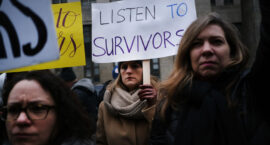
Releasing the Epstein files without real consequences risks turning a long fight for truth into yet another moment of exposure that leaves survivors without justice and systems of abuse intact.
In the final days of 2025, under the cover of the holidays, Trump’s Department of Veterans Affairs (VA) instated a total ban on abortion and abortion counseling.
The new policy applies to all VA healthcare facilities across the U.S., including in states where abortion remains legal. As a result, the VA now has “one of the strictest abortion bans in the country,” according to the Center for Reproductive Rights.
In late January, Sens. Patty Murray, Richard Blumenthal, Chuck Schumer and Democratic members of the Senate Veterans’ Affairs Committee introduced a joint Congressional Review Act (CRA) resolution—an oversight tool through which Congress can overturn rules issued by federal agencies, by a simple majority—to nullify the administration’s abortion and abortion counseling exclusion.
Garnering a same-day endorsement by an array of veterans’, medical, women’s, and reproductive health and rights organizations, they urged “both chambers to act swiftly to overturn this extreme policy that puts veterans’ health and safety at risk.”
Modeling appears glamorous. Beautiful people, high end clothing and photo shoots in exotic locations. But the reality is far more bleak.
I was ecstatic when I was selected to be on America’s Next Top Model. By the time I understood how little control I had, it felt too late to ask questions. Personal phones were gone. Contact with the outside world was restricted.
When Netflix released Reality Check: Inside America’s Next Top Model, my reaction was not shock. It was recognition.
The rich men surrounding Jeffrey Epstein, and the working and middle-class men who were lured into Dominique Pelicot’s twisted fantasy, navigate the social world from very different sides of the class chasm.
But they share something in common, too: They’re all men who were socialized into a misogynous culture that dehumanizes women, turns them into sexual commodities and licenses men to mistreat them.
Misogynous exploitation is not rooted primarily in plutocratic privilege. The sense of unquestioned entitlement to women’s bodies that many observers have noted about “Epstein class” men is hardly confined to the wealthy.
Jeffrey Epstein’s crimes were not carried out in isolation—they were enabled by a system that repeatedly narrowed investigations, shielded powerful figures and sidelined survivors.
Investigative journalist Julie K. Brown with the Miami Herald has extensively documented the mishandling of the Epstein case. Early reports and accusations were treated with skepticism; initial investigations were shut down; charges were narrowed; powerful actors were shielded; and even meaningful survivor notification of prosecutorial decisions was bypassed. Drawing on more than two decades working within the legal system on domestic violence and sexual assault cases, I see the Epstein files as a stark illustration of how institutions often fail those they are meant to protect.
The partial and selective release of the Epstein files only deepens these concerns. Survivors’ identifying information has been exposed while the names of powerful associates remain redacted. When victims are left vulnerable and power remains protected, accountability has not merely failed—it has been inverted.
This moment demands more than incremental disclosure: It requires full transparency, rigorous investigation and prosecution wherever the evidence leads, so that survivors’ courage is met with the justice they were promised.
In every issue of Ms., we track research on our progress in the fight for equality, catalogue can’t-miss quotes from feminist voices and keep tabs on the feminist movement’s many milestones. We’re Keeping Score online, too—in this biweekly roundup.
This week:
—“Kristi Noem sees immigrants like me as subhuman,” says Santiago Mayer, executive director of Voters of Tomorrow.
—A majority of U.S. voters think DHS Secretary Kristi Noem should be removed, and disagree with how ICE is operating.
—Women are 47 percent of athletes at the Winter Olympics in Milan.
—California Gov. Gavin Newsom fired back at threats from Louisiana over abortion protections.
—President Trump appointed no women of color to federal judgeships in his first year in office.
—A new Kansas law introduces a “bounty hunter” aspect to transphobic bathroom bills.
—Some ICE detention facilities and prisons refuse to provide appropriate menstrual products.
—A Kentucky couple was arrested over a year after seeking care for a miscarriage.
—A wave of “common sense” candidates, more than half women, recently won competitive school board races in swing states. Sixty-two percent of “extremist” candidates lost their elections, showing that culture war tactics like book bans may no longer resonate with local voters.
… and more.
The Epstein files scandal has all the elements of a gigantic media spectacle. It encompasses everything from true crime to political intrigue, and offers a peak behind closed doors into the lifestyles of the rich and famous. It has more than a little sex and violence.
It’s a conspiracy theory come to life.
Media commentary has explored seemingly every angle. Or has it? On closer examination, something has been missing.
Featuring the cases of Amber Heard, Gisèle Pelicot, Brittany Higgins, Colombian journalists at Volcánicas and others, Silenced traces a global pattern of defamation suits used to punish survivors and the reporters who amplify their stories.
It’s a fitting but frustrating coda that Silenced itself faced legal threats right after its festival premiere.
(This is one in a series of film reviews from the 2026 Sundance Film Festival, focused on films by women, trans or nonbinary directors that tell compelling stories about the lives of women and girls.)
The Department of Justice has released more than 3 million pages of records related to Jeffrey Epstein. For decades, survivors have begged for answers and accountability. But they say the latest tranche of documents—many containing unredacted names, contact information and identifying details—have left them retraumatized, exposed and furious.
Some describe the release as careless. Others call it deliberate. Many say it confirms what they have long believed: that survivors are still not being centered, protected or heard.
Read survivors’ reactions, in their own words.
“My sister Maria Farmer filed a lawsuit against the government for negligence in this case, and really as I see it this is just further examples of that—of the ways that we have not been protected and that DOJ has not done their job.”
“I can’t help but wonder why the DOJ has once again failed us. Again. It feels like they’re ignoring our need for protection, especially when they’ve taken the time to redact the names of powerful individuals … but not ours. This double standard makes it even harder for us to trust them.”
In every issue of Ms., we track research on our progress in the fight for equality, catalogue can’t-miss quotes from feminist voices and keep tabs on the feminist movement’s many milestones. We’re Keeping Score online, too—in this biweekly roundup.
This week:
—For the first time, more Americans support than oppose abolishing ICE.
—Senate Democrats refused to pass a DHS bill that would fund ICE for this fiscal year. Instead they passed a two-week continuing resolution to give them time to negotiate reforms designed to prevent further brutality from ICE and CBP agents.
—Artists use Grammy acceptance speeches to denounce Trump and ICE: “Our voices matter,” urged Billie Eilish. “We are humans and we are Americans,” said Bad Bunny.
—Organizations raise alarms about Grok AI spreading nonconsensual intimate images on Twitter.
—Virtual reality may be a tool to change opinions about catcalling.
—Access to IVF has led to more unmarried women in their 40s choosing to have babies.
… and more.