What We Learned When We Stayed: What 50 Years of Care in the South Taught Us About Abortion and Trans Rights

We’ve been here before.

When Dobbs v. Jackson came for abortion care in our states, we did two things: We opened clinics across state lines so our patients would still have a legal option. And we stayed. We kept our original clinics open, expanding the care we’d always offered or always wanted to offer.

When U.S. v. Skrmetti came for gender-affirming care, we kept providing that too, because abortion care patients and transgender patients are not separate communities.

The calculation patients make before they walk through the door is identical for both communities: Will I be seen? Will I be safe? Will the person across from me treat my body with humanity, or like a problem to be managed?

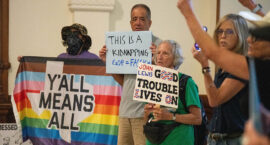
June marks anniversaries of both Dobbs and Skrmetti, and that conviction has never felt more urgent. Long before these two cases, the intersection of abortion rights and trans rights was already living in our waiting rooms; in the patients who received reproductive care and gender-affirming hormone therapy under the same roof; in the person who drove hours across the state because we were the only provider they trusted; and in those who trust us with their whole-person care because their grandmothers, mothers, sisters, aunts and friends have relied on our clinics for care for 50 years.

Between our two organizations, we’ve earned a century’s worth of experience at the practice of staying and enduring. CHOICES has kept their doors open for 52 years, and the Women’s Health Centers of West Virginia and Maryland will celebrate 50 years of care on June 24—the same day Roe v. Wade was overturned four years ago.

Support independent clinics in hard places keeping the doors open. And when the next fight comes, show up for the communities under pressure. Remember that those targeted first won’t be the last, but they will be the ones to lead the way.

Tennessee Tries to Silence Women Nearly Killed by Its Abortion Ban: ‘We Will Have Our Day in Court,’ Pledges Lead Plaintiff

Tennessee was supposed to face nine women in court on April 27 in a closely watched trial over the state’s abortion ban—women who say they were denied emergency care, forced to flee the state for abortions, or pushed to the brink of death after suffering catastrophic pregnancy complications. After waiting nearly three years to testify publicly about what happened to them, the plaintiffs were prepared to finally take the stand.

Then, less than two business days before the trial was set to begin, Tennessee Attorney General Jonathan Skrmetti (yes, the same Skrmetti whose name is now attached to the Supreme Court’s landmark anti-trans healthcare ruling) filed an appeal invoking a newly enacted state law which prevents Tennesseans from suing over any state law that harms them. The move stripped the court of jurisdiction over the case, abruptly halting the proceedings and potentially delaying the trial for months or years.

“We should be in court today standing up to Tennessee’s abortion ban,” the Center for Reproductive Rights said in a statement after the cancellation. “These women deserve their day in court. But Tennessee politicians refuse to listen.”

Among the plaintiffs is Allie Phillips, who says she was forced to travel to New York for an abortion after learning her fetus had a fatal diagnosis and that continuing the pregnancy put her own life at risk. By the time she arrived for care, she learned the fetus had already died in utero, placing her at heightened risk of infection and blood clots.

Phillips shares her story and reaction to the canceled trial, in her own words.

“I would have testified about how I would have risked my future fertility and my life if I had stayed pregnant in Tennessee. … I already had a 6-year-old daughter, Adalie, to raise. She needed me to live and be her mom. …

“We’re appealing. We don’t know how it will take but even if it’s five years, we will have our day in court. I’m not going anywhere.”

War on Women Report: Rise of ‘Sleep Porn’; Georgia Midwives Sue for Right to Practice; Louisiana Family Massacre Exposes Deadly Intersection of Domestic Violence and Guns

MAGA Republicans are back in the White House, and Project 2025 is their guide: the right-wing plan to turn back the clock on women’s rights, remove abortion access, and force women into roles as wives and mothers in the “ideal, natural family structure.”

We know an empowered female electorate is essential to democracy. That’s why day after day, we stay vigilant in our goals to dismantle patriarchy at every turn. We are watching, and we refuse to go back. This is the War on Women Report.

Since our last report:
—Access to mifepristone remains protected for now, after a U.S. district court granted a stay in Louisiana v. FDA.
—A new CNN investigation reveals a sprawling online network where drug-facilitated sexual assault, marketed as “sleep porn, ” is filmed, shared and monetized, drawing millions of viewers. Meanwhile, survivors face steep barriers to reporting and justice.
—The Ohio House passed the Indecent Exposure Modernization Act, an extreme bill that seeks to ban any expression or performance of drag where minors are or may be present. The proposed ban includes even daytime family-oriented events such as drag queen story hours, where performers dress up as storybook characters and read to children at libraries or bookstores.
—In a devastating shooting spree spanning three locations, Shamar Elkins shot and killed eight children, seven of whom were his own, and severely wounded two women: his wife, Shaneiqua Pugh, and Christina Snow. Both women are mothers to the deceased victims.
—In Georgia, a group of reproductive healthcare advocates is challenging the state’s restrictions on some forms of maternal healthcare, arguing that Georgia’s current laws give doctors too much control over midwives’ ability to practice.
—Nine women in Tennessee are suing the state over its abortion ban after nearly denying due to being denied abortion care.

… and more.

These Fathers of Trans Children in the U.S. Are Deconstructing Their Own Masculinity to Become Better Parents

The Dads, a new feature-length documentary, follows the fathers of trans, nonbinary and gender-expansive children as they weather the rapid escalation of anti-trans legislation in the United States over the past two years. Directed and produced by Luchina Fisher, the film debuted last month at the South by Southwest (SXSW) Film Festival.

The film bears witness to parents’ struggle with whether to stay in the United States or move abroad in face of bans on restrooms, sports and gender-affirming care for trans youth.

In the end, The Dads is about faith—faith in the experiment of the United States, faith in dads to know who their children are and how best to protect them, and faith in all dads to grow and learn who they are. 

How Attacks on Immigrant Teens Helped Build the Post-Roe Playbook

A conversation between legal scholar Shoshanna Ehrlich and Brigitte Amiri, deputy director of the ACLU’s Reproductive Freedom Project.

“In the first Trump administration, we still had Roe. By losing that underlying constitutional right to abortion at the federal level, the door has been opened for the second Trump administration to both compound the attacks and move in new directions,” Amiri told Ms.

“We were screaming from the rooftops that they were coming after Roe, and abortion was going to be banned, and we were not believed. … As with all rights, they’re tenuous and you have to continue to fight to enforce them.

“It’s always the most marginalized, as we’ve been talking about. It’s the people who have the fewest resources, people who live in rural areas, young people, people without documentation, people with limited language skills. That is who will feel the brunt the hardest of these policies.”

A New Supreme Court Term Brings Familiar Trouble

The Supreme Court’s 2025–’26 term opens under the shadow of the Trump administration’s growing influence over the judiciary. Last term, the Court issued 140 emergency rulings—many of them unsigned—compared to just 55 full opinions. These “shadow docket” decisions often favored the Trump administration, even in cases where the stakes included the rights of transgender people, immigrants and federal employees.

Now, with several Trump-backed cases on the merits docket, legal experts Michele Goodwin and Steven Vladeck warn that the Court’s deference to presidential power could deepen.

From conversion therapy bans to voting rights and gender-affirming care, the consequences of this term’s decisions will reverberate far beyond the courtroom.

‘These Aren’t Decorative Constitutional Provisions—They’re Powerful Tools Waiting to Be Used’: How the ERA Project Is Advancing the Feminist Agenda, State by State

In the final episode of the Ms. Studios podcast Looking Back, Moving Forward, ERA Project director Ting Ting Cheng breaks down the power of state Equal Rights Amendments—and how activists and lawmakers can leverage them to build a stronger foundation for federal constitutional equality for everyone.

Listen to the latest episode of Looking Back, Moving Forward, “The Feminist Fight For The Equal Rights Amendment Is Far From Over—and More Urgent Than Ever (with Pat Spearman, Ellie Smeal, Carol Moseley Braun, Kathy Spillar, and Ting Ting Cheng)” on Spotify, Apple Podcasts or wherever you get your podcasts.  

The Promise of the Equal Rights Amendment Is More Urgent Than Ever

In the fifth episode of Looking Back, Moving Forward, advocates and experts reflect on more than 50 years of activism to ratify the ERA—and the power that would come from women’s constitutional equality to redefine our democracy, protect our fundamental rights and change the stories of women’s lives.

Listen to the latest episode of Looking Back, Moving Forward, “The Feminist Fight For The Equal Rights Amendment Is Far From Over—and More Urgent Than Ever (with Pat Spearman, Ellie Smeal, Carol Moseley Braun, Kathy Spillar, and Ting Ting Cheng)” on Spotify, Apple Podcasts or wherever you get your podcasts.

Keeping Score: Democrats Fight Republican Redistricting; Periods Make College Students Miss Class; Costco Refuses to Sell (Safe, Legal) Abortion Pills to Appease Antiabortion Politics

In every issue of Ms., we track research on our progress in the fight for equality, catalogue can’t-miss quotes from feminist voices and keep tabs on the feminist movement’s many milestones. We’re Keeping Score online, too—in this biweekly roundup.

This week:
—“I am deeply alarmed by news reports that Costco is refusing to sell safe, effective, and legal medication for no other reason than to appease the politics of antiabortion fanatics,” said Sen. Patty Murray (D-Wash.).
—The Democratic Legislative Campaign Committee called for Democrat-led state legislatures to pursue redistricting: “The DLCC refuses to allow Republicans to rig the maps to keep themselves in power.”
—“A troubling shift is underway: Women are leaving the U.S. workforce in unprecedented numbers. But this isn’t a choice; it’s a consequence,” warned Catalyst president and CEO Jennifer McCollum after a report showed 212,000 women have left the workforce since January.
—A third of college students have missed class because of their period.
—The Trump administration is planning to restrict coverage of abortion care for veterans in almost all circumstances.
—RFK Jr. takes aim at antidepressant use during pregnancy, despite American College of Obstetricians and Gynecologists’ approving of their usage.
—Texas’ abortion ban has made miscarriages more dangerous.
—A federal court blocked the Trump administration’s restrictions on grants from the Office on Violence Against Women. Seventeen states had challenged the restrictions, and the order is a temporary win for organizations supporting survivors of domestic and sexual violence. 

… and more.

Pregnant and Unmarried? In Tennessee, That’s Now Grounds for Denial of Care.

This week marked the first reported case of a woman being denied prenatal care for being unmarried in the state of Tennessee and the country. And it is the direct result of the state’s 2025 Medical Ethics Defense Act, which went into effect in April. The law enables physicians, nurses, hospitals and insurers to invoke religious, moral or ethical objections to the provision of care and treatment, with no legal requirement to provide patients with a referral or alternative.