14 Powerful Lines From Justice Jackson’s Dissent on Conversion Therapy: ‘Like It or Not, Treatment Standards Exist in America’

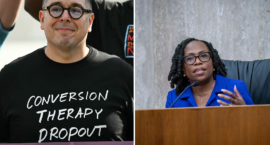
The Supreme Court on Tuesday struck down Colorado’s ban on conversion therapy for LGBTQ youth, ruling the law likely violates the First Amendment—a decision advocates warn will put young people at risk.

In a rare and forceful move, Justice Ketanji Brown Jackson delivered her dissent from the bench.

We’ve pulled the most powerful, incisive—and yes, spiciest—lines from her 35-page dissent. Read, share your favorite line, and help lift up a dissent that refuses to mince words about what’s at stake.

The SAVE Act Is Designed to Erode Access to the Ballot. The Woman Who Built the Largest Voter Protection Operation in History Is Not Surprised.

The Senate has begun debating the SAVE America Act—a bill that would require Americans to show a birth certificate or passport just to register to vote.

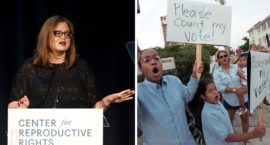
Rachana Desai Martin is not surprised. She has spent her entire career watching exactly this happen.

Desai Martin is one of the only people in the country who has spent her career building the infrastructure to protect both voting rights and reproductive rights. She has seen both fights from the inside. And what she sees—clearly, consistently, without drama—is that these are not two separate battles.

“At base, both of these things are really about power and control,” she told me. “When we’re advocating for reproductive rights, it’s to give people power over their own bodies and their lives and their families and their futures. When we’re talking about voting rights, it’s to give people the power to pick their representatives and have their government work for them.”

Same target. Same architecture. Same playbook.

The Latest Cache of Epstein Files Haven’t (and Won’t) Spark Wall Street’s #MeToo Moment

In 2010, a 28-year-old woman working at the London branch of a Wall Street bank was leaving the office around 10 p.m. when a colleague pushed her against a wall and tried to forcibly kiss her. “A cab driver saw what was happening and physically pulled him off me,” the woman, who asked not to be named for fear of repercussions, told me. She reported the incident the next day to her manager, who told her she “should dress for the job I want” and not “like a stripper.” The women quit a month later. “I just wanted out,” she said. “I was mortified.”

What is notable about this story is how common it is. Even now, she said, you can speak to almost any woman who has spent time working in finance and she will know someone who has been harassed or assaulted. Often she has her own story.

That culture, and Wall Street’s willingness to perpetuate it, is back in the spotlight after the latest release of emails linked to Jeffrey Epstein, which are reviving scrutiny of his extensive connections across the industry.

‘America’s Next Top Model’ Was a Microcosm of the Modeling Industry’s Power Problem

Modeling appears glamorous. Beautiful people, high end clothing and photo shoots in exotic locations. But the reality is far more bleak. 

I was ecstatic when I was selected to be on America’s Next Top Model. By the time I understood how little control I had, it felt too late to ask questions. Personal phones were gone. Contact with the outside world was restricted.

When Netflix released Reality Check: Inside America’s Next Top Model, my reaction was not shock. It was recognition.

‘Lone Star Three’: How Three UT Austin Students Paved the Way for Birth Control Access in 1960s Texas

In 1969 Victoria Foe, Judy Smith and Barbara Hines were students at the University of Texas in Austin when Smith invited Foe and Hines to attend women’s liberation meetings at her house. Their discussions led them to start a campus Birth Control Information Center and eventually evolved into an underground network that helped women access safe abortion at a time when it was illegal in Texas. 

Their activism would eventually extend far beyond their university campus, planting the seeds for Roe v. Wade, the landmark Supreme Court decision that would legalize abortion in the U.S. Not until 1965 did birth control in the U.S. become legal for married women. Not until 1972 did it become legal for anyone, married or unmarried, to access birth control.

A new documentary, Lone Star Three, directed by Karen Stirgwolt, tells the story of the women who formed the underground networks that allowed young women to access reproductive care in Texas in the days leading up to Roe v. Wade. Ms. recently spoke with Foe and Hines (Smith passed away in 2013), and archivist Alice Embree, about their activism from the 1960s to the present moment.

‘A Deliberate Attempt to Terrorize’: Former FBI Agent Asha Rangappa on What Real Law Enforcement Looks Like—and What ICE Is Not

ICE is the highest-funded federal law enforcement agency in American history—its budget larger than the FBI, ATF, DEA, U.S. Marshals Service and Bureau of Prisons combined. Its agents wear masks, drive unmarked vehicles and operate with an impunity that has drawn comparisons to secret police forces around the world. Multiple federal courts have refused to trust the agency’s own statements of fact. And in Minneapolis, ICE agents shot and killed Renee Macklin Good and Alex Pretti in front of their neighbors’ cameras.

Asha Rangappa has seen this movie before—just never in America.

A former FBI special agent who spent years in the bureau’s New York division, specializing in counterintelligence, Rangappa was trained to monitor threats to America. Her job required surgical precision, behavioral psychology, extraordinary patience and, above all, trust.

“The bread and butter of your work as a law enforcement agent is that you need the community’s help,” she told me. “You actually can’t do your job without it.”

Abortion Clinics Left Unprotected as DOJ Weaponizes FACE Act Against Journalists and Peaceful Protesters

As unbelievable as it sounds, President Donald Trump’s Department of Justice has deployed the FACE Act—not against antiabortion extremists who invade clinics and terrorize patients, but against journalists documenting political protests and peaceful activists decrying the killing of Renee Good by federal ICE agents.

The Freedom of Access to Clinic Entrances and Places of Religious Worship (FACE) Act, a law designed primarily to protect abortion providers, clinic staff and patients, is being perverted by the DOJ as part of its broader effort to deny freedom of the press and undermine the rule of law.

The DOJ has criminally charged nine people, including two journalists, under the FACE Act for entering a church to speak out against a pastor who is reportedly the acting field director for ICE in Minneapolis. The high-profile and highly unusual arrests of journalist and former CNN anchor Don Lemon and independent Minneapolis journalist Georgia Fort, along with several peaceful activists, underscore the Trump administration’s latest attack on the rule of law, freedom of speech, and the right to assembly.

The Trump administration purposefully ignored clinic invasions and blockades by antiabortion extremist groups in 2025—all while reproductive health clinic staff and patients have experienced a dramatic surge in threats and violence.

One Year In: 53 Ways the Second Trump Administration Is Harming Women and Families

A sweeping, year-one rundown of how Trump’s second-term power grabs and policy rollbacks are eroding women’s rights, healthcare and economic security, including—from dismantling the Women’s Bureau at the Department of Labor and shuttering reproductive health clinics, to passing historic cuts to the Medicaid program and sowing mistrust in abortion pill safety.

Oscar-Shortlisted Film ‘Belén’ Exposes the Injustice That Helped Transform Argentina’s Abortion Laws

Belén didn’t know she was pregnant until she miscarried in a hospital. She’d gone to the emergency room suffering excruciating abdominal pain. Instead of receiving care, she awoke from surgery handcuffed to her hospital bed and accused of having an illegal abortion.

This is the true story behind Belén, a powerful new Argentine film directed by, written by and starring Dolores Fonzi. It is based on the ordeal of a young woman from northern Argentina, chronicled in Ana Correa’s nonfiction book What Happened to Belén: The Unjust Imprisonment That Sparked a Women’s Rights Movement, the prologue of which was written by Margaret Atwood.

Despite a lack of evidence, Belén was charged with aggravated homicide and sentenced to eight years in prison.

After two years, Belén was freed, thanks to the legal work of activist and lawyer Soledad Deza and the sustained support of women’s organizations and women’s rights activists and movements, such as “Ni Una Menos” (Not One Less). Her case became a rallying cry for reproductive rights, with thousands taking to the streets under the banner #LibertadParaBelen (“Freedom for Belén”), paving the way for Argentina’s historic legalization of abortion in 2020.