
Releasing the Epstein files without real consequences risks turning a long fight for truth into yet another moment of exposure that leaves survivors without justice and systems of abuse intact.


More Than A Magazine, A Movement

Releasing the Epstein files without real consequences risks turning a long fight for truth into yet another moment of exposure that leaves survivors without justice and systems of abuse intact.

Over 30 years ago, world leaders came together in Beijing and made a promise: Gender equality would be a global standard, not a distant aspiration. This March, as the United Nations Commission on the Status of Women convenes for CSW70 under the theme of strengthening access to justice and eliminating discriminatory laws, that promise remains not only unfinished, but increasingly under coordinated assault.
Since 1999, Equality Now’s Words & Deeds reports have tracked laws and policies that discriminate against women and girls, documenting progress when legal reform has been achieved and holding governments accountable when words fail to translate into action.
Our new Words & Deeds update, Progress and Backlash: Accountability for the Rights of Women and Girls, shows that we are at a perilous moment of global regression in women’s rights. Across regions, protections once considered settled are being diluted, defunded and, in some cases, deliberately dismantled.

In honor of the 250th anniversary of the signing of the Declaration of Independence, the right-wing Heritage Foundation—developers of Project 2025, the policy guidebook written to influence the Trump administration’s legislative priorities—has issued a 168-page position paper, “Saving America by Saving the Family: A Foundation for the Next 250 Years.”
The document is intended to “restore the family,” by elevating a male-led, heterosexual model of social relations.
The report is both absurd and terrifying—which is why the National Women’s Law Center (NWLC) is sounding an alarm about it. Emily Martin, the NWLC’s chief program officer and Amy Matsui, its vice president of childcare and income security, spoke to Ms. reporter Eleanor J. Bader about “Saving America by Saving the Family” in late February.

The majority of U.S. teenagers live in states that require parental involvement in abortion healthcare decision-making. If parents are unavailable or teens under 18 do not want to involve their parents, they must go to court and convince a judge that they are mature enough to decide on their own or that the abortion is in their best interest.
To avoid this invasive and burdensome process, resourceful teens are now turning to abortion care from telehealth providers located outside their restrictive states.
Under the Reagan administration, parental involvement laws proliferated as an attempt to restrict minors’ access to reproductive healthcare.
One of the most well-known, devastating consequences of these laws was the 1988 death of Becky Bell in Indiana. When Bell became pregnant as a teenager, Indiana had a parental consent law. Bell was afraid to tell her parents about the pregnancy for fear of disappointing them, but she was also afraid to go before a local judge she heard was reluctant to grant waivers. Believing she had no other option, she turned to an unsafe, likely self-induced abortion. Several days later, Bell was rushed to the hospital with a massive infection and died. Her death became a poignant symbol of the lethal effects of restricting young people’s access to safe abortion.

Grok, the AI chatbot used on Musk’s platform X, has been under fire for generating nude or sexualized images of real people, including individuals who are minors. In one estimate, Grok produced one nonconsensual sexual image per minute over a 24-hour period. Prompts such as “put her in a transparent bikini” produced altered images that were then circulated publicly, some accumulating thousands of likes. The targets are real women and underage girls whose images were manipulated without their knowledge or permission.
Elon Musk responded by making a joke, requesting a Grok-generated image of himself in a bikini and reacting with laughing emojis. When the platform’s most powerful figure and one of the country’s most powerful men treats the abuse as a punchline, it sends a message about what is actually harmful versus what he thinks should be considered humor—and provides a tacit granting of consent to young men on the platform to keep making these images.
Much of the public conversation about young people and AI has focused on cheating in school or declining literacy. Far less attention has been paid to what it means when a middle school boy can type a sentence and produce a sexualized image of a female classmate in seconds as a joke or for attention—or to pretend he received it from her for status.
For girls growing up in this online environment, the message is unmistakable: Your image is not protected as yours. Your body can be altered, distributed and consumed for entertainment. Its violation can be dismissed as a joke.
Teachers, parents, lawmakers and platform leaders are behind. The question is not whether this will shape the next generation’s understanding of power and intimacy—but what we will step in to do about it.

Apartheid is the one Afrikaans word that the whole world knows. It is arguably South Africa’s greatest contribution to the development of international criminal law so far.
As a South African who lived under apartheid, I recognize the same architecture of systemic oppression in the Taliban’s rule over women in Afghanistan.
In the same way that Black people were excluded from spaces and services—“whites only” beaches and benches, for example, and entire suburbs—women in Afghanistan are excluded from public life. They are not permitted to travel outside their homes without a mahram, a close male relative. Authorities have instructed businesses and health clinics to refuse services to all women who are not accompanied by a mahram.

Jeffrey Epstein’s crimes were not carried out in isolation—they were enabled by a system that repeatedly narrowed investigations, shielded powerful figures and sidelined survivors.
Investigative journalist Julie K. Brown with the Miami Herald has extensively documented the mishandling of the Epstein case. Early reports and accusations were treated with skepticism; initial investigations were shut down; charges were narrowed; powerful actors were shielded; and even meaningful survivor notification of prosecutorial decisions was bypassed. Drawing on more than two decades working within the legal system on domestic violence and sexual assault cases, I see the Epstein files as a stark illustration of how institutions often fail those they are meant to protect.
The partial and selective release of the Epstein files only deepens these concerns. Survivors’ identifying information has been exposed while the names of powerful associates remain redacted. When victims are left vulnerable and power remains protected, accountability has not merely failed—it has been inverted.
This moment demands more than incremental disclosure: It requires full transparency, rigorous investigation and prosecution wherever the evidence leads, so that survivors’ courage is met with the justice they were promised.

The U.S. ranks as the 19th most dangerous country for women, 11th in maternal mortality, 30th in closing the gender pay gap, 75th in women’s political representation, and painfully lacks paid family leave and equal access to healthcare. But Ms. has always understood: Feminist movements around the world hold answers to some of the U.S.’s most intractable problems. Ms. Global is taking note of feminists worldwide.
This week: stories from Iran, Afghanistan, the Netherlands and more.
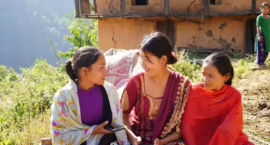
As the world goes digital, so does the ancient practice of child marriage.
More than half a billion women and girls living today are, or were, child brides. Among young adult women aged 20 to 24, one in five was married before age 18.
But that doesn’t mean that child marriage has stayed the same. There has been gradual progress in ending child marriage (around a decade ago, one in four women was married under 18). And technology is playing a growing role, both in cases where girls say “I do” and in cases where they say “I don’t.”

For adults who’ve conveniently blocked out memories of their own teenage angst, director Paloma Schneideman’s Big Girls Don’t Cry may bring all those feelings roaring back—but it’ll also urge you to have a little empathy for the younger version of yourself.
A New Zealand entry in Sundance’s World Cinema Dramatic competition, the film is a sensitive, insightful portrayal of how teenagers struggle to sort out their own mixed motivations while shuttling constantly between big adult feelings and childlike urges.
(This is one in a series of film reviews from the 2026 Sundance Film Festival, focused on films by women, trans or nonbinary directors that tell compelling stories about the lives of women and girls.)