As justices question Colorado’s ban on conversion therapy for minors, decades of research show the practice causes lasting harm and drives suicide risk among LGBTQ+ youth.
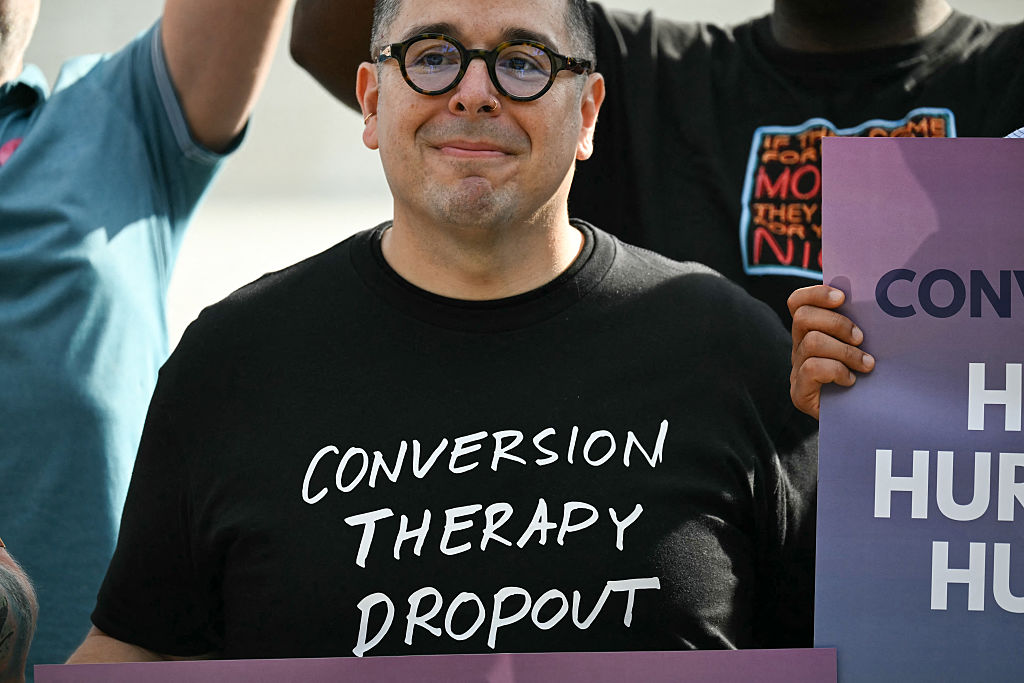
As the Supreme Court heard oral arguments Tuesday in Kaley Chiles v. Patty Salazar—a challenge to Colorado’s law that bans conversion therapy for minors—several conservative justices signaled skepticism toward state bans and concern that the law may restrict speech rather than professional conduct.
Chiles is a Christian mental health counselor being represented by lawyers from Alliance Defending Freedom (ADF), a conservative legal advocacy group that opposes abortion and LGBTQ+ rights. If the Court rules in favor of Chiles and ADF, it could undercut bans in more than two dozen states and reopen avenues for therapists and faith-based counselors to offer (or market) so-called “conversion” interventions to young people.
Conversion therapy is a widely debunked practice that tries to change a person’s sexual orientation.
This legal debate has real, devastating consequences for people like Theo, a nonbinary ex-Catholic who hosts the podcast Disordered: Responding to Catholic Teachings on Gender and Sexuality. Theo first encountered conversion therapy when a priest gave them a book by a Christian mental health professional who claimed to “help” people recover from same-sex attraction and gender-expansive identities.
“Conversion therapy was like death by a thousand cuts,” Theo said. “Each question or suggestion seemed small and benign … but it wasn’t. It was like I suddenly realized I was bleeding to death and couldn’t figure out how I hadn’t noticed sooner. I begged God to make me normal, feeling that my life was not worth living if I could not be straight.”
Theo said they know Catholic therapists who practice conversion therapy under the table, priests and youth ministers who incorporate it into spiritual direction, and retreat leaders who appeal to it in their talks. For years, Theo feared telling their story—worried others would downplay their trauma or deny it happened.
The danger is clear: A report from the Williams Institute at the UCLA School of Law found that lesbian, gay and bisexual people who have experienced conversion therapy are nearly twice as likely to attempt suicide. The practice remains alarmingly prevalent. A 2021 study from The Trevor Project estimated that more than 500,000 LGBTQ+ children in the U.S. were at risk of undergoing conversion therapy, and a 2023 report found more than 1,300 practitioners nationwide—over half operating in religious or ministerial roles. Twenty-seven percent of LGBTQ+ youth live in states with no legal protections at all.
According to Cornell University’s What We Know Project, in their study of 47 peer-reviewed studies about conversion therapy’s effectiveness in altering sexual orientation without causing harm, 12 concluded that conversion therapy is either ineffective and/or harmful, linking it to depression, suicide, anxiety and social isolation,
Similarly, a 2020 report released by the Williams Institute at the UCLA School of Law found that lesbian, gay and bisexual people who have experienced conversion therapy were almost twice as likely to consider and attempt suicide compared to others who have not experienced conversion therapy. Another study with more than 4,000 participants led by Stanford Medicine found that conversion therapy programs are also linked to PTSD, depression and suicide.
This increased risk of dying by suicide makes sense: Another study published in 2020 found that men who have experienced conversion therapy were more likely to have internalized homophobia. These programs reinforce an internal hatred and rebuke of the self. Only one study found by the What We Know Project concluded that conversion therapy was effective for only a minority of participants—but according to Cornell University, the study was deeply flawed.
As these studies—and a review of 46 others published between 2000 and 2020—found, there is no robust evidence that conversion therapy is effective in changing a person’s sexual orientation or gender identity. But it can cause real, long-term psychological and physical damage to participants.
Conversion therapy largely takes its name from the medical violence committed against and perpetrated on disabled women, women with mental illnesses, lesbian, bisexual and queer women and women of color—groups who were historically institutionalized on a massive scale for straying outside of what was considered “acceptable” behavior for women.
Women who defied domestic control, read novels or experienced “uterine derangement” (or “period-related madness”) found themselves confined in asylums and facing violent medical interventions like lobotomies, hard labor and shock therapy up through the 19th and 20th centuries.
Kate Moore’s book The Woman They Could Not Silence (2021) delves into one woman’s own struggle within institutionalized systems: Elizabeth Packard, an Illinois housewife and mother of six, who was committed to the Illinois State Hospital in Jacksonville, Ill., because of her intellect and independence. As Moore shares, Packard’s fight for freedom and survival shows how systems of institutionalization and medical abuse were used to silence her and make her submit to patriarchal systems of control.

This is not unlike conversion therapy, which historically used some of the same medical techniques to try to “turn” young people and adults alike straight. Up until the 1990s, according to the Minnesota Department of Health, conversion therapy included lobotomy and aversive conditioning, including electric shock, burning with metal coils and ice baths.
As Lucas Wilson documents in his book Shame-Sex Attraction: Survivors’ Stories of Conversion Therapy (2025), “coercive conversion and proselytizing are predicated upon superiority—the desire for a homogenous Christian world.”
“For some Christians, this superiority entitles them to mold others in their image—sometimes through violent means—to behave or act like straight, White Christian followers,” Lucas shared in an interview for Religion Dispatches.
Most conversion therapy programs are run by faith organizations or have some element of spirituality or religion.
While more recent iterations of conversion therapy utilize talk therapy, and organizations still running this program attempt to distance themselves from the term “conversion therapy” because of its harmful connotations, it does not deny connections to physically harmful conversion therapies, nor does it deny that talk therapies that make up the majority of conversion therapy programs across the country are still deeply harmful.
All medical violence—including prohibiting access to reproductive care—is interconnected. It’s no coincidence that the push to legalize conversion therapy for minors is led by the same far-right actors that pushed for the overturn of Roe v. Wade and access to reproductive care, another vital form of gender-affirming care.
Conversion therapy originated from medical violence against women who did not conform to gender-based norms, arguably the same reason that Christian conversion therapy practitioners today target LGBTQ+ people who do not conform to heteronormative, cisgender norms. It sets a dangerous precedent for what other kinds of medical violence can be leveraged to reinforce far-right gender normative ideals.
This piece is excerpted and readapted from a previous piece, “Legalizing Conversion Therapy Sets a Dangerous Precedent for Medical Violence,” published in April.