A wide-ranging dialogue on how queer and trans experiences of menopause disrupt narrow narratives and open new possibilities for policy, care and collective understanding.
Menopause—and the conversations surrounding it—is having a moment: Celebrities are speaking out, a commercial marketplace is booming, and state legislatures have introduced a wave of reforms over the past year. But as public attention grows, so too must our scrutiny of who benefits from this surge of visibility … and who risks being left behind.
This essay is part of the latest Women & Democracy installment, Flipping the Menopause Script Is Essential to Democracy, published in the middle of Black History Month, in partnership with Black Girls’ Guide to Surviving Menopause. This series helps flip the script, building on seven years of narrative and reproductive justice work led by Black Girls’ Guide to Surviving Menopause and commemorates “Iranti Ẹ̀jẹ̀: Remembering Blood,” a 2025 intergenerational gathering in Durham, N.C., centering marginalized menopausal communities. Menopause is not only a physical transition—it is also cultural, social and political. Recognizing its full scope is essential to advancing true health and civic equity. As one contributor reminds us: “We will not disappear with age. We will arrive.”
A note from Ms. editors, followed by a conversation with writers and cultural workers Syd Yang and Austen Smith:
What would it mean to treat menopause not as a private medical event, but as a collective, political and even spiritual transition—one that spans far more bodies and experiences than mainstream narratives allow? As conversations about reproductive health and bodily autonomy intensify, menopause remains largely absent from policy debates, public health frameworks and cultural storytelling. When it does surface, it is often confined to narrow assumptions about age, gender and productivity.

In this wide-ranging conversation, reflect on their own experiences of perimenopause and menopause—experiences shaped by queerness, trans identity, spirituality and community—as well as the broader systems that render many menopausal people invisible. Together, they explore what it might take to build a more expansive framework for understanding menopause: one rooted in story, collective care and imagination, and one that could eventually inform workplace practices, healthcare access and policy.
*
Austen Smith: Hello?
Syd Yang: Oh, this is gonna be fun.
Smith: So fun. I’m really excited to have this conversation with you. I feel like we’ve been in this conversation since Iranti Ẹ̀jẹ̀ at the conference, and I feel like this is a continuation. So I’m excited to explore these questions.
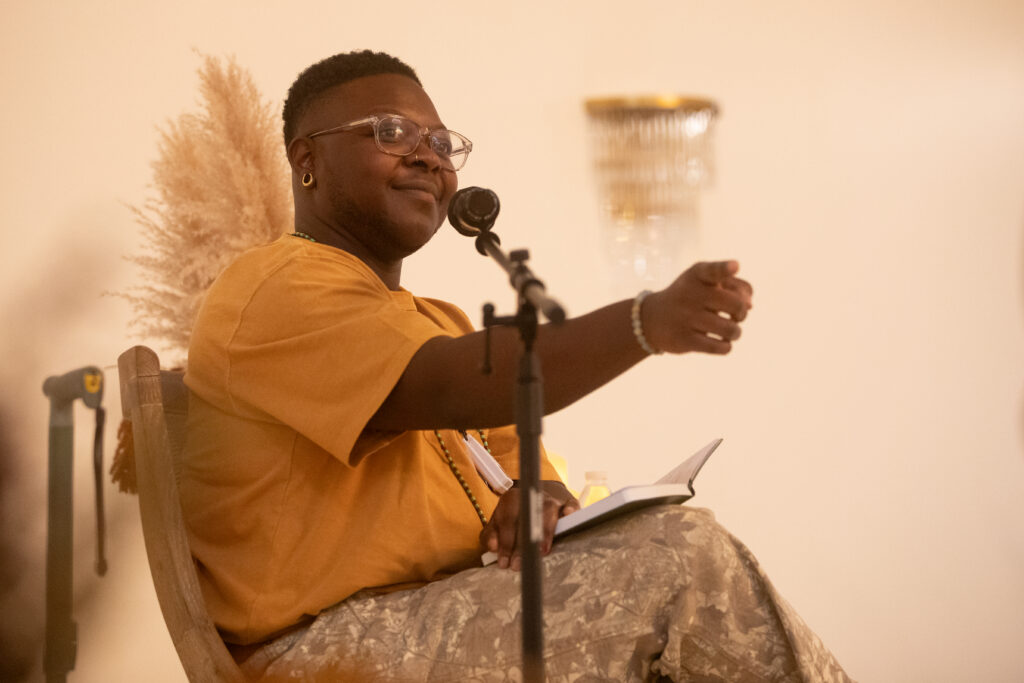
Yang: It’s been really interesting. When we first met, I think it was 2020, right? When I was in perimenopause and flailing, and feeling like I was flailing at life in so many ways. We got to meet through all those conversations that were happening then. I love how we’ve continued moving in spaces parallel to each other, and then intersecting at points. It feels really good to be in conversation now, six years later.
Smith: Isn’t that wild that it’s been six years?
Yang: Yeah. And also wild that we’re still talking about menopause and perimenopause.
To jump in, when I got the email asking, “Will you write this piece?” and “Black Girl’s Guide to Surviving Menopause is doing this collab with Ms. magazine, do you want to be a part of it? Can you write something with Austen?” I was like, why do people keep asking me to write about menopause? I’m not an expert.
And that’s the piece that keeps coming up for me. I’m just a person who went through this life experience, this transition. And yet my voice and stories are in a lot of different places. It’s been published in Mona’s book. It’s published in other places. You and I are still in conversation around this, which tells me we’re scratching the surface of what’s needed. People want to be talking about this, and they also need to be talking about it. I feel like we’ve been talking about it ad nauseam in so many forums, and it’s not enough. So I’m curious to continue being in conversation. What are the changes? What are the needs? What stories are people still longing for, that we’re still longing for?
Smith: Right. What gets to be considered action, and what gets to be considered action around menopause? I could feel your frustration of “Why do I keep being asked?” Similar for me, when I wrote my first essay about menopause, it was through the workshop that you and M’Kali Hashiki put on, and that series of conversations you all held. That helped me access what I was teasing out.
You and I have talked a lot about writing voice and how it can be a double-edged sword. Writing became the way I could intellectualize menopause, versus it just being a bodily experience without the story component. That was really hard to make sense of, especially as someone who went through it about 20 years younger than the age it usually starts. I remember saying this at the conference, I wrote about it thinking no one would find it in this local magazine, so it felt safe to put it there. Then I started getting email requests to include it or talk about it, and I was like, who found this, and why are people asking me? How many times do I have to tell my story for there to be a shift in the structural component of how we story and how we relate to menopause?
When I got the invitation to talk with you about menopause in terms of policy, it prompted me to look up whether menopausal policies even exist. What I learned is that the policies that exist are all in relationship to the workplace. I keep finding links and threads around the reproductive system and productivity and capitalism, and how deeply entangled they are. I’m not sure we even have a framework for what menopausal policy would look like. In the medical field or in society in general, like menopausal people being able to take time off work, or having access to free mental healthcare services.
Yang: Yeah. Or free services during the period that are all related to menopause.
Smith: These are things that feel beyond imagination. We have to create this in an entirely different realm, then bring it back here through conversation. As frustrating as it can be, because you never really know when your story is gonna be used and how it’s gonna be used, even by well-meaning people. I think I have to trust the divine spirits beyond this realm to carry my story where it needs to go.
I’m curious about your thoughts on this intersection of menopause and policy, and whether you even feel like that’s an intersection that’s possible.
Yang: I think what you touched on brings up a protectiveness around queer and trans stories of menopause, and that intersection of policy or political space. I’m noticing, with requests, and with my book deal, that there’s this outside feeling of “I want your stories.” Like this wanting to consume trans bodies, and queer experience, but in a consuming way. And it’s not just all queer and trans bodies, but specifically queer and trans BIPOC, bodies whose lineages and cultural experiences and roots are connected to the global majority.
It feels like colonialism, in a way. Like, “I want your story so I can do something with it.” That protectiveness rises in me. It makes me ask: who are our stories for? Even when M’Kali Hashiki and I started “Bloody Transitions” in 2020, those salons were about creating a container where our stories are protected and held. And it’s gone so much bigger than that, because the need is bigger than the 30 people who were in those rooms.
Each time I get the request, the question is there. And also, we need more stories, because the more we diversify and expand narratives, the more policies that get created, whether at work or in social and political spaces, will actually address broader experiences. But I still feel protectiveness. Who gets to consume this? And I feel hypervigilant, given the political arena right now around trans bodies and trans needs. Where’s the line between sharing, protecting, staying safe, and pushing the needle so there’s more awareness and understanding that it’s not just women’s bodies that go through perimenopause and menopause? It’s a wide range of bodies, a wide range of experiences.
Smith: Yeah. That feels like a very taut place to start, especially in the political circumstances we’re in, where there’s an agenda to push a binary system again. These systemic structures exist to hold everybody.
When you said “I want your stories,” it made me want to ask, have you seen Sinners? Because you said it just like Remick. “I want your stories.” I got a shiver down my spine. I run a project called Imagination Doulas, and one of our foundational beliefs is that ideas have agency. Listening to you talk about defensiveness and protectiveness, I realized we can’t control what our story does once it’s in the world. We can’t shield it or gatekeep it. We had conversations in a room of about 30 people, and now you have a book deal. We spoke at a conference. It has a life of its own.
Queer and trans people have always been at the forefront of social transformation. It’s almost like any structural change around menopause will be led by queer and trans bodies. If our society acknowledged the spiritual gifts of people who live at that intersection, it makes sense that we would be initiating that change. And I think it starts with story. Policy is just a story implemented at a systemic level. Through repetition, you start hearing the same things. Cis women start saying, “I’ve had the same experience as this trans person.” You start seeing the links.
I attended a dinner in Toronto during the Black Girl’s Guide tour where I met cis women who said, “Your story is similar to mine. I also wasn’t told this would happen. I also wasn’t prepared.” You start to see those arbitrary barriers erode with the presence of stories. So it’s like, how do I soften my defenses because the story can survive? I have spiritual tools to protect myself, and I have community. How do I release the attachment to the stories I tell, and let them do their work in the world? That’s hard, because we identify with ourselves. I think we should.
… As it stands, menopausal narratives aren’t serving anyone. No one fits these boxes. Even people who advocate for limited categories will realize they aren’t being served either.
Austen Smith

Yang: I appreciate you bringing in the spiritual component. Not just storytelling, because storytelling, in many ways, is spellcasting. That reminder of intention matters. We can bring intention into what stories are shared and how.
The book I’m writing with M-Kali Hashiki, fingers crossed it comes out this year, is really looking at how moving through perimenopause and menopause is a spiritual experience first and foremost. A spiritual journey, a spiritual initiation, a spiritual transformation. And that’s part of what I see as the power of the work Black Girl’s Guide is doing, elevating and centering this knowing that so many of our ancestors already understood. There’s a need for ritual and ceremony and attention brought to it.
As we think about policy, policy insists on being separated from the spiritual. When I say spiritual, I don’t mean religious. What we’re seeing is religion and policy aligning. I mean the spiritual. One narrative I hear often is “Gen X has all the answers.” We’re breaking the taboo, but the mainstream narrative is still binary in terms of gender. It’s women, cis women, straight women. And so many narratives are entrenched in wellness culture and diet culture. This idea that we have to fight this change, that perimenopause is bad, and how do you stay skinny, how do you stay young, how do you stay comfortable so you don’t become a disruptor? We need you skinny, pretty, quiet, productive.
I’ve developed a bad habit of going down a social media rabbit hole, watching far-right cis men talk about how women shouldn’t have voting rights anymore. It’s a horrible hole. And one refrain I keep hearing is women’s work is in the home. They’re to be seen and not heard. Pretty, caretakers, supportive, but don’t have opinions. What’s interesting is I see that reflected in some “pro-menopause” spaces too, mostly white cis straight women saying, “I want to be skinny, I want to maintain my youth.” To me, it’s the same narratives. Part of the same system.
Smith: As you were saying that, I was thinking about our conversation last week. Any liberatory, intersectional menopausal policy would require a completely different orientation to what we define womanhood as. Even cis women aren’t being served by the current framework. It’s entrenched in patriarchy.
I also want to include age. People have hysterectomies for different reasons at different points in life. Menopause isn’t limited to older age, and it never will be. How do we transfer menopause back into a spiritual process and culturally treat it that way, away from manufactured check marks that keep us categorized for systemic data, but that we internalize as personal identity?
Yang: Right. Even though that’s not all we are, and it doesn’t have to be who we are.
Smith: I think about that with the word trans. I’m not deeply attached to it the way some folks are. Or needing to define my queerness in a particular way. Ten years ago I was like, “I am this,” and “I am this,” and this is the hill I’m dying on. Now I’m like, meh. I don’t really care. Maybe that’s post-menopausal. It’s like negative fucks. I don’t care, you can call it what you want. I’m gonna do what I’m gonna do.
There’s a reminder that there is life beyond life. Life beyond these templates we’ve been given. That’s where the living takes place. Any policy born out of queerness would require us to redefine how we relate to gender markers and social identities. Everything would have to be reconstructed and deconstructed to meet actual needs. Because as it stands, menopausal narratives aren’t serving anyone. No one fits these boxes. Even people who advocate for limited categories will realize they aren’t being served either. Even if menopause is “meant” to serve white, cis, heteronormative women, there are still demands: a certain weight, looking young, doing all of this. There’s no ease there. I’m curious how you’re confronting that in your own menopausal process.
I was at an event Michaela Harrison hosted with whale singing, and she said, “It’s not them, it’s us.” We’re being reflected back to ourselves. It made me think about all the ways the things I say I’m against, I’ve internalized, because I swim in the waters by existing. I’m curious how you separated and teased out internalized patriarchal dynamics through your menopausal process.
Yang: I love that question because there are so many entry points. It’s experiential, not intellectual. And I loved what you said, that there’s life beyond life.
The narrative that hit me when I realized this is perimenopause was: I’m becoming irrelevant. Who I am in the world is becoming irrelevant. Nobody’s gonna love me, pay attention to me, listen to me. Everything about me is becoming irrelevant. The more I said it out loud, the more I was like, wait, what am I saying? In my head it’s ridiculous, but in my body it was like, no, I’ve been told this story my whole life, it must be true. It touched all these wounds of irrelevance. But what was interesting is how liberating it became. It became a practice of liberation.
Labels don’t really mean anything to me at this point. They’ve lost importance. Maybe it is that I don’t give any fucks. They’re just gone. I was more attached to being trans, queer, even Asian American before all of this. And now on the other side, my experiential knowing of living in a body has transformed. I’m like, oh, this is a body. And this body is a spiritual path, a spiritual experience. My work as a chaplain and spiritual practitioner is to be in a body. What does this body afford me in terms of experience and interconnectedness with others and with the world?
It’s a body, and labels are gonna change. Labels may define or confine me to different spaces, but they don’t define how this body experiences life. If I’m trans or cis, I’m still in this body. This is still my body. A body of a person who has different experiences. I’ve experienced perimenopause. I’m postmenopausal. I’ve experienced menopause. That doesn’t mean I’m a woman. It doesn’t mean I’m a man. It doesn’t mean anything. It just means this body has experienced that.
Something that shifted for me was around 2020. I was organizing to keep someone from getting re-elected. I was going through perimenopause and started talking about it more publicly. I noticed older cis lesbians, cis women, lesbians older than me, who had no problem using my pronouns before. The minute I started talking about perimenopause, all of a sudden I was being “she’d” in conversation. I was like, what is happening? Pronouns, whatever. But it was noticeable. You used to use my pronouns just fine, and now you’re “she’ing” me because I mentioned perimenopause. That showed me how gendered this experience is. Suddenly it was like, you can no longer see me as trans or nonbinary. All of a sudden it’s like, oh, you’re one of us again.
That happened in a number of places. It made me ask: What am I attached to? Is this okay? And how does that limit my desire to share my experiences? Which then limits my ability to ask for help, build solidarity with others. I’m curious for you, were there moments of interpersonal interactions around telling your story where you thought, whoa, that’s not the response I expected? Where you confronted a collective idea of menopause or what you “should” be experiencing?
The narrative that hit me when I realized this is perimenopause was: I’m becoming irrelevant. … The more I said it out loud, the more I was like, wait, what am I saying? In my head it’s ridiculous, but in my body it was like, no, I’ve been told this story my whole life, it must be true.
Rev. Syd Yang
Smith: I think I missed a lot of that because I experienced menopause so young. This wasn’t a conversation anyone was having with me. I wasn’t even having it with myself. But the vulnerability of sharing your story isn’t aligned with the distance it takes to teach someone something. When you’re sharing your story and also educating, it becomes a separation process. Do I stay open-hearted, or do I step back to teach? It’s so personal. Having to constantly say, “My pronouns are this,” every time a small space is created, it accumulates. Over time, you’re not anywhere near the intimacy needed for your story to come out.
When I was learning I was menopausal, it was actually my therapist who let me know those were the symptoms. I thought I was losing my mind. I was like, diagnose me. I’ve got five things I think it might be based on what I Googled. They were like, “Let me sit with this.” Then they said, “I think what you’re actually experiencing is menopause.” I was like, what? Doing my own research showed me that menopause, even as my body was going through it, was not for me. There was this dissonance: how is my body going through this, but all these websites say it’s for someone else?
I started thinking about systems that are responsive, not prescriptive. A responsive system would already know different bodies go through menopause. We should just tend to the reality. I remember talking with my mom early on. She said, “Women go through menopause.” I paused. It was defensive, like she wasn’t going to argue. I had to decide my battle. I said, “That’s interesting, because you have a child going through menopause right now who’s not a woman.” And left it at that. Those are the experiences where I’ve felt outside the narrative. But I feel kept by my ancestors because my first entry point into communal spaces was with M-Kali Hashiki, and then into building relationship with Omisade and Black Girl’s Guide. I’ve felt carried, like, “We’re gonna lift you up, move you across all this bullshit, and sit you here.” That’s what it’s felt like. It protected me from the “I’m not useful anymore” story because my brain wasn’t even at the point of having enough experience to feel that.
I am curious about the cost of going through menopause young. I don’t know what the costs are, but it thrusts you into an elderhood even if you don’t feel you’re there. I’ve tried to be responsible with it. Once you tell your story, you become an expert of your story. Then when someone resonates, you become an expert of their story. And that weight is like, oh no. I don’t know anything outside what’s happening to my body. But there are so many people thirsty to be mirrored. How do I create safe distance between our stories, so we can resonate but still have unique experiences? So I’m not the expert of your story, and you reclaim that. How do I have a healthy detachment from my story so it can live its own life in the world? I don’t want to over-identify with my story to the point I forget this is a body and I’m just living in it.
Being menopausal young has bypassed a lot. The fucks have left the building at 27 instead of 47. It’s giving free. Emotionally, patriarchy shows up too. As someone masculinizing my body while going through this deeply feminine experience, without calling it a woman experience, it raised a question: what type of masculinity am I becoming? Is this the only option? Hyper-masculine, toxic, is this the only option? I think about boy children raised with that conditioning from the beginning.
I see my masculinity in its youth, like a puberty phase. Going through these two puberties at once. Menopause almost anchored my masculinity in something that wasn’t manhood, and also wasn’t womanhood. It was some other third thing. Maybe 2,500 things. It allowed new possibilities of masculinity to emerge, and I think those possibilities are being led by trans and queer people. The blueprint is here. Our stories are precious because the potential is embedded in them. I’m curious: how has menopause queered you even more, if it did? And how do we queer menopause, if that’s What conditions would allow for the radical policy we’re speculating about right now, making up in real time?
Yang: I appreciate what you’re sharing. It reminds me of how you named last week that menopause is inherently queer. If it’s inherently queer, then the expansiveness is what we get to play in. It becomes more interactive for me. I can bring more curiosity versus expertise. That means there’s space for so many more stories and experiences.
One thing M-Kali Hashiki and I have talked about for years is how profoundly different our physical experiences were. Not a little bit different. Profoundly different. And yet, that is perimenopause. And we’re just two people. That creates vast places to explore. It becomes: what’s this, and what’s this, versus “it is this.” Where’s the mystery? If mystery resides here, then this is a spiritual endeavor, being in menopause and being with each other.
I appreciated you bringing up intimacy. There’s a spiritual intimacy that showed up when I sat with my body and the cosmos, because I am the cosmos. Our bodies are the cosmos. There’s a deep intimacy of knowing of self and other. People say, “We are all one.” Okay, sure, from a metaphysical place. But that doesn’t mean we all have the same experience or understanding.
So what does that mean? How do we explore that? How do we build intimacy from that? It comes back to storytelling, asking each other questions like we’re doing today. And being in inquiry with our bodies. Letting go of right and wrong, good or bad. It is something that is happening. How do I get curious about it? Learn more? Be with it? Befriend it even? Can I befriend the brain fog, and not make it wrong? If I can release the construct of right and wrong, there’s a freedom of existence and presence I can offer my body, myself, my stories. To me, that is freedom.
On a practical level, I’m consulting with an organization right now on building an employee handbook from a liberatory lens. What does it look like to codify policies for a liberatory workplace? One thing happening in that process is the organization not saying, “This is what the policies are,” but stepping back and asking, “If we want a liberatory workplace, what do you need? Folks on this team, what do you need to fully show up? As a whole being, not just as an employee.” That’s a shift. It reorients what’s important. It’s not “You must have one experience to belong.” It’s “All our experiences need space, and our needs need to be met, or at least held, for this to function.” It creates new conversations. People say, “I don’t know how to orient to this. This is new.” It’s informing me how much we need this practice of giving people space to name and own their experience as valid and necessary.
When I think about policies, I think about who we’re talking to, who we’re asking, what questions are being asked, versus just what policy is being created. Often a small number of people decide “We have all the information, here’s the policy, everyone must conform.” That’s a patriarchal system. To dismantle that, we have to work differently, engage differently, build intimacy differently, and allow intimacy in professional relationships. What does that look like?
In my postmenopausal journey, I want more intimacy, not less. More connection with my body, even when uncomfortable. More connection with other people, even when profoundly uncomfortable. I’m becoming more adamant that our survival, our freedom, collective freedom, does not happen if we push away intimacy and connection. That’s the answer. But it won’t look the same for everybody.
I am the cosmos. Our bodies are the cosmos. There’s a deep intimacy of knowing of self and other.
Rev. Syd Yang
Smith: It’s so interesting. We can close out here, but I want to name some words that came up as we’ve been speculating this radical menopausal policy. Community-centered, interactive curiosity versus expertise.
Yang: Mystery, honoring mystery, spiritual intimacy, inquiry with and not for.
Smith: Releasing right or wrong. Co-created and living, like a policy that is alive.
Yang: Like a living document.
Smith: I feel like this is doable. Your questions, who are we talking to and what are we asking, that feels like the key. It would be interesting to see a story-based research project, thousands and thousands of menopausal bodies answering questions and telling stories, and pulling threads together to say: this is what people are saying.
Thank you for this. I’m so grateful for our conversations. We could talk even longer, but we should get this over to them.
Yang: I know. I love it. Our 800-word essay has become an hour-long conversation. It’s so rich. I’m so appreciative that we get to walk in this world together.
Smith: Same.