From Mary Wollstonecraft to Sojourner Truth, the fight for women’s rights emerged alongside—and was fundamentally shaped by—the struggle to abolish slavery and secure universal human rights.

This essay is part of the FEMINIST 250: Founding Feminists series, marking the 250th anniversary of America by reclaiming the revolution through the women and gender-expansive people whose ideas, labor and resistance shaped U.S. democracy. Taking the form of essays, audio, poetry and original art, historians and scholars revisit the nation’s origins to center those written out of the founding documents and reimagine what a truly inclusive democracy requires.
It has been nearly 20 years since we elected the first Black president of the United States. But will this nation ever be ready for a woman president?
Michelle Obama doesn’t seem to think so. In an interview from Jan. 23, the former first lady (making history alongside President Barack Obama) lamented that the country demonstrated its unreadiness by rejecting two experienced, competent women—one white, the other a woman of color—for probably the least competent man in United States history to occupy the office of the presidency.
Women’s equality might very well be the last barrier for American democracy to overcome—although the fight for women’s rights can be traced back to the origins of this nation, right alongside the fight for abolition and racial justice.
On the 250th anniversary of the founding of the republic, it is timely to trace the history of American feminism, whose roots lie in the revolutionary era and are inextricably bound with the movement to abolish slavery.
Feminism and Abolition Take Shape in the Age of Revolution
During the Age of Revolution, prominent feminists across the Atlantic championed women’s rights and anti-slavery.
The French revolutionist Olympe De Gouges, who wrote the Declaration of the Rights of Woman and Citizen (1791), was an abolitionist.
So was Mary Wollstonecraft, the British author of the foundational feminist text, A Vindication of the Rights of Woman (1792). Wollstonecraft penned an appreciative review of a pioneering Anglo-American slave narrative, The Interesting Narrative of the Life of Olaudah Equiano, or Gustavus Vassa, the African (1789), a searing indictment of the African slave trade.
One of the first American women to be ever published was the enslaved young girl Phillis Wheatley, whose poems condemned both slavery and racism.
Other Black women in New England, like the indomitable Elizabeth Freeman, took the lead in suing for their freedom, ushering in emancipation in Vermont and Massachusetts, among the earliest northern states to abolish slavery.
Abolition Fuels a Radical, Intersectional Women’s Movement
The link between the first women’s rights movement and abolition would only grow with the start of the second wave of abolition in the 19th century.
Radical Quaker abolitionists Elizabeth Heyrick and Lucretia Mott linked abolition with feminism.
Black women like Maria W. Stewart took the lead in speaking out against slavery in public and founded the first female antislavery society, the Salem Female Anti-Slavery Society. As Stewart put it, “What if I am a Woman?”
Long before Hillary Clinton said, “Women’s rights are human rights,” at the Fourth World Conference on Women in 1995, the abolitionist feminist Angelina Grimké argued, “Human Rights not Founded on Sex.”
In 1840, the abolition movement split over politics and religion, as well as women’s rights, with the election of Abby Kelley to the Business Committee of the American Anti-Slavery Society. The Garrisonian wing of abolition (the followers of William Lloyd Garrison) upheld women’s equality, while evangelical abolitionists opposed linking women’s rights with abolition.

At the World Anti-Slavery Convention in London that year, when women were not seated as delegates, Garrisonians, led by Lucretia Mott and Wendell Phillips, staged a walkout.
Some political abolitionists such as Theodore Weld (who was married to Grimké), Elizabeth Cady Stanton’s husband Henry B. Stanton, and Gerrit Smith, her cousin, also endorsed women’s rights.
The most important theorist of women’s equality in pre-Civil War America was not Stanton but Margaret Fuller, who questioned essentialist ideas about gender and reads like a modern advocate for transgender rights. Like Wollstonecraft, who praised Equiano’s narrative, she favorably reviewed Frederick Douglass’ slave narrative in the New York Tribune.
In 1848, a group of abolitionist women and men in Seneca Falls issued a Declaration of Sentiments for women’s rights, written mainly by Stanton.
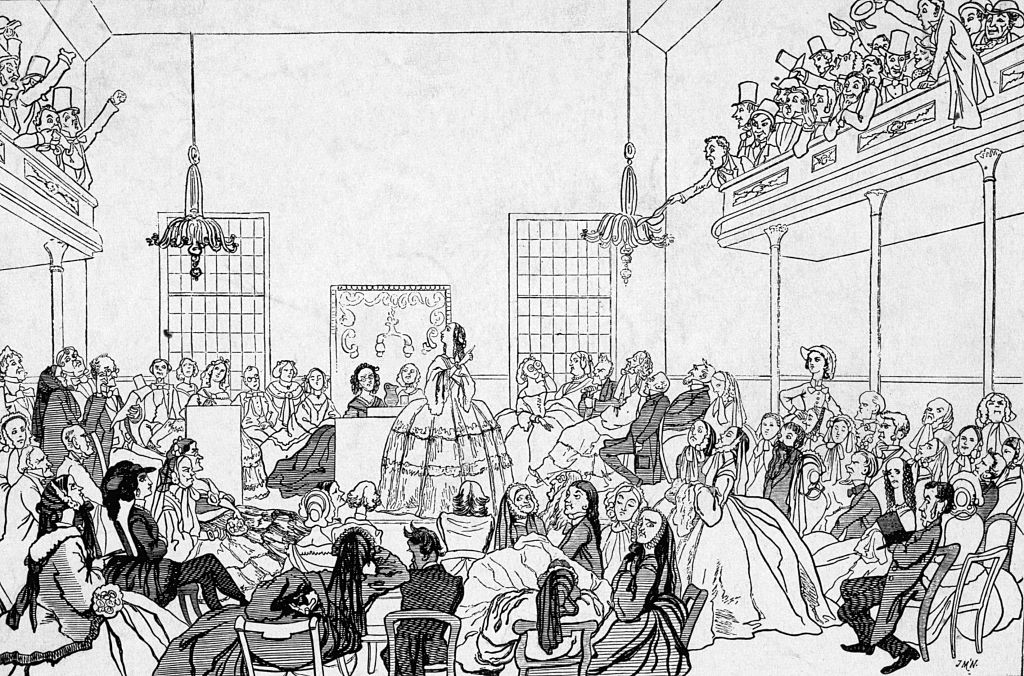
This was not the first demand for women’s rights.
Abolitionist Lucy Stone had lectured for women’s rights before.
Abolitionists Lydia Maria Child, Sarah Grimké and Angelina Grimké had written for women’s rights earlier.
Women supporting the abolitionist Liberty Party had earlier petitioned for political rights, including the right to vote, and Reverend Samuel May delivered his feminist sermon, “The Rights and Condition of Women” in 1846. Abolitionist women had organized petition campaigns and anti-slavery fairs, as well as wrote and lectured for abolition.
Lucretia Mott, who embodied abolitionist feminism, was present at the founding of the American Anti-Slavery Society in 1833 and at Seneca Falls.
Frederick Douglass published the proceedings at Seneca Falls in his newspaper The North Star, part of its motto: “Right is of no Sex—Truth is of no Color.” He was the only man who signed Stanton’s declaration.
Some historians have speculated that Black women were also present. They certainly had their say. As a Black schoolteacher Mary E. Miles, who would marry the freedom seeker Henry E. Bibb and settle in Canada, wrote:
“The colored woman who would elevate herself must contend not only with prejudice against poverty [and] prejudice against color but prejudice against her sex.”
This was probably one of the first statements of what we call today intersectional feminist analysis.
Abolition was the midwife of the first women’s rights movement. The women’s conventions of the 1850s modeled themselves after abolitionist women’s national conventions of the 1830s. The women’s conventions were organized mainly by Lucy Stone and Susan B. Anthony. Fellow travelers included abolitionist men who attended them. They demanded women’s property rights, female education, suffrage, equality in marriage and divorce, wage equality and access to professions.

Sojourner Truth is best known for her famous 1851 speech at the Ohio convention in Akron, transcribed by Francis Gage. Historian Nell Painter has disputed Gage’s account, however, as Truth did not utter the slogan, “Ar’n’t I a Woman?” even though she often lectured with a banner inscribed with the abolitionist feminist maxim, “Am I not a Woman and a Sister?”
Other Black abolitionist feminists like Frances Ellen Watkins Harper and Mary Ann Shadd Cary became active in the women’s movement after the Civil War.
The synergy between abolition and women’s rights peaked during the war when women campaigned for emancipation.
In 1863, Stanton and Anthony founded the Woman’s National Loyal League (WNLL). Angelina Grimké Weld’s address to the WNLL made it clear that abolitionist women saw themselves as foot soldiers of what she dubbed “our Second Revolution.”
Harriet Jacobs, known today for Incidents in the Life of a Slave Girl, her iconic slave narrative, was on its executive council, and Truth was a member.
Northern women worked in the Sanitary Commission and in nursing during the war and chafed at the gendered hierarchy they encountered. Many became suffragists.
Reconstruction Redefines Rights—and Fractures the Movement
After the war, the National Women’s Rights Convention reconvened in 1866 to hitch women’s rights to the attempt to establish Black citizenship. Stanton called Reconstruction the “woman’s hour.”
Just a year earlier, Wendell Phillips, the newly elected president of the American Anti-Slavery Society, had declared it the “Negro’s hour.” Anthony moved to make the national women’s convention into the American Equal Rights Association (AERA), which would fight for universal suffrage, for Blacks and women.
The speech of the convention came from Frances Harper, who insisted that the convention pay more attention to the question of racism. As she famously proclaimed, “You white women here speak of rights. I speak of wrongs.”
Reconstruction … gave the women’s movement a strategy of enfranchisement: the use of constitutional amendments to expand rights.
By 1869, the women’s movement split over the Reconstruction-era constitutional amendments: the 14th Amendment that introduced the word “male” in the Constitution and the 15th Amendment that enfranchised Black men but not women. Stanton and Anthony opposed these amendments by adopting increasingly elitist arguments and allied with George Francis Train, a flamboyant racist who quipped, “when blacks and ‘Rads’ unite to enslave the whites, ‘Tis time the Democrats championed woman’s rights.” (For the 19th century, we just need to flip what we know today about the Democratic and Republican parties. The Democrats were the party of the South, states’ rights and slavery; the Republicans were the party of Black rights and big government.)
Abolitionist feminists, like Stone, disgusted with Stanton’s and Anthony’s tactics, founded the New England Woman Suffrage Association (NEWSA) in 1868, the first organization to devote itself solely to women’s suffrage. It supported the 15th Amendment that enfranchised Black men but also called for a 16th Amendment for women’s enfranchisement.
The schism in the suffragist movement would have long-term fatal consequences for the women’s movement. Stanton and Anthony founded the National Woman Suffrage Association (NWSA) in 1869. Stone founded the American Woman Suffrage Association (AWSA). The split between Stanton and Anthony and abolitionist feminists was an ideological divide over fundamentally different visions of feminism: intersectional abolitionist feminism versus feminism pure and simple. A divided women’s movement would take a longer time to achieve its goals.
When the opposing suffrage organizations finally united in 1890, they navigated a conservative political environment when African Americans had been disfranchised and Reconstruction overthrown. By privileging appeals to southern white women and condoning racial segregation in local and state organizations, the suffrage movement sacrificed Black rights at the altar of white women’s rights—another expedient strategy with mixed rewards as most southern states voted against the 19th Amendment that gave women the right to vote.
When Black suffragists like Ida B. Wells and Mary Church Terrell insisted that the suffrage movement address segregation and lynching in the Jim Crow south, they were told that these were not women’s issues.
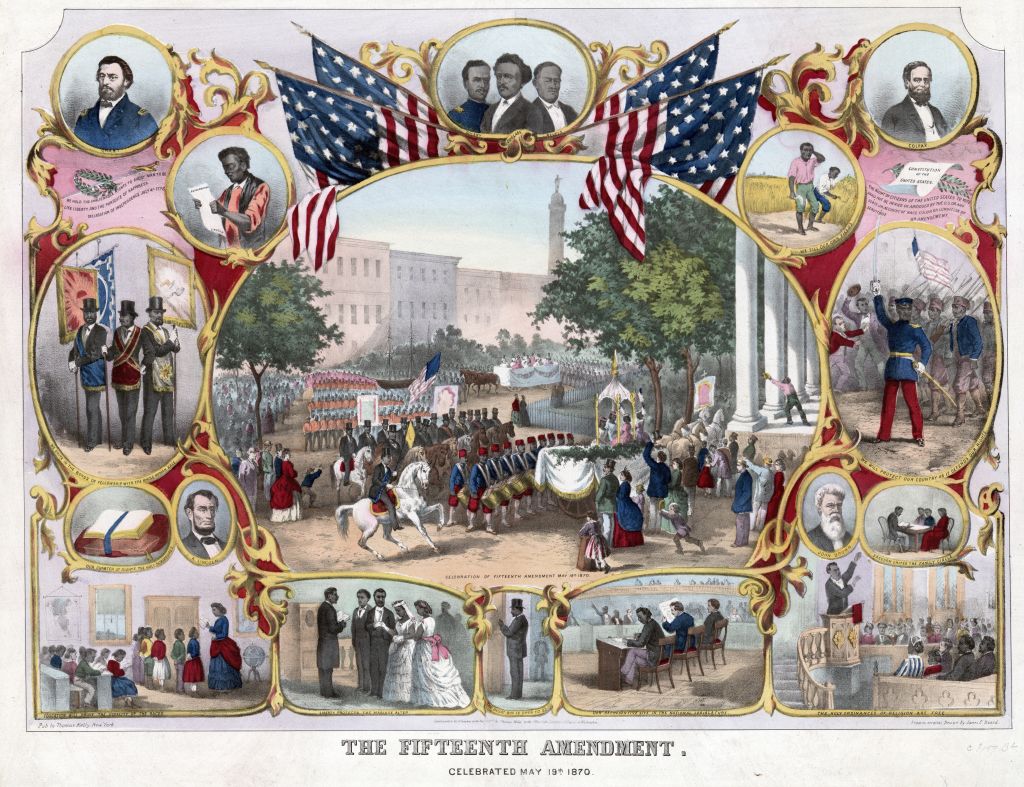
Reconstruction nonetheless gave the women’s movement a strategy of enfranchisement: the use of constitutional amendments to expand rights.
The 19th Amendment, passed in 1920, was modeled on the 15th Amendment. Named the Susan B. Anthony Amendment, it became an important stepping stone in the reconstruction of American democracy. But it was not the conclusion of women’s quest for equal citizenship.
The roots of the Equal Rights Amendment, named after Lucretia Mott, which would guarantee equal rights in all spheres regardless of sex, lay in abolitionist feminism.
The Legacy of Abolitionist Feminism Endures
Nearly all the modern expansion of citizenship rights—from the right to privacy and reproductive freedom (overturned in the Supreme Court’s Dobbs decision of 2022), to the outlawing of discrimination on the basis of sex, to same-sex marriage—have stemmed from the equal protection clause of the 14th Amendment. Abolition democracy bequeathed a legacy of activism to modern American feminism. It is a legacy inextricably linking race with gender, in the political sphere and beyond.
Whether such legacies eventually lead to a woman president remains to be seen.
Explore the entire FEMINIST 250: Founding Feminists essay collection:
- The main Founding Feminists page contains original art and a historical timeline and invites readers to submit original poetry.
- America’s Founding Feminists: Rewriting America’s Origin Story, by Janell Hobson, professor of women’s, gender and sexuality studies at the University at Albany.
- Haudenosaunee Governance: The Matrilineal Democracy That Shaped America, by Michelle Schenandoah, founder of Rematriation, a Haudenosaunee women-led nonprofit organization.
- ‘This Is Our Country Too!’: The Enduring Legacy of Spanish-Speaking Women in Early America, by Allyson M. Poska, professor of history emerita at the University of Mary Washington, translated by Antonia Delgado-Poust, associate professor of Spanish at the University of Mary Washington. Lea este artículo en español aquí.
- Claiming the Revolution: Gender, Sexuality and the Radical Promise of 1776, by Charles Upchurch, professor of British history at Florida State University.
- Reclaiming Phillis Wheatley (Peters): Imagination as a Feminist Founding Project, by Dana Elle Murphy, assistant professor of Black studies and English at Caltech.
- The Radical Potential of Traditional Femininity, by Jacqueline Beatty, associate professor of history at York College of Pennsylvania.
- Queer Possibilities in Revolutionary America, Jen Manion, Winkley professor of history at Amherst College.
- She Wanted to Be Free: Black Women’s Revolutionary Resistance, Dr. Vanessa M. Holden, associate professor of history, director of African American and Africana studies at the University of Kentucky, and director of the Central Kentucky Slavery Initiative.
- Sally Hemings and the Making of Democracy, Jessina Emmert, doctoral candidate in the Department of Women’s, Gender and Sexuality Studies at the University of Kansas.
- The Abolitionist Origins of American Feminism, Manisha Sinha, Draper chair in American history at the University of Connecticut.
- The Curious Case of Afong Moy: Asian Womanhood and National Belonging in the U.S., Anne Anlin Cheng, Louis W. Fairchild class of ’24 professor of English at Princeton University
- Making Disability Visible in History: A Conversation With Rosemarie Garland-Thomson, Janell Hobson, professor of women’s, gender and sexuality studies at the University at Albany
- Educating Women: A History of Access, Exclusion and Backlash, Nimisha Barton, lecturer at Cal State Long Beach and a DEI consultant in higher education