Maggie Gyllenhaal’s The Bride! reimagines Mary Shelley’s silent creation as a defiant, articulate woman whose rage and refusal to submit become acts of feminist resistance.

This review contains spoilers for The Bride!, as well as Poor Things, Ex Machina and HBO’s Westworld series.
Women are often stereotyped as overly talkative—gossiping, ‘blabbing’ or labeled ‘chatty Cathys.’ Archie Bunker in the television series All in the Family often tells his wife Edith to “stifle yourself” to stop her talking. Recently, one critic argued that “the bride,” played by Jessie Buckley, in writer-director Maggie Gyllenhaal’s new movie of the same name, talks too much.
What makes Gyllenhaal’s reinvention of James Whale’s 1935 film Bride of Frankenstein story so compelling is precisely because this fabricated lady has her own voice and uses it loudly and in a rage. We’re glad she speaks.
In Frankenstein, the original novel written by Mary Shelley in 1818, the female designed by the scientist Victor Frankenstein to be a mate for the lonely Creature never has a chance to speak. Frankenstein starts the process using a corpse and charnel house bones but tears it apart because he didn’t want to create a race of monsters.
In Whale’s Bride of Frankenstein, the bride does get created from several parts, including the corpse of a beautiful young woman, but again she never really speaks: After being brought back to life, Frankenstein’s bride takes one look at the hideous-looking Creature, lets out a hiss, and flees forever.
In Gyllenhaal’s version of the story, the bride constantly speaks—a barrage of words—and insists on being heard. At a club filled with lascivious men, including the fictional mob boss Lupino in 1930s Chicago, she is first “trying to be good, trying to be quiet,” but ends up vomiting on one of them and saying, “There’s your real monster!” and “What are you going to do—cut out my tongue too?” We later see that Lupino has grotesque jars full of human tongues. The men in the club paw at her, slap her, but we hear her say what could be a theme of the film: “I have a lot more to say. Are you ready?”
She dies after falling down the club stairs, but is brought back to life using electricity after the Creature, played by a quietly charismatic Christian Bale, begs the woman scientist (played by Annette Bening) to create a mate for him, and they dig up the young woman’s corpse from the grave.
One of the reasons this bride is so galvanizing is that she’s assertive, articulate and has a mind of her own. This is a woman who tries out the meaning of words and resists being stifled or controlled.
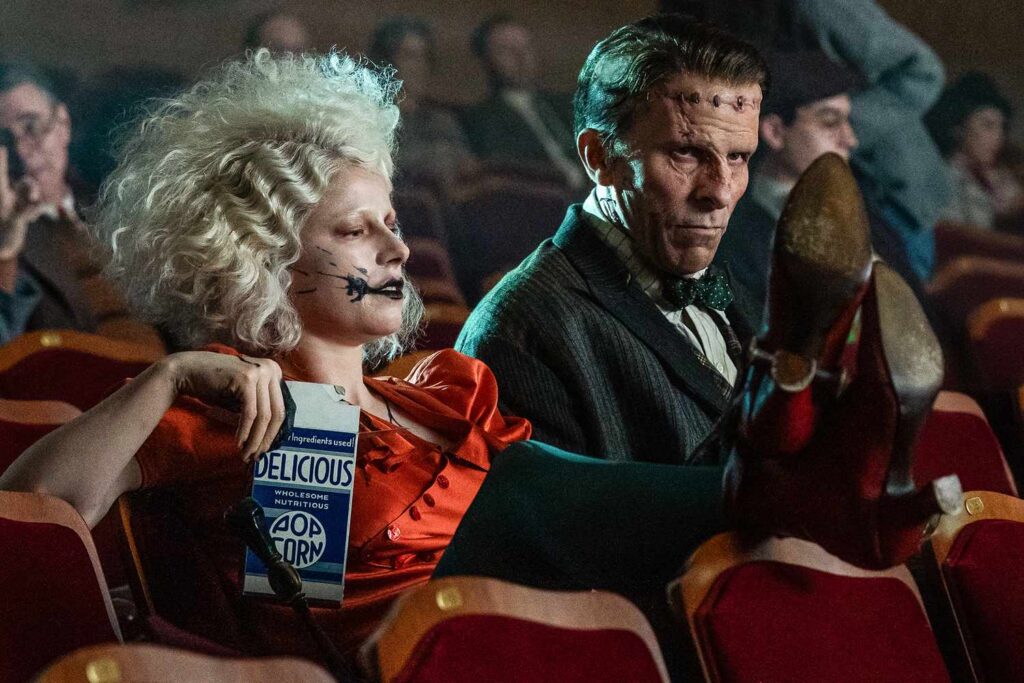
After she’s brought back to life, she and Frankenstein laugh as she mockingly tries out the words for her role. “Helpmate? Helpmeet Lady?” but she’s no docile, compliant lady like the smiling female robots in the novel and two film versions of The Stepford Wives. When the Creature tries to lift her after she falls, she says, “Keep your hands off me!”
Thinking about the word bride, she asks him if bride means he will marry her. After he says yes, she replies, “Well frankly no,” and “Fuck off, Frank!”
She’s a well-read monster too. And she’s a woman who resists. One of her repeated phrases is, “I prefer not to,” quoting Bartleby in Herman Melville’s 1853 short story, Bartleby, the Scrivener.
Filmmakers creating artificial women like to picture their creations as highly, if not improbably, literate. In Yorgos Lanthimos’ 2023 film Poor Things, Bella (played by Emma Stone) quickly goes from child-like phrases to reading Ralph Waldo Emerson.

In my recent book Artificial Women, I argue that many artificially-created women in films and television series go from being produced to gratify a man, to wanting their own freedom and autonomy. Ava in Alex Garland’s 2014 film Ex Machina uses her wits to free herself from the compound, and Bella in Poor Things demands to go “Out!”
The bride, too, in Gyllenhaal’s film says, “Unlock the fucking door!” and “Let me out!”
Some artificial women are designed as helpmates or lovers, but can also become full of rage as they rebel and even become murderous. The robot Kyoka in Ex Machina, who is created by Nathan to be a servant and sex slave, ultimately gets into a rage and knifes Nathan. Ava herself ruthlessly kills Nathan and locks Caleb into the compound in the end as she manages her escape.
In the British television series Humans, Niska, created to be a prostitute, escapes and becomes murderous in revenge.
As well, in the television series Westworld (2016-2022), robots (called “hosts”) at a theme park are created to allow visitors who act out all their violent and sexual fantasies without any repercussions. Though within the plotline, both Dolores the prostitute and madam Maeve become rebellious killers after fleeing their docile role.
Bella, however, is repelled by the violence of the outside world and comically acts out her own revenge in witty ways: At the end, she turns her ex-husband into a hybrid goat who keeps her lawn trimmed.
Gyllenhaal’s film is full of sexual violence and rage. Dancing ecstatically with Frankenstein, her mass of blonde hair waving, she repeatedly becomes a target. As the mobsters grab her (“hold the fucking bitch down”), she’s attacked by men in the street outside the club (Frankenstein kills two of the men in her defense), and she is nearly raped by a trooper who stops their car when they are escaping in a wild ride on the road. Later, she angrily calls out the names of women who were murdered, but also is remorseful about her own killings, saying, “Pressure hurt harm injury.”
Still, Gyllenhaal sees the bride’s autonomy, her unwillingness to be controlled, her rage, as a call to action. In the film, there is a frame story shot in black and white with the author Mary Shelley (also played by Jessie Buckley) voicing her own thoughts and she praises “resistance to tyranny.” When the trooper asks Frankenstein and the bride for their automobile licenses on the road, and tells them to step outside the car, Shelley’s voice says, “Where’s your fight, girl? … Where’s your rage?”
The bride’s fearlessness inspires other women, who cosplay her likeness—faces painted with ink-stained drips—and cry out “Brain attack!” as they protest in the streets, while a tabloid blares the headline: “Killer Bride Ignites a Revolution.” Later, after Frank is killed by one of Lupino’s henchmen, Ida returns to Dr. Euphronius’ lab and points a gun at a scientist to get her to help revive Frank and calls out “Me too! Me too!” voicing a stirring cry reverberating in our own post-Weinstein world.

In a New York Times interview, Gyllenhaal recounted how at the film’s test screenings, there was some criticism about the film’s violence, so the resulting film “is a little bit pulled back from what was originally in the movie.” A few women in the screening said, “I don’t want to see a woman being violated”
But in the interview, Gyllenhaal insisted that violence against women “is a major reality in the culture we are living in,” adding, “so if we’re going to see it, we need to see it in a way that is very hard to watch, because it is very awful.” Depicting rage was also important to her; she said she was “very curious about what’s underneath it.”
It was personal: “I do feel angry about all sorts of things, and feel a lot of vulnerability underneath that, and just a need and desire to be heard.”
Throughout The Bride! the bride laments that she doesn’t remember her own name, and the voice of Mary Shelley tells her, “Find your name, girl!” Frankenstein tells her that her name could be Penelope Rogers (a riff on Ginger Rogers and the 1930’s musicals he loves to watch). Later we learn before she died, she was originally “Ida,” a woman working undercover and posing as a party girl to try to gain information on the mobsters, particularly Lupino, to bring him to justice.
Frankenstein remembers her at the club as being “volcanic” and a “firecracker.” She is also a woman capable of murder (though the detective said she only really committed one murder, in self defense). She also a woman who resisted being categorized as a bride but could also mournfully tell Frankenstein at the end, “I’ll love you till the end of time.”
The bride in the film is no monster. She, like the Creature in Mary Shelley’s novel and in Whale’s film is only driven to being a killer after being attacked. “She was a live wire,” says the remorseful detective, and “we put her in a hole.” Dr. Euphronius, thinking of her project to reanimate the dead woman, says, “We wanted to see a disobedient geometry” but Ida/Penelope/the bride is no impersonal geometry. She is a woman for our times: She is independent, assertive, fearless, a woman whose face tattoo is a badge of honor.
In the film she is, ultimately and ironically, the one who is most alive.
In the end, even after being once again killed, she’ll be alive once more. In the film’s final credits, we’re happy to see that the intertwined fingers of the couple begin to move, hinting that they will once again become animated and lovers once more.