


Skepticism toward women who report sexual violence is closely tied to broader doubts about women’s leadership, credibility and decision-making, according to new research.

Nearly a decade after the rise of the #MeToo movement, public conversations about sexual harassment and assault are changing.
A wave of public disclosure marked the early years of #MeToo: Women shared experiences of sexual harassment and assault that had gone unheard. Powerful institutions promised change and new, bipartisan policies followed. Many believed society was entering a new era of accountability.
Today, the conversation has changed.
High-profile cases that once seemed to symbolize progress have become subjects of renewed debate, with some convictions overturned. Public attention to the issue remains high, especially when claims involve people in high-profile sectors such as politics and entertainment, but so too does skepticism, with commentators increasingly describing this moment as a “post-MeToo” era.

Our data, released in Tulane University’s Newcomb Institute 2025 Violence Experiences Survey (VEX), suggests this skepticism is widespread:
- In Louisiana, 53 percent of men and 35 percent of women agree that women sometimes lie about sexual harassment or sexual assault.
- Nationally, 47 percent of men and 34 percent of women agree.
At one level, these findings reflect public attitudes towards sexual violence. At another, they raise broader questions about women’s credibility.
The same attitudes that cast doubt on women’s reports of sexual harassment and assault are also linked to doubts about women’s leadership and authority on issues affecting their own health.
This skepticism of women’s reports of harassment and assault does not stand alone, our data shows—it is connected to other attitudes about women, including their ability to be political and economic leaders. People who are more skeptical of women’s reports of sexual violence are also more likely to believe men make better leaders than women do, and they are less likely to believe in the value of abortion access for women’s health.
This matters because believing women—and believing in women—affects whether women come forward to report sexual violence. In Louisiana, only about 3 percent of women who experienced sexual violence in the past year reported it to authorities. Public attitudes help shape these decisions.

Women often remain silent about sexual harassment and violence because they fear retaliation, damage to their careers, strain on their families, public scrutiny or simply the emotional cost of coming forward. When people expect skepticism, they may decide the cost of reporting outweighs the benefits.
Ultimately, this is an issue of women’s credibility. The same attitudes that cast doubt on women’s reports of sexual harassment and assault are also linked to doubts about women’s leadership and authority on issues affecting their own health.
The question is not only whether we believe women when they report harm, but whether we trust women to lead and to decide what is best for their health and safety.
*
A note from Ms. editors: We want to hear from you for The Majority, a new campaign collecting stories about how reproductive freedom has enabled readers to build the lives they want and need.
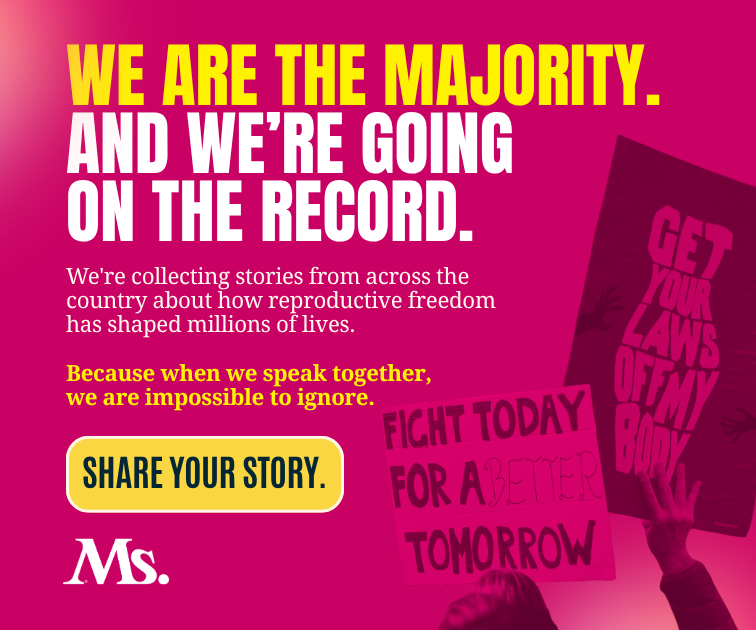
Poll after poll shows a majority of Americans support reproductive healthcare access. Yet public debate overlooks the lives shaped by abortion access, contraception, IVF, miscarriage care, maternal healthcare or comprehensive sex education—countless women who chose to pursue an education, have children, not have children, protect their health and chart their own future. What’s your reproductive freedom story? Add your voice. Together, these stories will help show not only why reproductive freedom remains a majority value, but also what it makes possible.
Look to these trusted groups if you or a loved one needs to know more about reliable abortion care:
- A one-stop-shop for abortion seekers: I Need An A
- Other websites to explore all your options for abortion care: Plan C Pills, Abortion Finder
- Safe websites to buy abortion medication: Aid Access, Massachusetts Medication Abortion Access Project, Hey Jane
- If you need help affording abortion care, tell your telemedicine provider or contact an abortion fund near you.
- To protect your digital privacy when planning your abortion, click here.
- For free legal help as a patient or doctor, call If/When/How’s Repro Helpline—844-868-2812—or contact Pregnancy Justice.
- For medical advice, contact the Miscarriage & Abortion Hotline: 833-246-2632.
- If you need to know the abortion law in your state, look to the Center for Reproductive Rights. or Guttmacher Institute.
Ensure work like this article continues
At Ms., we believe the stories that shape women’s lives deserve serious, sustained coverage. That’s why, since 1972, we’ve reported on gender, politics, democracy, reproductive freedom, economic justice and culture long before the mainstream press caught up. Our journalism remains independent because it is funded by readers—not advertisers, corporations or billionaires. If this story mattered to you, please consider supporting Ms. by making a tax-deductible donation, becoming a member to receive a magazine subscription, or gifting a membership to a friend. Your support helps ensure that feminist journalism not only survives, but thrives.