We need to afford ourselves space to think long-term and big picture, to push back on backlash, and be clear about what a future of reproductive freedom could be and what it will take to get there.

Originally published by The Contrarian on Aug. 20, 2026, “Keeping Our Eyes on the Prize.”
I was recently alerted to a new rock opera called 1972 previewing in Boston this fall about women’s lives and abortion in America before Roe v. Wade. The promo site has me thinking about the juxtaposition of working in between spaces of heaviness and promise—much as we are today—and how activists, advocates and everyday people dare to envision the future.
As we know, the nation rounded the corner to 1973, the year Roe was decided. The ruling quickly showed itself to be more porous to legal limitations than full-blown liberation—with its narrow roots in privacy interests rather than principles of equality; its reverence for doctors’ decision-making; and, especially, its rickety trimester framework, about which Justice Sandra Day O’Connor later noted all but ensured the decision was on a “collision course with itself.”
Sure enough, Roe was soon degraded by federal interventions like the Hyde Amendment, which prevents Medicaid from paying for abortions, as well as by restrictive state laws like parental consent, waiting periods and mandatory counseling—the constellation of which meant that the legal right to abortion did not equate to access for all.
Nearly 50 years later, the Dobbs decision brought a devastating reversal. But it simultaneously ushered in a moment akin to 1972—the opportunity to reimagine bodily autonomy and build something better.
And now, in 2026, we have begun to see glimmers of such vision emerge in the law by way of more expansive court rulings and bolder legislation.
Among some recent examples:
- Abortion and mental health. Last week, a federal judge issued a ruling chipping away at Idaho’s extreme abortion ban and making clear that women in the state can get an abortion if their health is in danger or if they are at risk of taking their own lives. The language of the decision harkens to a novel but essential right to defend oneself from harm: “It is an affront to human dignity to bar pregnant women from receiving life-saving care on the basis that the threat comes from a mental health condition, rather than a physical health condition.”
- Abortion and equality. Earlier this summer, a Pennsylvania intermediate state appellate court ruled that the exclusion of Medicaid coverage for abortion is a violation of both the state Equal Rights Amendment (ERA) and the federal Equal Protection Clause, noting: “There is no comparable exclusion of any health coverage—reproductive or otherwise—for men.” Equality arguments are powerful, and, when it comes to state constitutions, there are 29 that have broader sex equality language than the U.S. Constitution. (The center I lead at New York University Law is home to the Marcy Syms Equality Initiative, a law and policy think tank that provides expert analysis on the mobilization of state ERAs, among other work. This year we hosted a full-day symposium on leveraging equality arguments in support of reproductive rights; panel discussions can be viewed here.)
- Legislation. Massachusetts became the tenth state—joining Alaska, Colorado, Michigan, Minnesota, Oregon, New Jersey, New Mexico, Maryland and Vermont, plus Washington, D.C.—to remove restrictions on gestational limits for abortion. A law signed last week by Gov. Maura Healy eliminates the state’s prior Roe-fueled four-pronged framework that guided abortion decisions after 24 weeks for life-threatening situations for the patient or fetus. (And they are quite rare; according to Reproductive Equity Now, abortions after 24 weeks account for less than 1 percent of all performed in the United States.) Championed by major medical groups, including the national Society for Maternal-Fetal Medicine, the Massachusetts Medical Society and the state chapter of the American College of Obstetricians and Gynecologists, state lawmakers were deliberate in their effort to help more patients stay in-state should they need emergency care. According to Judiciary Committee Chair Rep. Mike Day, the bill’s passage comes after 16 years of failed attempts “to get government out of the way of a health issue, and to lessen the trauma inflicted on pregnant women, who are suddenly confronted with unbelievably tragic news about their pregnancies more than six months into their term.”
For decades, conservatives have sought to derail expansive approaches like these by weaponizing them as political wedge issues, often with conjured vocabulary—descriptors like “late-term abortion” and “partial-birth abortion,” for example, are not actual medical terms but rather gimmicks to sway the public. It still works. Media about the Massachusetts law has been similarly hyperbolic, from the Wall Street Journal headline “Massachusetts Enacts Abortion Until Birth,” to Fox News calling it “extremist and barbaric.”
There is no doubt that abortion will be a political pawn and electoral issue for the foreseeable future. Let’s commit to keeping our eye on the bigger prize—beyond taking it to the polls, we need to afford ourselves the space to think long-term and big picture, to push back on backlash, and be clear about what a future of reproductive freedom could be and what it will take to get there.
As if it is 1972 all over again.
A few resources: For readers interested in tracking abortion-focused litigation, Kaiser Family Foundation publishes a regularly updated round-up; Center for Reproductive Rights does the same for abortion legislation nationwide.
Look to these trusted groups if you or a loved one needs to know more about reliable abortion care:
- A one-stop-shop for abortion seekers: I Need An A
- Other websites to explore all your options for abortion care: Plan C Pills, Abortion Finder
- Safe websites to buy abortion medication: Aid Access, Massachusetts Medication Abortion Access Project, Hey Jane
- If you need help affording abortion care, tell your telemedicine provider or contact an abortion fund near you.
- To protect your digital privacy when planning your abortion, click here.
- For free legal help as a patient or doctor, call If/When/How’s Repro Helpline—844-868-2812—or contact Pregnancy Justice.
- For medical advice, contact the Miscarriage & Abortion Hotline: 833-246-2632.
- If you need to know the abortion law in your state, look to the Center for Reproductive Rights. or Guttmacher Institute.
*
A note from Ms. editors: We want to hear from you for The Majority, a new campaign collecting stories about how reproductive freedom has enabled readers to build the lives they want and need.
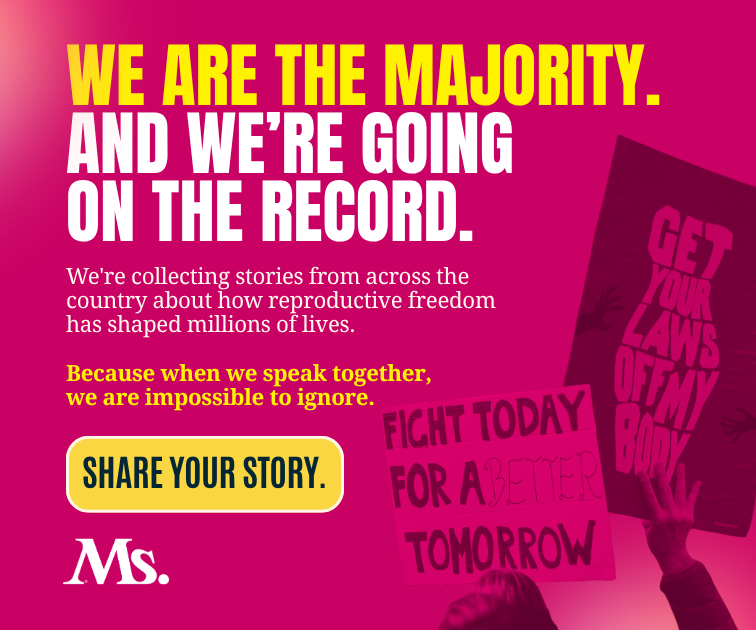
Poll after poll shows a majority of Americans support reproductive healthcare access. Yet public debate overlooks the lives shaped by abortion access, contraception, IVF, miscarriage care, maternal healthcare or comprehensive sex education—countless women who chose to pursue an education, have children, not have children, protect their health and chart their own future. What’s your reproductive freedom story? Add your voice. Together, these stories will help show not only why reproductive freedom remains a majority value, but also what it makes possible.