Editor’s note: This article originally appeared in the December 2001/January 2002 issue of Ms. magazine.
Casualty of War: The U.S. Press Corps Wimps Out
Two weeks before the U.S. began bombing Afghanistan, an unnamed military officer involved in the planning offered the Washington Post some chilling insight into the Bush administration’s media strategy: “This is the most information-intensive war you can imagine,” the source said. “We’re going to lie about things.”
If you expected the press to summon up some outrage at the prospect of a deliberate disinformation campaign—to maybe start asking, “Was that a lie? No? How about that?” at White House news briefings—you were probably disappointed. Not one major U.S. paper bothered to reprint the quote. (Salon.com did.)
A free, independent and critical press is never more crucial than in wartime, when millions of lives and the course of history can turn on small bits of information.
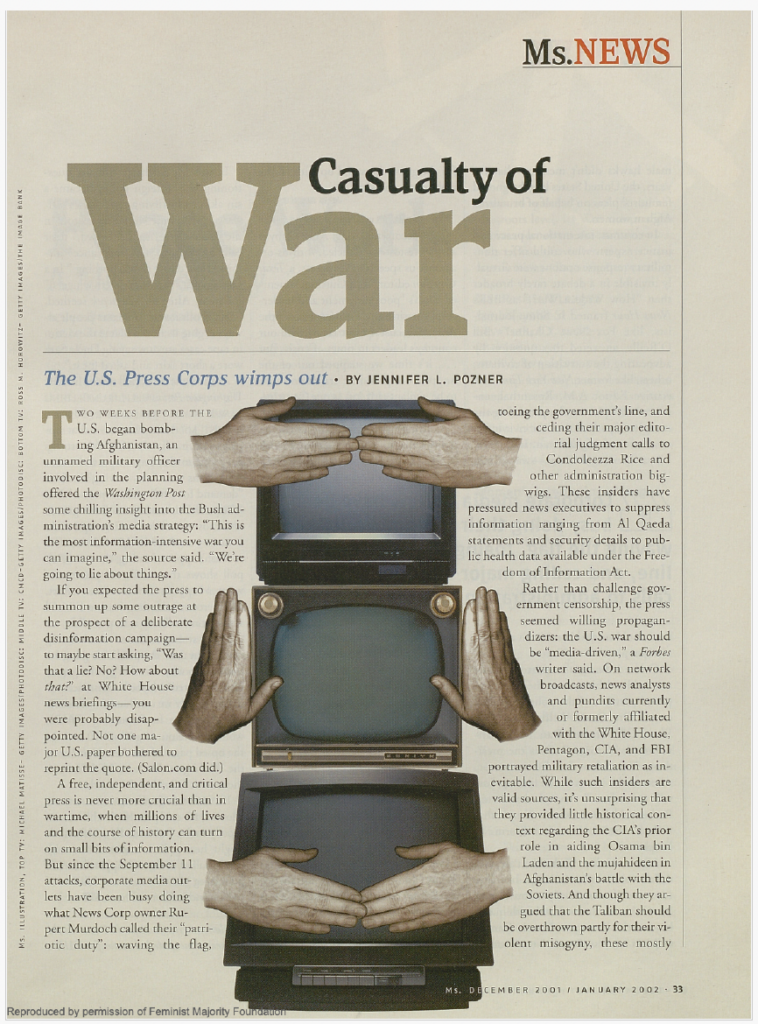
But since the Sept. 11 attacks, corporate media outlets have been busy doing what News Corp owner Rupert Murdoch called their “patriotic duty”: waving the flag, toeing the government’s line, and ceding their major editorial judgment calls to Condoleezza Rice and other administration bigwigs. These insiders have pressured news executives to suppress information ranging from Al Qaeda statements and security details to public health data available under the Freedom of Information Act.
… These mostly male hawks didn’t mention that for years, the United States largely ignored feminists’ pleas on behalf of brutalized Afghan women.
Rather than challenge government censorship, the press seemed willing propagandizers: The U.S. war should be “media-driven,” a Forbes writer said. On network broadcasts, news analysts and pundits currently or formerly affiliated with the White House, Pentagon, CIA and FBI portrayed military retaliation as inevitable.
While such insiders are valid sources, it’s unsurprising that they provided little historical context regarding the CIA’s prior role in aiding Osama bin Laden and the mujahideen in Afghanistan’s battle with the Soviets. And though they argued that the Taliban should be overthrown partly for their violent misogyny, these mostly male hawks didn’t mention that for years, the United States largely ignored feminists’ pleas on behalf of brutalized Afghan women.
In contrast, international peace and justice experts who could offer nonmilitary response options were virtually invisible in a debate rarely broader than “How Wide a War?,” as PBS’ NewsHour framed it. Some journalists, like Fox News’ Bill O’Reilly, answered that question by advocating for the starvation of civilians. Others, like former New York Times executive editor A.M. Rosenthal, answered the question by proposing the complete destruction of the civic infrastructures of Afghanistan, Iraq, Iran, Libya, Syria, and Sudan—war crimes that would surely kill millions of innocent people.
Other influential reporters, while not as bloodthirsty, saw themselves as proud partners of the politicians they cover.
On David Letterman’s Late Show, CBS anchor Dan Rather announced, “George Bush is the president. He makes the decisions. … Wherever he wants me to line up, just tell me where.” Several days later, Rather told Entertainment Tonight that if Bush ever “needs me in uniform … I’m there.”
ABC’s Cokie Roberts certainly didn’t volunteer to suit up, but she, too, un-self-consciously admitted to Letterman an almost blind faith in our boys at the Pentagon: “Look, I am, I will just confess to you, a total sucker for the guys who stand up with all the ribbons on and stuff.”
A few reporters were less accommodating. After Dubya’s testosterone-fueled, with-us-or-against-us speech to Congress, a Texas City Sun editor, Tom Gutting, lamented Bush’s “poor judgment and leadership,” writing, “I’m aware of the American custom not to criticize our country’s leaders in times of crisis. But … it’s time we snapped out of the ‘support our president’ trance and start to be vigilant citizens, as our Constitution demands.”
Gutting’s skepticism was welcome amid calls to replace scrutiny with “unity.” But the demands of democracy held little interest for Sun publisher Les Daughtry Jr., who, the next day, penned an apology in addition to an editorial headlined, “Bush Has Been Superb; Editor Used Poor Judgment,” calling Gutting’s column “offensive” and “incorrectly stated.”
Within a week, Gutting was fired.
He wasn’t alone. Since Sept. 11, the cost of expressing dissent has been steep: Journalists in Oregon and New York were sacked after presenting alternative views, while several progressive radio shows were yanked off the airwaves and the Internet. And when the White House didn’t appreciate a wisecrack from comedian Bill Maher, press secretary Ari Fleischer ominously warned “all Americans” to “watch what they say, watch what they do.”
In this McCarthy-ite climate, questioning U.S. foreign policy became a sin akin to justifying terrorism. Antiwar activists were vilified as traitors in the “blame America first crowd,” their calls for “justice, not vengeance” dismissed as a desire to “do nothing.” In a rant against “reactionary left-wingers,” Jonathan Alter of Newsweek seethed, “Talk about ironic: The same people always urging us not to blame the victim in rape cases are now saying Uncle Sam wore a short skirt and asked for it.”
At the same time, poll stories like the Washington Post’s “Public Is Unyielding in War Against Terror; 9 in 10 Back Robust Military Response” that appeared immediately after the attacks gave the misleading impression that Americans were “unswerving” in their “demand for a full-scale response.” But “the public” is not a monolithic group, and those numbers don’t compute. As it turns out, the nine-in-10 statistic refers to Bush’s approval rating; the same Post poll shows that while 44 percent of women support a broad military effort, “48 percent said they want a limited strike or no military action at all.”
Pretty strong evidence contradicting the notion that “the public” is gung-ho for war. So why was this gender gap so underreported? Maybe because, according to a study we conducted at Fairness and Accuracy in Reporting (FAIR), women were outnumbered 10 to 1 on the op-ed pages of The New York Times, The Washington Post and USA Today in the month following the attacks.
If a wider range of women’s voices are allowed to compete with the sea of mostly male, Fed-friendly insiders, we might hear a little more about why nearly half of us do not support a broad, punishing war that may cost billions of dollars and millions of lives.
To honor five-plus decades of feminist reporting, rebelling and truth-telling, From the Vault features some of our favorite classics from the pages of Ms. The complete Ms. Magazine Archive—every issue since 1972—is now available digitally on ProQuest: free to students, educators and activists via their libraries. Ask your local or campus librarian about subscriptions or free trial access. (More info here.) For an essential collection you can hold in your hands, don’t miss 50 YEARS OF Ms.: THE BEST OF THE PATHFINDING MAGAZINE THAT IGNITED A REVOLUTION (Alfred A. Knopf)—a stunning anthology of the most audacious, norm-breaking stories Ms. has published.