


At just 19, Houston’s first nationally televised performance revealed a young Black woman bringing her own vision to a music industry eager to credit powerful men for her talent.
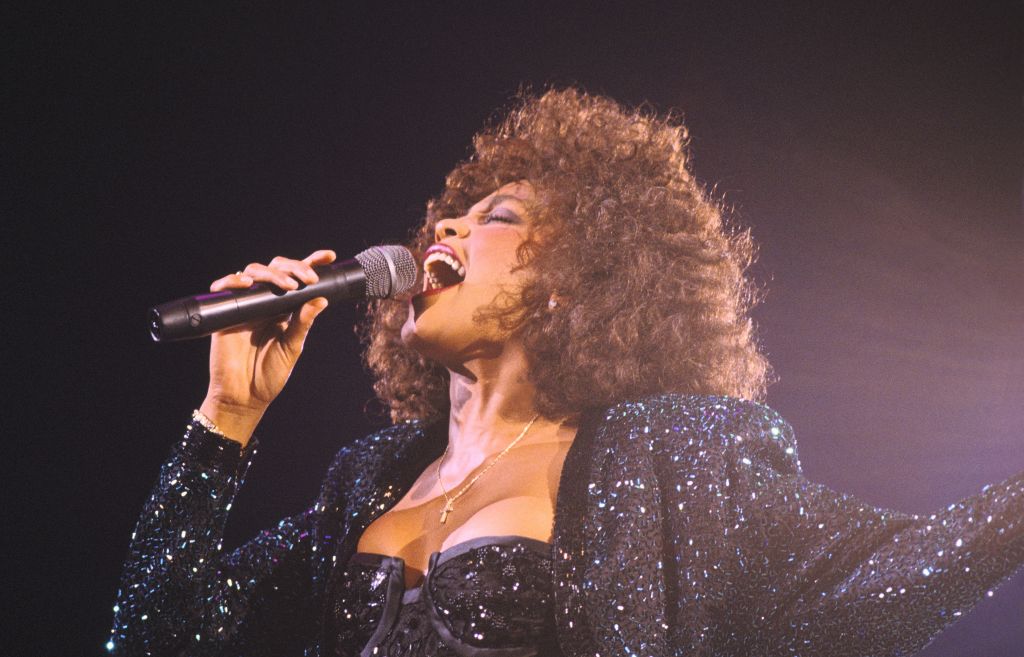
Whitney Houston is often seen as an ingenue mindlessly shuttled toward stardom by powerful men, such as her label executive Clive Davis. But she brought great care and control to her art from the very beginning—even in her first nationally televised performance, at age 19.
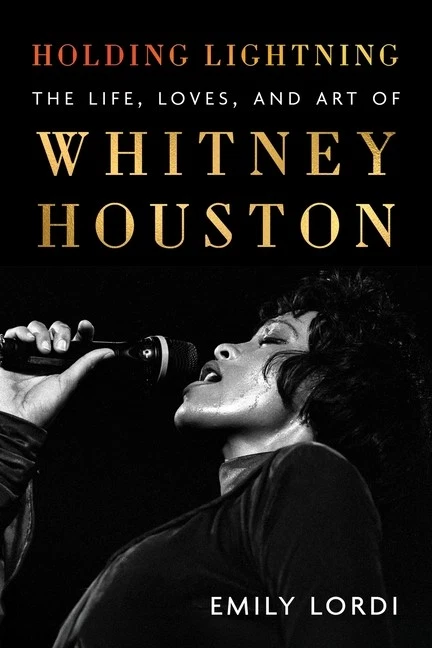
Excerpted from Holding Lightning: The Life, Loves, and Art of Whitney Houston by Emily Lordi (out Sept. 29), the first full-length critical biography of the iconic singer and American legend.
In 1983, Whitney Houston appeared on The Merv Griffin Show to sing “Home.” The performance reveals the bright, complex selfhood Whitney sought to express, even in spaces that were framed for her, not by her.
Whereas hosts today speak with artists themselves, not their male chaperones, the segment (which her best friend Robyn Crawford watched from their condo in Iselin, N.J.) begins with Merv introducing not Whitney but Clive Davis, the head of her label, Arista, whom he praises as “a giant of a man, probably the most knowledgeable man the record business has ever known.” The gesture was likely meant to secure the gentleman’s agreement, whereby Clive would break new Arista artists on the show.
Black women are often commandeered in this way, their rise attributed to some power beyond themselves, and to the men who recount their own crucial role to whomever will listen.
Clive and Merv discuss the “spark” Clive felt upon “discovering” Whitney. He compares her to stars like Lena Horne and Dionne Warwick, saying, “If the mantle is to pass to … somebody who is … sensuous, who’s innocent, who’s got [not only] an incredible range of talent, but guts and soul,” it would be Whitney. “You’ve either got it or you don’t have it,” Clive concluded.
“She’s got it,” said Merv.
Their exchange (which even Robyn rolls her eyes at, describing in her memoir that Clive was there “talking about how he’d ‘discovered’ Whitney”) was as good a point of origin as any for the mythology always ready to spring up around the female artist: She is the raw material, the spark of gold, that the great man discovers and shapes. Black women are often commandeered in this way, their rise attributed to some power beyond themselves, and to the men who recount their own crucial role to whomever will listen.
In the coming years, the news media would describe Whitney as Clive’s invention so often, it was considered an original angle to find a different man to credit for her success—such as Gerry Griffin, the subject of a 1986 Billboard piece, who’d heard her sing at Sweetwater’s before Clive did.
Griffin in turn credited the promotion team for selling 1987’s Whitney Houston, while concluding that Clive “really made this record happen.”
The picture of Arista as a factory of male worker bees obscured the queen bee at the center; and the fact that, as much as Clive had chosen Whitney, Whitney had chosen him.
“Home” is a gorgeous, black-diamond-level song, though its opening phrases are low and brief enough to accommodate the shortness of breath one might feel when nervous, which Whitney appeared to be. She arrived at the mic a little too early and folded her hands while waiting to begin. She wore a purple off-the-shoulder taffeta top and skirt, her hair short and natural. Griffin’s house band was dragging, so her mother Cissy—who was used to being in charge of musical groups and was not going to let anybody mess with her daughter’s big moment—stepped up to direct it herself. You can see her through the scrim backstage, arms waving before a group of men who might’ve resented her stage-mom antics but followed her tempo nonetheless.
By the time Whitney got to the bridge—belting her way undeterred through the convoluted, breath-draining lyric: “I know you’re listening, God, so won’t you please try not to make it hard to know I shouldn’t believe everything that I see”—she had burst forth to take charge of the song.
“I know, I know where I’m going!” she sang, giving the audience a knowing look that made the lyric a meta commentary on her career.
In what would become a signature move, she reharmonized the penultimate words—“like yours, like mine”—to build suspense before the home stretch; and she ended in a stance that was another trademark: arms flung straight out, head thrown back. It’s both an homage to Barbra Streisand’s closing flourish and a sign of victory and praise from a Black girl inheritor of civil rights wins, born between the church and the stage.

“Home” might have appealed to Griffin’s white viewers as a big, Streisand-type number driven by Whitney’s pipes and storytelling. Black listeners were more likely to appreciate her virtuosic take on a contemporary classic. Her performance was Black not because of its “guts and soul,” but because Whitney used techniques from Black performance traditions: asserting your unique style by revising a standard; methodically building a song’s intensity; and casting your whole being into a performance.
Still, Whitney’s version was relatively restrained. When Stephanie Mills, the original Dorothy, brought the song to a majority-Black Showtime at the Apollo crowd in this era, she launched a revival. She ran back and forth, came down into the audience, and just sat down on the stage. She was among her people; they knew who she was, and could receive her benediction: “Peace! Joy!” she cried out, imagining a home that was also heaven.
Whitney is simply not at home like that. She’s bringing her Blackness into a white space, negotiating a radical self-belief with a desire to do well. The song itself captures these tensions.
The Wiz, subtitled “The Super Soul Musical ‘Wonderful Wizard of Oz,’” was a Black Wizard of Oz for the children of the civil rights and Black Power generations. But its climactic ballad spoke to those who would integrate previously all-white schools, neighborhoods and workplaces—and might not always know where home was.
The song’s Black composer, Charlie Smalls—who had attended Juilliard and understood such crossings—begins with a backward glance in the Black vernacular: “I wish I was back there, with the things I’ve been knowing.”
He ultimately presents home not as a Black place to which one might return, but as a Black musical language—and more explicitly, a “world full of love” that “we must look inside our hearts to find.” The concept resonates with “Greatest Love of All,” which similarly locates a superlative love within the singer. But you only need a portable home of this kind when you’re displaced. A home inside your heart is only necessary when you’re not in Kansas anymore; or in Newark, or East Orange.
To declare yourself so deeply rooted as to feel at home everywhere, is especially audacious for a young Black woman signing with a record label helmed by powerful white men. But Whitney, for all her vocal bravado, doesn’t try to make it sound easy. It takes work for her to assert, “I know where I’m going!” It takes work for her to keep going.
When she flings herself into the last “home,” she brings a little cry to her voice, as if to dramatize and glorify the sheer energy it has taken to get there.
Excerpted from Holding Lightning: The Life, Loves, and Art of Whitney Houston by Emily Lordi. Copyright © 2026 by Emily Jeanne Lordi. Published by Mariner Books, an imprint of HarperCollins Publishers. All rights reserved. Reprinted with permission.