


Originally published on Kornbluh’s Substack, “History Teaches…” as “History Teaches … Rallying With The Flag: A Spirited ‘No Kings’ Rally Before—and For—the Vote.”
On Oct. 17, in honor of No Kings 4.0, I found myself standing at a suburban intersection littered with big-box stores in my once farm-filled Vermont town. There, local organizers with Indivisible gave weekend activists like myself sturdy signs that said “VOTE” on one side, with an American flag on the reverse.
I’m not much given to following rules, or holding signs that other people give me with messages worked out by committee. And I can’t remember a time when I had an uncritical or non-ironic relationship to the flag.
But it worked: Despite everything, despite history, even, I was happy to wave my little representation of Old Glory.

Women’s history offers plenty of reasons for a complicated relationship to that flag. Suffragists demanded a voice in a government that claimed its authority from the people while denying most women the vote. And the ratification of the 19th Amendment in 1920 left racist barriers to the ballot standing for Black women. People had to keep organizing, for decades, to make a constitutional promise mean something in their lives.
There is no particular reason to be sentimental about that history. There is every reason to take seriously the work of people who insisted that the country owed them more.
What that little flag meant at my demonstration in Williston, Vt.—and others‘ in Salt Lake City, Utah; San Diego; Brooklyn; Atlanta; Dallas, Texas, and many other places—was the promise of democracy at a time of genuine peril. It’s hard to have an ironic relationship to that.
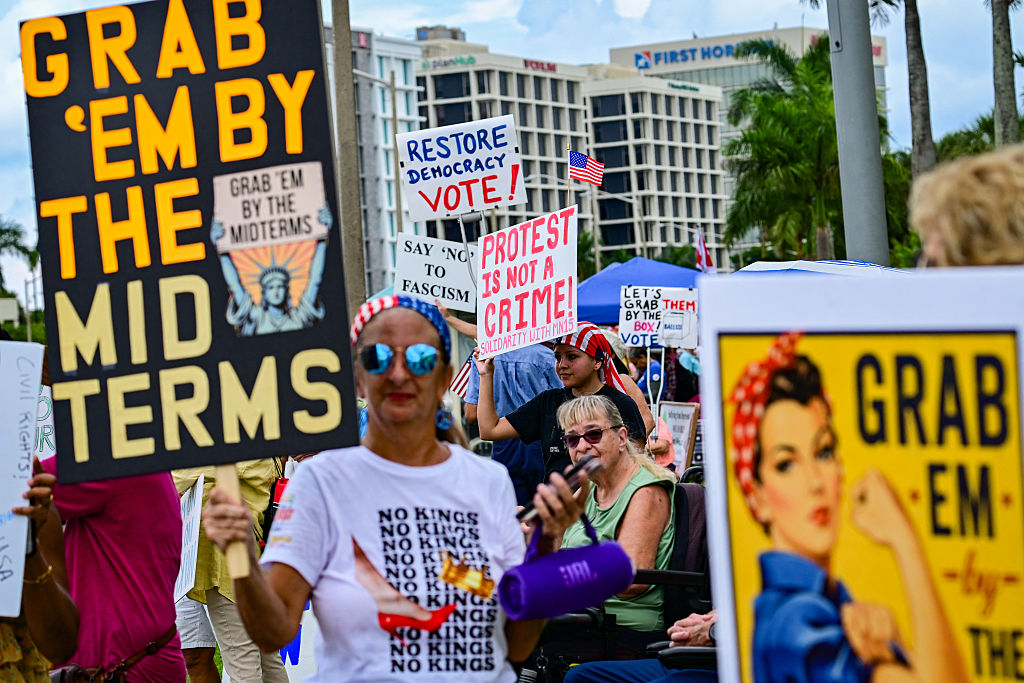
When things are bad enough, as they are here, now, the flag can stand for a bare commitment to independent courts and lawyers who do their jobs, to a vote free from intimidation, and to hard-fought political conflicts that don’t end in using governmental machinery to punish people on the other side.
Federal agents searched Rep. Ilhan Omar’s Washington, D.C., home on Oct. 12; she called it political intimidation. Guard officials said troops filmed beside a D.C. ballot box had paused on patrol; election officials requested limits on their placement. Being able to disagree with the president, and to cast a ballot without wondering about the soldiers nearby, should be ordinary expectations.

The group I stood with in the considerable chill in Williston was generally pretty quiet, save the boombox somewhere under the folds of the frog costume worn by the guy standing next to me. Somebody on the corner closest to the turnoff to the big grocery store and the PetSmart periodically bellowed, “Vote!”

The boombox played “Talkin’ Bout a Revolution” by Tracy Chapman, “Get Up, Stand Up” by Bob Marley, and “Streets of Minneapolis” by Bruce Springsteen, which he dedicated to the people of Minneapolis, immigrant neighbors, and the memory of Renee Good and Alex Pretti.
As for me, whenever I saw a neighbor who had a window rolled down, even if it was just so that their yellow Lab (standard-issue Vermont canine) could catch interesting smells, I issued a heartfelt plea to vote. “Stop the corruption,” I said. “Vote early!” I implored, just as the organizers wanted me to.
I was happy to carry a flag that stood for the work still to do: keeping a democracy, and making it more worthy of the name.
The organizers had helpfully printed a place to start on the other side: VOTE!
*
A note from Ms. editors: We want to hear from you for The Majority, a new campaign collecting stories about how reproductive freedom has enabled readers to build the lives they want and need.
Poll after poll shows a majority of Americans support reproductive healthcare access. Yet public debate overlooks the lives shaped by abortion access, contraception, IVF, miscarriage care, maternal healthcare or comprehensive sex education—countless women who chose to pursue an education, have children, not have children, protect their health and chart their own future. What’s your reproductive freedom story? Add your voice. Together, these stories will help show not only why reproductive freedom remains a majority value, but also what it makes possible.