Buckle Up, the Primaries Are Coming: From New Mexico to California, Women’s Representation Is on the Ballot

Weekend Reading on Women’s Representation is a compilation of stories about women’s representation in politics, on boards, in sports and entertainment, in judicial offices and in the private sector in the U.S. and around the world—with a little gardening and goodwill mixed in for refreshment!

This week:

—June primary contests will take place in 18 states.
—Concerning trends are taking place for women’s representation in New Jersey.
—The American Women’s History Museum on the National Mall is at risk.
—All 15 men in Donald Trump’s original Cabinet remain, but four of its seven original women are now left.

… and more.

No Women Were Present at the U.S.-China Negotiations. This Is By Design.

Weekend Reading on Women’s Representation is a compilation of stories about women’s representation in politics, on boards, in sports and entertainment, in judicial offices and in the private sector in the U.S. and around the world—with a little gardening and goodwill mixed in for refreshment!

This week:
—Mexico continues to bet the U.S. on women’s political representation.
—A brief explanation on the Supreme Court’s attack on voting rights.
—In a 2028 presidential nomination poll, women lead among Democrats.
—Denise Powell earns a primary nod in a hotly contested Nebraska congressional race.

… and more.

From the Halls of Congress to Out on the Trail, Women Beg the Question: Why Not You?

Weekend Reading on Women’s Representation is a compilation of stories about women’s representation in politics, on boards, in sports and entertainment, in judicial offices and in the private sector in the U.S. and around the world—with a little gardening and goodwill mixed in for refreshment!

This week:
—Rachel Entrekin makes history by setting a new course record at the Cocodona 250 ultramarathon, becoming the first woman to win the race outright.
—Amy Acton could become Ohio’s first woman governor.
—Mother’s Day has always been about women’s political power.

… and more.

The Supreme Court Gutted the Voting Rights Act. Women Will Pay the Price.

The Court didn’t strike down Section 2 of the Voting Rights Act—but it didn’t need to. By requiring proof of intentional discrimination, the majority has made it dramatically harder to challenge maps that dilute the voting power of communities of color. As Justice Elena Kagan warned, the provision is now “all but a dead letter.”

For the women elected from majority-minority districts, that shift is not abstract. These are the very districts that made their representation possible—and now, those districts are among the most vulnerable to being redrawn or erased.

The consequences were immediate. Within hours of the ruling in Louisiana v. Callais, Florida lawmakers advanced a new congressional map targeting majority-minority districts, including seats held by women.

In the 11 states most likely to face redistricting pressure, up to 36 such districts could be redrawn—12 of them currently represented by women.

As voting rights litigator Yael Bromberg explained, the Court is now effectively looking for a “smoking gun” of discrimination. Short of that, legislatures can redraw maps along partisan lines, even when the racial impact is clear.

The statute remains on the books, but its practical force does not. And what replaces it is not neutrality—it is discretion. State legislatures can choose which incumbents to protect and which to leave exposed, creating new opportunities to sideline women and weaken the political power of the communities that elected them.

What happens next will not hinge on another sweeping ruling, but on a series of decisions that are easier to overlook and harder to challenge—and that will determine, district by district, who gets to remain represented at all.


Amid Escalating Attacks on the Voting Rights Act and U.S. Democracy in Crisis, Lani Guinier’s Vision Feels More Urgent Than Ever

Lani Guinier’s birthday was a few weeks ago. She would have been 76 years old. And as I find myself doing each year, I return not just to her work—which speaks powerfully on its own—but to the moments that shaped my understanding of it.

I first met Lani Guinier when I was 15, at a crowded living room gathering where she spoke with remarkable clarity about the Voting Rights Act, representation and the promise of American democracy. Even then, I understood I was in the presence of someone whose ideas would change how we think about power—and whose words would quietly set the course for my own life.

Years later, I would come to know Guinier not just as a towering legal mind, but as a mentor, an ally and, in her own words, a “democratic idealist.”

When her 1993 nomination to lead the Justice Department’s Civil Rights Division was derailed by distortions of her work, she refused to retreat. She kept going—teaching, writing, speaking and pushing the country to imagine a democracy where every vote carries real weight. Her belief that representation must be meaningful—not merely symbolic—remains one of the most urgent and unfinished projects in American public life.

That urgency feels especially sharp now. In the wake of the Supreme Court’s decision in Louisiana v. Callais, which has effectively stripped Section 2 of the Voting Rights Act of much of its force, the distance between the right to vote and the reality of representation has only grown. Lani Guinier understood that gap better than anyone. And she left us not just a critique, but a blueprint—one that continues to guide those of us still working to build a democracy where every voice is not only heard, but truly matters.

Juliana Stratton’s Big Senate Win, Kristi Noem’s Next Steps and the Origins of Women’s History Month

Weekend Reading on Women’s Representation is a compilation of stories about women’s representation in politics, on boards, in sports and entertainment, in judicial offices and in the private sector in the U.S. and around the world—with a little gardening and goodwill mixed in for refreshment!

This week:
—Illinois primaries feature a big U.S. Senate win for Juliana Stratton.
—The IPU/U.N. Women Report on Women in Politics presents a sobering global snapshot.
—Mississippi will remain the only state that has never sent a woman to the U.S. House.
—Ranked-choice voting is being used for student elections at over 100 colleges and universities.

… and more.

Women’s History Month: Looking Back on How Far We’ve Come and the Hill That Lies Ahead

Weekend Reading on Women’s Representation is a compilation of stories about women’s representation in politics, on boards, in sports and entertainment, in judicial offices and in the private sector in the U.S. and around the world—with a little gardening and goodwill mixed in for refreshment!

This week:
—Primary season marks few advances for women.
—Donald Trump’s endorsements were overwhelmingly male, and they mattered.
—LA Charter Commission recommends ranked-choice voting.
—German women oppose online hate speech.

… and more.

Democracy Is Not Self-Executing: How We Shape a Better Government Through Laws, Institutions and Culture

Weekend Reading on Women’s Representation is a compilation of stories about women’s representation in politics, on boards, in sports and entertainment, in judicial offices and in the private sector in the U.S. and around the world—with a little gardening and goodwill mixed in for refreshment!

This week:
—The SAVE Act would block women, young people and low-income people from voting.
—Crowded Illinois primaries call for ranked-choice voting.
—The American women’s hockey team wins gold at the Winter Olympics in Milan.
—An election in Denmark could extend women’s leadership

… and more.

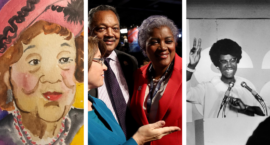
Celebrating Black Americans’ Commitment to Democracy, From Jesse Jackson to Dorothy Height to Shirley Chisholm

Weekend Reading on Women’s Representation is a compilation of stories about women’s representation in politics, on boards, in sports and entertainment, in judicial offices and in the private sector in the U.S. and around the world—with a little gardening and goodwill mixed in for refreshment!

This week:
—We celebrate the impact of Jesse Jackson.
—A new poll shows that Kamala Harris would defeat Donald Trump in a rematch.
—What the Heritage Foundation’s war on gender equality means for women’s representation.

… and more.