Asian Americans Are a Powerful Voting Bloc. It’s Time for the Political World to Start Acting Like It

Asian Americans and Pacific Islanders (AAPI) are the fastest growing racial group in the U.S. and a powerful voting bloc. Yet, they remain underrepresented in almost every industry, including politics. 

AAPI voters feel ignored and overlooked by both political parties. And there are only two AAPI senators—Mazie Hirono and Tammy Duckworth—and 19 representatives currently serving at the federal level. There have only been six AAPI governors in the history of the U.S., none of whom are currently in office. 

Electing Asian American and Pacific Islanders isn’t just about visibility; it leads to better policies, better lives and improved livelihoods. Investing in AAPI organizing and representation can’t wait.

Women Deserve to Live in a Nation Free of Gun Violence: The Ms. Q&A with Kris Brown

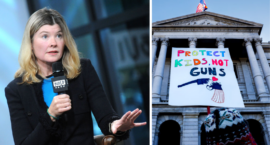
This fall, the Supreme Court will hear oral arguments in U.S. v. Rahimi, a case about a Texas law that prevents individuals subject to domestic violence restraining orders from possessing firearms. In a country where an abuser’s access to a firearm makes it five times more likely that he will kill his victim, where gun ownership continues to increase and where domestic violence and mass shootings are fundamentally entwined, a ruling overturning the Texas law (and making similar laws impermissible) would be disastrous.

“I believe America stands for the proposition that you can walk down the street and not get shot,” Kris Brown, president of Brady United Against Gun Violence, told Ms. “And I’ll never stop fighting for that.”

Billboards Throughout South and Midwest Advertise Abortion Access: ‘Pregnant? You Still Have a Choice’

For years, anti-abortion groups have dominated the American landscape with billboards. Now abortion rights supporters are battling back with their own.

Shout Your Abortion recently posted six abortion rights billboards along interstate 55 through five states that have banned abortion—from Memphis, Tenn., to Carbondale, Ill. The billboards include messages like, “God’s Plan Includes Abortion” and “Abortion is Okay: You Know What’s Best for You.” 

Upcoming SCOTUS Case Exposes Domestic Violence Victims to New Risks

The Supreme Court is set to rule on United States v. Rahimi this term, a case which will decide whether the government can continue to prevent alleged domestic abusers with a restraining order from possessing firearms. 

Those of us on the frontlines of this battle must speak now. We can’t control the outcome of this case, but we can point to the data and fight for the survivors who come through the doors of our hospitals and social service organizations. We can’t afford to stand on the sidelines and let victims down.

‘Banned! Voices from the Classroom’: The Path to an Elite Education, in the Absence of Affirmative Action

With a recent Supreme Court ruling gutting affirmative action, parents and students find themselves navigating a landscape where the rules have shifted with little notice.

A high-schooler about to apply for college, and his mom, join their voices: “Both of us feel whiplashed by the constant yo-yo between our identities and contributions. It is in these sudden changes that we stand together, searching for understanding. In our shared experiences of marginalization, two generations can transcend difference, because we both know what it means to be made invisible, and we each feel the well-intentioned pressure to get it right the first time because of insider information and academic achievements.”

New England Advocates Build a Regional Model for Abortion Rights

On Tuesday, Sept. 26, Massachusetts-based Reproductive Equity Now, formerly NARAL Pro-Choice Massachusetts, announced an expansion of its work into Connecticut and New Hampshire to create a regional organization to strengthen abortion access across New England. As more states ban abortion, advocates hope this regional strategy will ensure abortion health care for New Englanders and patients traveling to the region for care.

“As 20 states have moved to restrict or ban abortion, wiping out access to care in broad regions of our country, we must focus on state-by-state work to build regional blocks for abortion access. This work will begin in New England, and we hope that this model can be replicated to advance reproductive freedom nationwide.”

‘Inverse Cowgirl’: My Life as an Intersex, Intersectional Activist in the Lone Star State

Turns out sharing your truth about being a woman born with balls for the first time in front of a panel of Southern legislators makes for a pretty interesting story—but I’m getting ahead of myself. I wrote a book called Inverse Cowgirl about my experience living intersex in Texas.

“Wendy Davis was right about one thing: We’re all on the same team. We’re all fighting for consent—to make our own decisions about our bodies rather than have someone else make them for us. Many intersex individuals, myself included, have undergone surgeries in our youth to force our bodies to fit the gender binary better. Some surgeries, like mine, involve sterilizing us without our consent—stripping us of our reproductive freedom. Sound familiar?”

Women Lawmakers Have Pushed Back Against Senate Dress Codes for Decades

Last week, Senate Majority Leader Senator Chuck Schumer (D-N.Y.) announced a major change to the long-standing informal dress code: “Senators are able to choose what they wear on the Senate floor,” he stated. The move was seen as no less than a revolution, especially for an establishment known for its adherence to tradition and archaic protocols. The attention this seemingly unimportant change has gotten shows us why what we wear matter.

If women have managed to reclaim the power of the suit and make it a staple of their wardrobe, while also finding creative ways to be noticeable, male senators can now have this opportunity to use their clothes to fashion their image.

The Supreme Court’s Blindness to Gender Violence

If you thought the Supreme Court’s decision overturning Roe v. Wade was the end of the Court’s war on women, think again. Now gender violence laws are under attack. Case in point: last term’s decision in Counterman v. Colorado striking down a stalking conviction as unconstitutional. This upcoming term, the Court is poised to deal another blow to domestic violence laws, in a case about guns: United States v. Rahimi.

The only answer is for women to return to a newly vital project since Dobbs: the Equal Rights Amendment.

(This article originally appears in the Fall 2023 issue of Ms. Join the Ms. community today and you’ll get issues delivered straight to your mailbox!)

A Government Shutdown Would Be Deadly for Hungry and Food-Insecure Americans

Congress is once again at a complete gridlock, barreling toward a government shutdown. Pundits are placing bets about the length of a potential shutdown, which party will cave first, and which government programs will be brought to a standstill.

But what has been minimized by some as merely a political temper tantrum will also have a deep and scarring impact on the 40 million Americans facing hunger.

Programs like SNAP, WIC and the child tax credit work effectively when they are sufficiently funded. Oh, and every dollar invested in WIC generates about $2.50 in healthcare cost savings. Shouldn’t this be a no-brainer?