War on Women Report: State Department Mass-Burns Contraceptives; GOP Budget Decimates Medicaid; Texas Crisis Pregnancy Center Funds Paid for CEO’s Smoke Shop

MAGA Republicans are back in the White House, and Project 2025 is their guide—the right-wing plan to turn back the clock on women’s rights, remove abortion access, and force women into roles as wives and mothers in the “ideal, natural family structure.” We know an empowered female electorate is essential to democracy. That’s why day after day, we stay vigilant in our goals to dismantle patriarchy at every turn. We are watching, and we refuse to go back. This is the War on Women Report.

Since our last report:
—After a highly publicized trial, a jury acquitted music mogul Sean “Diddy” Combs of the most serious charges—sex trafficking and racketeering conspiracy.
—Texas’ funding pipeline for antiabortion crisis pregnancy centers allowed CPCs to spend millions of taxpayer dollars with little oversight into how the money was used.
—A Texas man is suing a doctor in California who he claims sent abortion pills in the mail to his girlfriend.

… and more.

Keeping Score: States Ramp Up Antiabortion Efforts; Black Women Forced Out of the Workforce; Only a Quarter of Americans Say Trump Has Helped Them

In every issue of Ms., we track research on our progress in the fight for equality, catalogue can’t-miss quotes from feminist voices and keep tabs on the feminist movement’s many milestones. We’re Keeping Score online, too—in this biweekly roundup.

This week:
—States continue to develop strategies to pass antiabortion laws.
—Texas Attorney General Ken Paxton is still attempting to sue New York doctor Margaret Carpenter. New York Gov. Kathy Hochul responded, “Attorney General Paxton should focus more on his own private life instead of dictating the personal decisions of women across America.”
—Almost 300,000 Black women left the labor force in the past three months.
—Rep. Marc Veasey (D-Texas), co-chair of the Voting Rights Caucus, is leading a bill to prevent unnecessary redistricting in between censuses.
—Sens. Jeanne Shaheen (D-N.H.) and Brian Schatz (D-Hawaii) have introduced a bill preventing the unnecessary destruction of foreign aid food, medicine and medical devices.
—The Supreme Court enabled Trump to dismantle the Department of Education.
—Trans women were banned from U.S. women’s Olympic sports.
—Rep. Debbie Dingell (D-Mich.) is sharing her own history with domestic abuse as part of her advocacy to support survivors: “For me, it’s just about trying to keep other people from having to go through what we did and for mothers and fathers—there are men that are victims too—to know that there are resources.”
—Chef José Andrés details the policy changes needed to save millions in Gaza from starvation: “A starving human being needs food today, not tomorrow.”
—Under a quarter of Americans can name a female historical figure, and only 6 percent of monuments honor women.
—South African runner Caster Semenya won her case at the European Court of Human Rights.
—After bipartisan criticism in Congress, the Trump administration will release $1.3 billion for after-school programs that has been withheld from states.
—A Kentucky appeals court agreed that Jewish woman Jessica Kalb may continue her suit against the state’s strict abortion ban, which violates her religious beliefs.

… and more.

Juneteenth Calls for Economic Justice, Not Trump’s Racially Coded Gimmicks

As Juneteenth approaches, we are called to remember not just the day when the last enslaved Black Americans learned of their freedom, but the ongoing struggle for true justice and equality in this country.

In this context, Donald Trump’s economic and immigration policies—packaged as efforts to “Make America Great Again”—take on a more troubling meaning. They are not just policy proposals; they are part of a deliberate strategy to reinforce racial divides, undermining the very ideals that Juneteenth represents.

The Ugliest of Bills: How Republicans’ Reconciliation Bill Endangers All Children

One of the many dangers of the budget reconciliation package currently before the Senate is its audacity. It is so large, so ugly and so expensive—nothing beautiful to see here—that it can be hard to know how to fight back. 

So much is at risk that, even assuming some of the most talked-about measures, such as Medicaid cuts, are removed or modified in the Senate, it is likely that passage of This Ugliest of Bills (THUG Bill) would still fundamentally harm millions of people.  

Children—citizen and non-citizen—are going to be especially hard hit if this ugliest of bills passes.

‘I Just Wish I Could Have One Good-Paying Job’: A Black Mother’s Story of Hard Work and Hope

Front & Center began as first-person accounts of Black mothers living in Jackson, Miss., receiving a guaranteed income. Moving into the fourth year and next phase of this series, we’re expanding our focus beyond a single policy intervention to include a broader examination of systemic issues impacting Black women experiencing poverty. This means diving deeper into the interconnected challenges they face—including navigating the existing safety net; healthcare, childcare and elder care; and the importance of mental, physical and spiritual well-being.

“I’m lucky if I get four or five hours a day of sleep, but it’s what I have to do to make sure my kids are taken care of and I have enough money to cover all my bills. … When I was part of the Magnolia Mother’s Trust, I was able to just work one job. … I hate that it’s over, I really wish leaders would create a policy like that that would be permanent.”

The Childcare Crisis Hampers Opportunity for America’s Families

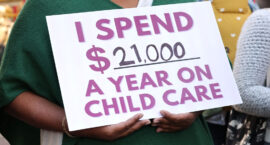
Half of all U.S. families live in childcare deserts with either inadequate or nonexistent licensed childcare to rely on for support. Within this landscape, many parents are forced to make difficult decisions about their children’s care or their own jobs, not because it’s what they think is best for their family, but because they lack any other options.

As the incoming Trump administration readies itself for office, early childhood advocates must press any advantage to keep childcare and early learning a top priority.

The Ultimate Mother’s Day Gift? Systemic Support for All Mothers

At the beginning of 2024, the U.S. House of Representatives passed a $78 billion tax legislation that included the expanded CTC, but this has since stalled in the Senate. Giving unconditional cash to mothers showed us just how transformative unrestricted financial aid and support for mothers can be—so why don’t we sustain these kinds of investments in families?

The U.S. Can Create True Wealth by Giving Cash to Parents Who Need It

In 2018, we launched the Magnolia Mother’s Trust, the United States’ first modern-day guaranteed income program and the first in the world to focus solely on low-income Black mothers. 

Our goal is simple: Provide the financial capital necessary for these mothers to dream a little bigger and breathe a little easier. We can give everyone that kind of wealth. And yes, I will play on the word here—we can guarantee it. If we are willing to understand, a little financial investment can change someone’s life, and allow them the flexibility, heart, and mind to build and define true wealth—equity, delight, honor and love. 

Giving Parents More Cash Is a Start—But It Can’t Be the End

The big news out this week: The expanded child tax credit could be reinstated for three years as part of a bipartisan tax package. This would be a huge deal for families across the country who have been struggling with dwindling supports from the government as pandemic-era boosts expire. 

While this latest deal lacks heft—in that it maxes out at a little more than half of the 2021 expanded CTC that was our nation’s greatest tool ever in fighting poverty—it is still significant for putting us back on the path toward radical transformation.

Here’s What Biden Had To Say About Abortion, the Child Tax Credit, and More in the State of the Union

In his State of the Union speech to Congress and the nation Tuesday night—during which Republicans found little to cheer for (and, in some cases, cause to disrupt)—President Biden specifically addressed some of the major issues of concern to feminists. From calling for advancing paid family and medical leave and expanding the Child Tax Credit, to LGBTQ+ rights and abortion—the latter of which is expected to be a major motivating issue for women voters in the 2024 election—he spoke on a number of feminist topics.