
A single mother on the verge of becoming a doctor confronts an inflexible loan cap that punishes low-income parenting students and threatens to derail years of sacrifice.


More Than A Magazine, A Movement

Civil rights mean equal protections and opportunities under the law, and are a vital part of human rights and for the functioning of a democracy. They include liberties such as the right to vote, the right to a trial, and the right to access government services and education.
A single mother on the verge of becoming a doctor confronts an inflexible loan cap that punishes low-income parenting students and threatens to derail years of sacrifice.

A new community-based tracker reveals how quickly the Trump administration is advancing policies that erode civil rights, healthcare access and worker protections.

Billionaire MAGA donors, anti-women politicians and Trump loyalists are the forces behind Republicans’ dangerous assault on voting rights.
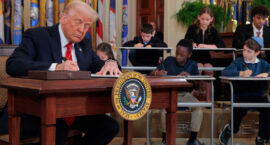
In a North Carolina coastal community, an elementary school may be forced to end its free monthly dinners where parents come together with teachers to talk about their children’s academic progress, as well as their mental and physical health.
In a rural corner of Texas, local high schools may have to stop participating in a partnership connecting students with local colleges, trade schools and career opportunities—even though parents insist that college and career readiness is the biggest need for their kids.
In Idaho, an elementary school may be forced to stop its after-school program, which parents named as a major help.
These parent-empowering initiatives are now under threat because each of these schools receives federal dollars from the Education Department for their “community school” programs—federal dollars that are now on the chopping block.

International students across the U.S. are losing their visas without warning. For many, the only explanation is a dream turned nightmare—and a government no longer pretending to welcome us.

As Trump moves to dismantle the Department of Education, echoes of Jim Crow remind us what happens when states are left to decide who deserves an education—and who doesn’t.
Programs like Social Security, Medicaid, Medicare and the GI Bill exist because certain rights are too fundamental to be left to the whims of individual states or marketplaces. Education is one of them.

A new phase in U.S.–Taliban relations appears to be quietly unfolding under the Trump administration—marked by lifted bounties on senior Taliban officials, a symbolic embassy cleanup in Kabul, and the release of an American hostage. While these developments are being framed as constructive steps toward diplomacy, they also reveal a stark reality: The future of U.S.–Taliban engagement may be transactional, and Afghan women and girls are likely to be left out of the equation.
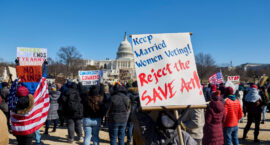
Women—especially Black women—are still fighting for equal rights and opportunities in the U.S. Meanwhile, members of Congress are threatening to undermine the hard-fought, fundamental right to vote for all Americans, including millions of women, under the guise of misleading allegations of voter fraud. And they’re ironically calling it the Safeguard American Voter Eligibility (SAVE) Act.
Make no mistake: The SAVE Act is not going to “save” anything. This legislation would create unnecessary barriers to registering to vote in every state. It would require all voters to provide proof of citizenship documents in person when registering to vote or updating their registration—provisions that effectively end online, automatic, and mail-in voter registration. Women who change their name after marriage or divorce would face unnecessary barriers to registering to vote.

A few years ago, I went searching for Pauli Murray. By that point, the poet, civil rights activist and pioneering legal scholar had been dead for 35 years. But in researching her life for the book I was working on, I’d learned about the profound impact that her work had had on the very fabric of America and particularly on the country’s legal system. I was convinced that because of everything Murray had done—the extent to which she had shaped movements and laws and lives—she would have to be remembered prominently and publicly. It was probably just my own fault, I reasoned, that I hadn’t previously heard of her.
Like millions of others around the world, I have spent the last few weeks oscillating between fear, anger and sadness as I’ve watched the new U.S. administration neglect the core values of democracy and wreak havoc with the systems that have propped up this country for centuries. With no way of changing the mind of a morally bankrupt megalomaniac, I’m concentrating on what I can do. Since I’ve learned of her remarkable life, I’ve loved telling people about Murray; about the unlikely against-all-odds battles she faced head-on—public wars she waged while simultaneously grappling with her own often-debilitating private troubles. If the federal government chooses to ignore those upon whose shoulders we all stand, those of us who recognize the indignity of this will simply have to make up for it by telling their stories loudly, telling their stories often and then repeating them over and over and over again. It is, after all, what Pauli Murray would do.

The Trump administration’s rollback of Biden-era NIL guidance weakens Title IX protections, deepening financial disparities for female college athletes.