
A new community-based tracker reveals how quickly the Trump administration is advancing policies that erode civil rights, healthcare access and worker protections.


More Than A Magazine, A Movement

In 1873, the Comstock Act banned sending obscene literature, abortifacients, contraceptives or sexual information through the U.S. mail system. The language regarding contraception was later removed in 1971 after the Griswold v. Connecticut ruling. Antiabortion advocates have suggested that Comstock Law could be used as a backdoor method of enforcing a national abortion ban by restricting the shipment of abortion drugs as well as medical equipment used in abortions.
A new community-based tracker reveals how quickly the Trump administration is advancing policies that erode civil rights, healthcare access and worker protections.
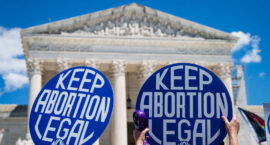
Three years ago, the U.S. Supreme Court overturned Roe v. Wade and denied women a right to abortion that had existed for nearly half a century. Fourteen states have since banned the procedure completely, with almost no exceptions. Four more have passed time limitations so onerous that the services are effectively unavailable.
And yet abortions continue to take place across the country, in numbers equal to or greater than before. How has this been possible?
In their new book, After Dobbs: How the Supreme Court Ended Roe but Not Abortion, sociologist Carole Joffe and legal scholar David C. Cohen uncover and analyze the courageous and innovative work of medical providers, politicians, lawyers, advocates and private donors, working tirelessly on the ground to secure continued access.
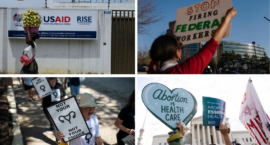
In every issue of Ms., we track research on our progress in the fight for equality, catalogue can’t-miss quotes from feminist voices and keep tabs on the feminist movement’s many milestones. We’re Keeping Score online, too—in this biweekly roundup.
This week: Trump pulled university funding and arrested student leaders over pro-Palestine protests; a Texas midwife faces felony charges for providing abortion care; Congress members avoid town halls after Department of Education and other federal agencies were decimated; abortion bans threaten the lives of Black mothers; and more.

HB 446 is just one of a new generation of social purity laws being presented across the country, using fears of “social contagion” from over a century ago that still ring true for many Americans.
Understanding this history is vital to unpacking the danger—often connected growing white supremacist movements—of these laws and the social fears they represent.

Last month Texas Attorney General Ken Paxton filed a civil lawsuit on behalf of the state against New York doctor Maggie Carpenter, co-founder of the Abortion Coalition for Telehealth, for prescribing abortion pills through telehealth to a Texas woman.
Paxton’s lawsuit is a direct attack on telehealth abortion shield laws— a move that has been anticipated since Massachusetts enacted the country’s first such law in the immediate aftermath of the Supreme Court’s 2022 decision in Dobbs.

In recent years, the use of abortion pills has skyrocketed and now accounts for an estimated 65 percent of all abortions performed in medical settings, including through both brick-and-mortar clinics and telehealth providers.
Carrie N. Baker’s fascinating new book, Abortion Pills: U.S. History and Policy, tells the story of a decades-long struggle for acceptance of this safe, secure and private method of ending an early pregnancy. It’s also a story of antiabortion attempts to suppress abortion pills.

During the presidential campaign, Trump forcefully avowed he did not support a national abortion ban—a position consistent with two-thirds of the electorate—gloating instead that he was responsible for sending the issue back to the states where it belongs. He also distanced himself from the “virally unpopular” Project 2025—the far-right playbook for the next conservative administration.
However, warning signs suggest that Trump may have been pandering to the electorate on both scores. Notably, when his remarks on the campaign trail about a national ban are considered alongside his existing ties to Project 2025, his boast about returning control over abortion to the states may well prove to have been stopgap measure en route to a blanket ban, although perhaps by way of a back-channel strategy.
A former Trump official chillingly predicted that Trump’s track record of having “adopted the most pro-life policies of any administration in history … is the best evidence … you could have of what a second term might look like.’”

“Pills have become the frontline of the battle for abortion access,” writes professor and Ms. contributor editor Carrie N. Baker in her new book Abortion Pills: U.S. History and Politics—the first to offer a comprehensive history of abortion pills in the United States.

Americans are picking their first president after the Supreme Court overturned their constitutional right to an abortion.
Now, two-and-a-half years later, with near-full abortion bans in 13 states, deaths confirmed because of them, and a smattering of states that have enacted protections via the direct democracy of ballot initiatives, the country has a choice: to reelect Republican Donald Trump, whose pledge to undo Roe helped fuel his first ascent to the White House; or to elect Democrat Kamala Harris, who is running on resurrecting abortion rights as she aims to be the first woman to win the presidency.
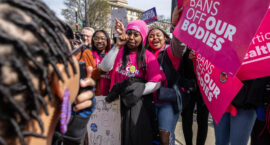
When it comes to abortion pill availability, the Supreme Court left open a dangerous door that the Republican-controlled states of Missouri, Kansas and Idaho are now seeking to walk through.