A (Brief) History of Women’s Rights, 1600 to Present

From the Haudenosaunee women who successfully challenged warfare in the 17th century, to today’s feminist organizers defending democracy, reproductive freedom and civil rights, the struggle for women’s equality has never been a straight line. It is a story of persistence, resistance and collective action spanning centuries.

Compiled by editors at Ms. and researchers from the National Women’s History Alliance, this women’s history timeline traces the interconnected histories of feminism, abolition, labor organizing, civil rights, reproductive justice, LGBTQ+ liberation and democratic participation.

No timeline can fully capture more than 400 years of feminist history, let alone every movement, leader, victory and setback that has shaped the ongoing fight for equality. Rather than offering a comprehensive account, this chronology highlights pivotal moments and turning points that help tell the story of how women have expanded the boundaries of freedom, democracy and human rights in the United States and beyond.

The timeline is part of Ms. magazine’s FEMINIST 250: Founding Feminists project, a multimedia essay series marking the 250th anniversary of the Declaration of Independence by examining the women and feminist movements that have worked to make the nation’s founding promises more fully realized. Through reported features, essays, interviews and historical analysis, FEMINIST 250 explores not only where we have been, but where we must go next to achieve true equality.

FEMINIST 250’s Parts 2 and 3—Feminist Lessons and Feminist Futures—drop this month on MsMagazine.com.

He Called Me ‘Doc.’ I Called Him ‘Rev.’ Remembering Jesse Jackson’s Moral Leadership

I knew Rev. Jackson beyond the conventions. He married me and my husband, Gregory Shaffer, almost 25 years ago. He always showed up and gave graciously of himself when I called—whether it was to host a convening on HIV/AIDS at Rainbow PUSH in the early 2000s, or to bring together hundreds of working-class residents from the South Side of Chicago to engage on matters of national healthcare, or to meet with (mostly women) academics coming together to figure out the intersections of law, family and reproductive rights at the University of Chicago Club 20 years ago. 

He called me “Doc” or “Doctor Michele.” I called him “Rev.”

A week ago, by his father’s bedside, Rep. Jonathan Jackson (D-Ill.) and I spoke by phone. He had just delivered a speech at the National Prayer Breakfast calling the president to account—to be more humane and just, and to “do what is right.” It was clear that Rev. Jackson’s legacy is already living on.

Seventy Years After Rosa Parks’ Arrest: How We Commit to Carrying the Work Forward

Weekend Reading for Women’s Representation is a compilation of stories about women’s representation in politics, sports and entertainment, judicial offices and the private sector—with a little gardening mixed in!

This week:
—The 2025 elections prove that voters across the country want women as their leaders.
—Democratic leaders are exploring ranked-choice voting for the 2028 presidential primaries.
—In a Tennesee special election, Democratic nominee Aftyn Behn surpassed electoral expectations for her congressional district.
—Fort Collins, Colo., elected Emily Francis as mayor in its first use of ranked-choice voting.
—College student Any Lucía López Belloza was deported in Massachusetts on her way home to Texas for Thanksgiving.

… and more.

Sarah McBride Makes History as First Transgender Member of Congress

Sarah McBride won Delaware’s at-large U.S. House seat, after she campaigned on expanding Delawareans’ access to healthcare—an effort on which she has focused her career in the state’s 1st Senate district. In January, McBride will be sworn in as the first out transgender member of Congress. 

McBride’s ascension marks yet another milestone for the millennial state legislator. As the country’s first out transgender state senator, the first transgender person to speak at the Democratic National Convention and the first out trans woman to intern at the White House, McBride has repeatedly broken barriers in politics and proven that voters are ready to elect transgender candidates into elected office.  

How I Talk to My Daughters About Kamala Harris

When Vice President Kamala Harris held her first rally as the presumptive Democratic presidential nominee, my husband and I watched intently as our daughters wandered into the room. They could see how excited we were—standing close to the TV, our hands clasped tight, my eyes welling up with tears. They asked us who she was, and we told them, “That’s Kamala Harris. And she is going to be our first woman president.”

“She looks like me,” said my 6-year-old, the daughter of a Nigerian American father and white mother.

Realizing Youth Power: Engaging Youth Beyond Elections

Ever since I could remember, the prevailing narrative about young people and elections has been that they don’t care and don’t vote. As a result, politicians have expressed no obligation to young people and their priorities. Yet, in August, as I watched the Democratic National Convention, I saw something different: Broadcasters and commentators referred to “the youth vote” as a meaningful voting bloc. For the first time, our political discourse was acknowledging the critical role young people have played in the last several elections.

Issues like climate change, reproductive justice, student debt, education and gun violence are life-and-death issues, with clear implications for young people’s daily experiences. Drawing from the work of foster care system and disability justice activists, young leaders rally for “Nothing about us without us.”

(This essay is part of a Women & Democracy multimedia package focused on Gen Z and student voters. The future envisioned by young leaders is bright—it’s built on reproductive rights, bodily autonomy, sustainability, freedom from violence and economic opportunity. Explore essays, a brand-new podcast, videos and more from some of your most loved [or soon to be!] influencers and writers, brought to you by Ms., DoSomething, the nonprofit that helps make volunteerism “cool,” and The Anthem Awards, the social impact arm of The Webbys.)

Rep. Jasmine Crockett on Politics, Patriarchy, Profits and the Presidency

U.S. Rep. Jasmine Crockett, representing Texas’ 30th Congressional District, has become a breakout star in the Democratic Party, effectively keeping politicians and pundits three times her age in check using clapbacks, one-liners—and facts. 

I was one of the first creators in history invited to the Democratic National Convention this fall. There, I spoke to Crockett, where she delivered an energetic, standout 10-minute speech. (“Will a vindictive vile villain violate voters’ vision for a better America or not?” she asked the crowd. “I hear alliteration is back in style.”) She shared her advice for young entrepreneurs, her fight for reproductive justice in Texas, and what it means for a woman of color to be nominated for president of the United States.

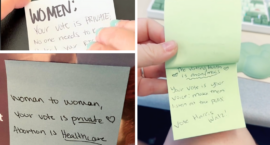
Women, Your Vote Is a Secret, Says New Guerrilla Post-It Campaign

In a world where the political gender gap is growing as women move left, a clever grassroots campaign is reminding women of a fundamental truth: Their vote is private. This guerrilla movement uses a simple yet powerful tool—Post-It notes—to reach women whose partners may disagree with their political choices.

The premise is simple: small, brightly colored notes discreetly placed in public spaces, like bathroom stalls, libraries, cafes, dorm buildings, workplace lounges, doctors’ offices and community boards. Each note carries the message that every woman has the right to cast her vote freely and privately.

The ‘New’ Masculinity Is Actually 50 Years Old

Since the presidential campaign shake-up in July, the national conversation about manhood has been abuzz with talk of a “new” masculinity, embodied by good, decent men like Tim Walz and Doug Emhoff. What’s actually new, though, is what’s coming into focus: the consequences of 50 years of men’s hard work to redefine manhood.

A growing number of men across all races and ethnicities have followed women in working to prevent domestic and sexual violence, protect reproductive rights and redefine and transform traditional ideas about manhood, fatherhood and brotherhood. Men are rejecting a fixed definition of masculinity and replacing it with an emotionally rich expression of masculinities.

Another Reason Project 2025 Is So Bad for Women? Guns.

If implemented, Project 2025 would be devastating for women, families and feminists everywhere. Voters—particularly women voters—need to understand these threats.

But while Project 2025’s abortion and LGBTQ+ rights plans have rightfully garnered outrage, there’s another, lesser-known threat to women, families and communities buried within these pages: a radical “guns everywhere” agenda.