The Radical Potential of Traditional Femininity 

In the 1700s and 1800s in the U.S., women were presumed to be subordinate to men: naturally helpless, emotional, vulnerable.

Reading through the thousands of petitions submitted by revolutionary-era women to the state, one might get the impression that all women accepted their subordinate status to men with humility and grace.

But what if they didn’t? What if their engagement with the discourse of feminine dependence was merely a shrewd tool, effectively deployed to cater to precisely what their readers—white, male elites—wanted to hear? What if the radical act of seeking a divorce in the 18th century contradicted the conservative language they employed? 

In most cases, we’ll never be able to deduce these women petitioners’ true feelings on their social and legal status. Many women petitioners in the revolutionary era left no trail for the historian to follow. 

What we can know is that the employment of this discourse of dependence, cunningly constructed in a sympathetic narrative neatly packaged for a patriarchal audience, was immensely effective. For the most part, women who engaged with these tropes of feminine subordination saw their petitions granted. Those that did not—including those who rebuked men—largely saw their pleas rejected or ignored. 

(This essay is part of the FEMINIST 250: Founding Feminists series, marking the 250th anniversary of America by reclaiming the revolution through the women and gender-expansive people whose ideas, labor and resistance shaped U.S. democracy.)

ERA Road Tour: Weekly Road Diary (March 8-13)

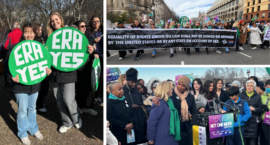
Inspired by the 1916 suffrage road trip that helped win women the vote, activists behind Driving the Vote for Equality are traveling across the country in the restored Golden Flyer II to build support for recognizing the Equal Rights Amendment as the 28th Amendment.

Each week, Ms. will share highlights from the road.

During its first week on the road, the Golden Flyer II carried the push for the ERA through the Mid-Atlantic.

Its second week took the Golden Flyer II through Virginia, North Carolina and Georgia—stopping in cities and towns where activists, students, historians and local leaders gathered to sign petitions, share suffrage history and press Congress to recognize the ERA as the 28th Amendment.

ERA Road Tour: Weekly Road Diary (March 2-7)

Inspired by the 1916 suffrage road trip that helped win women the vote, activists behind Driving the Vote for Equality are traveling across the country in the restored Golden Flyer II to build support for recognizing the Equal Rights Amendment as the 28th Amendment.

Each week, Ms. will share highlights from the road.

During its first week on the road, the Golden Flyer II carried the push for the ERA through the Mid-Atlantic. In New York, New Jersey, Washington, D.C., and Virginia, ERA advocates connected historic sites of feminist resistance with renewed calls for constitutional equality.

The Road to the ERA Runs Through Congress

In 1916, just as Americans were beginning to enjoy the new travel freedoms that came with motorized vehicles, a couple of frustrated leaders of the campaign to secure women’s rights to vote, Alice Snitjer Burke and Nell Richardson, secured one of the first gas-driven automobiles in the country. They named the car, a Saxon, Golden Flyer and set off across the country to get support for what would become the 19th Amendment, guaranteeing women the right to vote.

Yes, the original ‘road trip’ was an act of political audacity. Long before women even had the vote, these two women drove into towns across America, on their own, spoke in town squares, slept in boarding houses and not surprisingly, endured ridicule and resistance. They were history’s first “Thelma and Louise.” This road trip had a very different ending, of course, as it led to the passage of constitutional clarity on the question of voting rights, at least for white women, with the 19th Amendment. Getting that right guaranteed for all women, whatever race or circumstances, would still take other struggles. And the campaign for full equality for all women didn’t end with the Drive across America for voting rights.

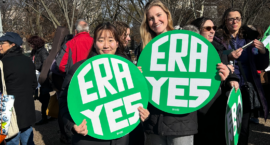
The struggle for a constitutional guarantee of equality has led to another road trip across America: Driving the Vote for Women’s Equality Tour.

When Burke and Richardson set out in the Golden Flyer in 1916, they did not know the outcome. They only knew that democracy requires action. And the action now is to finish the work through the ERA joint resolution. The message to policymakers is direct and clear: Recognize the will of the states and acknowledge that the ratification threshold has been met. Finish the work.

Equal means equal. It did in 1916. It does now. And this time, we will not stop until the Constitution says so.

America’s Founding Feminists: Rewriting America’s Origin Story

Two hundred and fifty years ago, a small group of men declared that “all men are created equal,” casting a vision of liberty that has shaped the American imagination ever since.

Yet even as they debated freedom in Philadelphia, women were writing, organizing, governing, resisting and insisting on their place within the nation taking form. Some, like Mary Katherine Goddard, literally set their names in print; others, like Phillis Wheatley, wrote themselves into intellectual existence against a backdrop of enslavement and doubt. Still others left their mark through acts of refusal and flight, choosing freedom when the republic would not grant it.

A new series, Founding Feminists—launching at the start of Women’s History Month—unfolds over two months, twice a week. On this semiquincentennial of the United States, Ms. turns to these “founding feminists” not as anachronistic heroines, but as architects of an unfinished democratic project. There is no nation without women at its core—no democracy without their labor, intellect, resistance and imagination.

From Haudenosaunee matrilineal governance, to Black women’s freedom-seeking acts, from revolutionary manifestos to quiet domestic rebellions, our Founding Feminists series reexamines the past to illuminate our present moment of backlash and possibility.

If the Declaration of Independence set forth a promise of equality, it was women—across race, class, sexuality and nationality—who pressed the nation to live up to it.

Two hundred and fifty years later, their questions remain ours: What does freedom truly mean, and who gets to claim it?

He Called Me ‘Doc.’ I Called Him ‘Rev.’ Remembering Jesse Jackson’s Moral Leadership

I knew Rev. Jackson beyond the conventions. He married me and my husband, Gregory Shaffer, almost 25 years ago. He always showed up and gave graciously of himself when I called—whether it was to host a convening on HIV/AIDS at Rainbow PUSH in the early 2000s, or to bring together hundreds of working-class residents from the South Side of Chicago to engage on matters of national healthcare, or to meet with (mostly women) academics coming together to figure out the intersections of law, family and reproductive rights at the University of Chicago Club 20 years ago. 

He called me “Doc” or “Doctor Michele.” I called him “Rev.”

A week ago, by his father’s bedside, Rep. Jonathan Jackson (D-Ill.) and I spoke by phone. He had just delivered a speech at the National Prayer Breakfast calling the president to account—to be more humane and just, and to “do what is right.” It was clear that Rev. Jackson’s legacy is already living on.

They Came for Nurses. What They’re Really Coming for Is Women’s Power—and Your Healthcare

In a quiet regulatory maneuver with seismic consequences, the U.S. Department of Education—under the direction of Republican members of Congress—has proposed reclassifying all graduate nursing degrees as “non-professional.” What sounds like an obscure bureaucratic shift is, in reality, a direct attack on the women who make up nearly the entire nursing workforce and who hold together America’s fraying healthcare system.

Virginia Will Choose Its First Woman Governor in November’s High-Stakes Election

Over the next month into Election Day on Nov. 4, 2025, Virginia voters will decide not only the state’s next governor, but also control of the House of Delegates. The outcome will determine the direction of Virginia’s policies for years to come, and will send powerful signals about the nation’s political climate. 

The race is already historic. For the first time, both major party candidates for governor are women: former U.S. Rep. Abigail Spanberger (D) and Lt. Gov. Winsome Earle-Sears (R). Whoever wins will become the state’s first woman governor. 

‘We Need Equal Rights in the Constitution’: NOW’s New Leaders Kim Villanueva and Rose Brunache See ‘a Lot of Energy for Advocacy’

Almost 60 years ago, in 1966, Pauli Murray, a queer Episcopal priest and legal scholar, approached noted feminist Betty Friedan about the need for an organization to push the Equal Employment Opportunity Commission to enforce the Civil Rights Act. Although the Act had passed in 1964 and banned discrimination based on race, color, national origin, sex, and religion, Murray understood that the law’s promise would remain unfulfilled without vigilance and pressure from activists. Friedan agreed, and later that year, the National Organization for Women (NOW) was created.

Newly-installed president Kim Villanueva—the former president of NOW’s Illinois chapter, cofounder of the Asian American and Pacific Islander Caucus and chair of the National Election Committee—and vice president Rose Brunache, former president of the DC chapter, spoke to Ms. reporter Eleanor J. Bader one month after taking office.

In Upcoming Virginia, N.J. and Pennsylvania Elections, Women’s Votes Will Decide the Future of Reproductive Rights and Equality

All eyes will be on the elections this fall in Virginia, New Jersey, Pennsylvania and beyond. These contests are not just bellwethers for next year’s midterms—they’re critical tests of how far Americans will go to defend women’s rights and equality at the state and national levels.

Women’s votes will be decisive. Pollster Celinda Lake told Ms. that women “are our own voters, we make up our own minds.” That independence has shaped elections for decades, with women consistently leaning more Democratic than men. This fall—from Virginia’s history-making two-woman governor’s race, to Pennsylvania’s Supreme Court retention battles—reproductive rights and equality are squarely on the ballot.

The message is clear: State-level elections matter profoundly, especially for women. The Dobbs decision pushed abortion and gender equality battles back to the states, and now voters must decide who will stand up for their rights.