Rewriting Herstory: Proposing an AP U.S. Women’s History Course

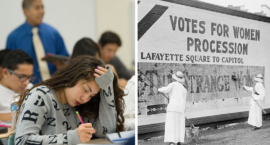
Washington, Jefferson, Hamilton, Lincoln, Roosevelt, King, Kennedy and Reagan each played critical roles in the history of our country and remain household names. Yet what of Murray, Chisholm, Eastman, Stone and Stanton? These women contributed greatly to the success of America, yet remain largely unknown to most Americans, including high school students. 

We are advocating to change this. As AP history students and educators, we propose the creation of a standalone AP United States Women’s History course. The youth of America are entitled to these stories traditionally left untold: the history of 50 percent of our population, who are currently a mere sidebar of token inclusion within a generic textbook on men’s history.

Remembering My Mother: Susan Catania, Champion of the ERA

Late last year, my mother Susan Catania—former Illinois state legislator, a relentless advocate for the ERA and a fearless champion of critical but politically unpopular causes—died.

Beholden to no one and with nothing to lose, she was known for her willingness to take unpopular stances. She introduced gay rights legislation, championed gun control and was the first Illinois legislator to sponsor the Freedom of Information Act. She passed income tax reform, a compensation plan for crime victims and legislation that led Illinois to become the first state to designate a state holiday honoring Martin Luther King, Jr. More than 50 of her bills became law. But the fight that defined her career was the Equal Rights Amendment; she even became the ERA’s primary sponsor in Illinois.

‘100 Years, Not One More’: ERA Advocates Rally on Centennial Anniversary

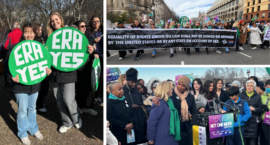
Chants of “not one more year” filled downtown D.C. as equal rights activists marched from the White House to the Capitol on Dec. 13—the 100-year anniversary of the ERA’s introduction in the House of Representatives. Activists, led by the ERA Coalition, demanded that not one more year pass without rights being protected by the Constitution on the basis of sex.

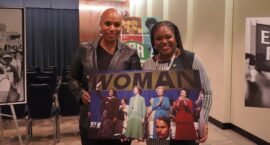
Reps. Cori Bush and Ayanna Pressley Lead Fight for ERA—100 Years After Its Introduction

ERA advocates in the U.S. have waged a 100-year fight just to get gender equality enshrined in the Constitution.

“The women of this country are exhausted, so we are leveraging every tool available,” said Rep. Ayanna Pressley (D-Mass.), co-chair of the ERA Caucus.

“We won’t stop until the ERA is officially part of the Constitution,” said fellow co-chair Rep. Cori Bush (D-Mo.). “We owe it to our daughters, to the next generation, to those who fought before us.”

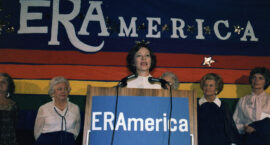
Rest in Power: Rosalynn Carter—Feminist, First Lady, and ERA and Mental Health Advocate

In the many tributes written since Rosalynn Carter’s death on Nov. 19, one word often is used to describe her: trailblazer. Indeed, Rosalynn Carter was like no other first lady. She testified before Congress on mental health issues; made policy proposals on caregiving and established the Rosalynn Carter Institute for Caregivers in 1987; worked to advance women’s rights; and helped in the ratification of the Equal Rights Amendment.

Carter’s own words are the most powerful about her belief and commitment to equality. “Although there has been progress, women still struggle to take their full, rightful places in politics, the media, business and athletics. … I would like for people to think that I took advantage of the opportunities I had and did the best I could.”

The Woman Behind SNAP: Leonor Sullivan’s Legacy Continues

The Supplemental Nutrition Assistance Program (SNAP), formerly known as food stamps, is the nation’s most important food assistance programs for low-income Americans, and one of its most important anti-poverty measures.

Former Representative Leonor Sullivan (D-Mo.) was one of only 11 women in the House in 1953, and came to Congress determined to help her constituents. Sullivan’s legislative strategy, aided by growing urban, Democratic power in the House, eventually led Congress to approve food stamp “pilot projects,” which ultimately laid the groundwork for SNAP.

United Nations Condemns U.S. Failure to Address Discrimination Against Women, Directs U.S. to Ratify ERA and CEDAW

The United Nations Human Rights Committee directed the U.S. to address rampant discrimination against women in American law and society, including epidemic rates of violence against women and girls as well as violations of their sexual and reproductive rights.

The committee specifically directed the U.S. government to recognize the fully ratified Equal Rights Amendment.

2023 Election Results: Abortion Wins Big

When analyzing Tuesday’s election results, one point becomes glaringly apparent: Abortion. Wins.

Abortion won (big) in Ohio. Abortion won in Virginia, where Democratic lawmakers pledged to voters to keep Gov. Glenn Youngkin’s anti-abortion and anti-education policies at bay—and voters delivered. Abortion helped keep Kentucky Gov. Andy Beshear (D) in office, who has made his pro-abortion-rights position clear. 

Ms. breaks down the results from the elections we were watching—plus a few other notable ones.

Action Is the Antidote to Despair

As Joan Baez, one of my favorite songwriters/performers/activists from my political ‘coming of age’ era, once said, “Action is the antidote to despair.”

Tuesday, Nov. 7, is Election Day in the United States, and voting is one action we can all take as U.S. citizens—and a privilege for every person living in a democratic country—to fend off the despair so easily experienced given the wars, the violence, and the rollback on rights in so many places today.

No Off Years: What’s at Stake in This Week’s Elections

Tuesday, Nov. 7, is the last day for voters in several states to head to the polls to vote in a number of off-year elections. While they may be lower-profile, some of these races are still deeply consequential.

We’ll be watching: Ohio’s pro-abortion ballot measure; Virginia’s state legislature; the Pennsylvania supreme court race; and the Kentucky and Mississippi governors’ races.