
Tierra Walker. Cecile Richards. Patty Berne. Melissa Hortman. Jane Goodall.
As 2025 comes to a close, we look back on the feminists and movement builders we’ve lost this year.


More Than A Magazine, A Movement

Minnesota state legislator and House Speaker Melissa Hortman was a fierce advocate for working families, abortion rights, climate action and gun safety. Her assassination in June 2025, in what officials describe as a politically motivated attack, underscores the rising tide of violence targeting women in power and those who defend reproductive freedom. This archive honors Hortman’s legacy and documents the broader feminist fight against extremism, political violence and the rollback of essential rights.
Tierra Walker. Cecile Richards. Patty Berne. Melissa Hortman. Jane Goodall.
As 2025 comes to a close, we look back on the feminists and movement builders we’ve lost this year.

In Part 2 of the Q&A between Jackson Katz and Cynthia Miller-Idriss, the author of Man Up discusses the link of misogynists and mass shooters: “The fact that so many domestically violent extremist attacks have both gendered and racialized dimensions shows that racism and misogyny are inseparable in the minds of many perpetrators.”
Miller-Idriss explains the key role online gaming and chat spaces play within the radicalization of young men and boys.
Misogyny is no doubt threaded through nearly ever mass shooting, and feminists are used as a scapegoat for taking away men’s opportunities.

Cynthia Miller-Idriss, director of the Polarization and Extremism Research & Innovation Lab (PERIL) at American University, makes the connection between gender policing, misogyny and far-right extremist violence, which for many years was not a connection scholars were willing to make.
Jackson Katz and Miller-Idriss discuss her book, Man Up, on misogyny, gendered violence, the MAGA movement and far-right extremism. Miller-Idriss says political violence coming from the far-right includes gender policing and exploitation.
“These aren’t just opportunistic elements of extremism—they are deliberate, organized and large-scale forms of gendered violence aimed at increasing pain and humiliation of victims, witnesses and family members. … I’m still blown away by how few people will acknowledge the connection.”

In every issue of Ms., we track research on our progress in the fight for equality, catalogue can’t-miss quotes from feminist voices and keep tabs on the feminist movement’s many milestones. We’re Keeping Score online, too—in this biweekly roundup.
This week:
—Doctors push back against Trump’s dangerous claims that Tylenol in pregnancy increases the risk of autism.
—The U.S. entered a government shutdown, affecting millions of federal workers.
—Sean “Diddy” Combs was sentenced to four years in prison.
—Zoologist and anthropologist Jane Goodall died at age 91.
—University of California students and faculty are suing the Trump administration for violating free speech rights.
—Student activists are stepping up to get around birth control bans on campus.
—Louisiana admits non-citizens voting is not a systemic problem.
—The ACLU and religious freedom organizations are suing to block 14 more Texas school districts from implementing a law requiring classrooms to display Ten Commandments posters.
… and more.
MAGA Republicans are back in the White House, and Project 2025 is their guide—the right-wing plan to turn back the clock on women’s rights, remove abortion access, and force women into roles as wives and mothers in the “ideal, natural family structure.” We know an empowered female electorate is essential to democracy. That’s why day after day, we stay vigilant in our goals to dismantle patriarchy at every turn. We are watching, and we refuse to go back. This is the War on Women Report.
Since our last report:
—A judge in Missouri is currently deciding whether a proposed amendment that would ban abortion in the state’s constitution can appear on the 2026 ballot … even though Missourians voted just last fall to keep abortion legal in the state.
—The Trump administration announced in August that it would remove gender-affirming care from the health services offered to federal workers.
—Mississippi declared a public health emergency as the state’s infant mortality rate soars to a rate nearly double the national average.
… and more.

When Minnesota police arrested 57-year-old Vance Boelter after a two-day manhunt, they uncovered notebooks filled with names and addresses of elected officials and abortion providers. The suspect, who authorities say stockpiled 48 firearms, had already gunned down two people and left others gravely wounded. His writings and sermons hint at extremist religious currents, including ties to the New Apostolic Reformation.
“Their vision is violent at the outset,” says Frederick Clarkson, a longtime researcher of Christian extremism.
Advocates warn that rhetoric casting abortion as a holy war is not fringe—it is increasingly mainstream within the movement, fueling both deadly plots and everyday harassment of patients and providers.

Her friend Melissa Hortman, a longtime Minnesota lawmaker, was murdered at home in June—shot by a man posing as a police officer who had also wounded two others and left behind a hit list of dozens of abortion-rights supporters. Among the names was Ruth Richardson, CEO of Planned Parenthood North Central States. “It was one thing to get a threat; it’s another to have confirmed threats where you have a friend and colleague who is assassinated,” she told Ms.
This tragedy unfolded against a backdrop of federal retreat: Trump pardoned extremists convicted of clinic blockades and violence, and his Justice Department declared it would largely stop enforcing the FACE Act, the law meant to protect providers. Advocates warn these decisions have emboldened extremists, leaving abortion providers more vulnerable than at any time in decades.

Weeks of shocking political violence has made one thing painfully clear: Whose suffering is taken seriously is deeply political. From the assassination of Charlie Kirk, to attacks on Democratic elected officials like Minnesota’s Melissa Hortman and her husband, the public and media response reveals a stark double standard.
While some deaths are weaponized to fuel extremism, others—like domestic violence victims, immigrants and marginalized communities—are routinely ignored.
This selective attention reflects the gendered and ideological framing of violence in the U.S. Today, more than ever, it’s crucial to recognize how political rhetoric and societal blind spots shape which acts of violence are acknowledged—and which are dismissed, leaving vulnerable populations at heightened risk.

The work of advocating for abortion rights has always been dangerous. But under the second Trump administration, which has enabled antiabortion lawmakers and vigilantes through policies and rhetoric, that danger has escalated dramatically, as state Rep. Melissa Hortman’s murder proves.
In our Fall issue, we delve into the motivations behind the shootings, and talk to the people who are trying to prevent further violence.
Here’s what else you’ll find in the Fall issue:
—a deep dive into how the Trump administration’s immigration policies are impacting families across the country—and advocates’ visions for a more just future.
—a visit to Syria’s “village of women,” which offers Kurdish women a refuge—one they’ll fight to protect.
—investigating how the Medicaid and SNAP cuts in the Republican budget bill will impact women and children.
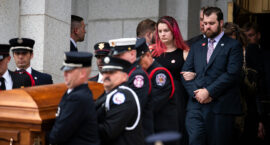
Minnesota experienced an act of devastating political violence last month: Former Minnesota House Speaker Melissa Hortman and her husband, Mark Hortman, were killed in their home. State Sen. John Hoffman and his wife Yvette are recovering from life-saving surgeries after shielding their adult daughter from the gunman.
In recent years, we’ve seen attacks escalate against elected officials across the political spectrum. However, we must recognize that Hortman, Hoffman and the other targets on the gunman’s list are uniquely vulnerable because of the way that we treat abortion: We isolate abortion from mainstream care, in law and practice; and we exclude it from insurance coverage, hospital systems and routine medical training.
By treating abortion as unsafe and morally suspect, rather than as legitimate medicine, we further normalize hostility towards it, its providers, and the policymakers who uphold access to it.