‘Mama’s in the Hole’: How Solitary Confinement Tries to Break Family Bonds

In this powerful mother-daughter exchange, Summer Knight and Kwaneta Harris reveal how nearly a decade of forced silence through solitary confinement shattered their bond—and how they’re fighting to rebuild it, piece by piece.

“Everything I did in my daily life, I’d wonder how Mama was doing the same thing in that hole. Was she cold? Could she see the sky?”

“How do you compress motherhood into five minutes at midnight? How do you explain to a child why you’re not calling on her birthday, her graduation, after her father died? … Without communication, we became strangers. She grew up with a ghost for a mother, and I mothered a memory.”

Motherhood’s Dirty Secret? Sometimes It Feels Like Hate.

Mothering is traditionally expressed in terms of extremes: The mother is imagined as either all giving, tender and devoted … or its opposite: mean, selfish and self-serving.

Social media generally mirrors this trend and divides mothering between something that is achievable in all its wonder and selflessness, or an experience that is continually dismal.

It is both.

No Room to Pump, No Room for Error: One Mother’s Fight to Feed Her Baby at Work

Could a system that was more responsive to parents’ needs improve their relationships, their children’s lives, even their sense of self? I began to report on that question and my book, Four Mothers: An Intimate Journey Through the First Year of Parenthood in Four Countries, is the result. It follows four women—from the U.S., Japan, Kenya and Finland, who all had babies around New Year 2022—through their first year of motherhood, to draw an intimate portrait of their lives and compare the support they received.

Read an excerpt from the book about one new mother’s experience in Kenya, where laws promise breastfeeding protections but workplaces often ignore them.

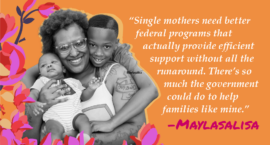
‘I Just Want My Babies to Be at Peace’: A Mississippi Single Mom on Surviving the System

Front & Center began as first-person accounts of Black mothers in Jackson, Miss., receiving a guaranteed income. Now in its fourth year, the series is expanding to explore broader systemic issues affecting Black women in poverty, including the safety net, healthcare, caregiving and overall well-being.

Maylasalisa has a newborn and is juggling school and caretaking while also trying to find work. She is the recipient of one year of guaranteed income from the Magnolia Mother’s Trust.

“Balancing work and motherhood isn’t easy, especially with a newborn. Right now, I have no choice but to stay home … If I could speak directly to the governor or the president, I’d ask for more help for single mothers—better programs that actually provide efficient support without all the runaround. There needs to be real opportunities for people to get and keep jobs, better transportation and more accessible resources. They have the money to do these things, they just don’t want to.”

Critical Programs for Women and Families Face Deep Cuts in House Budget Bill

A sweeping budget bill moving quickly through the House threatens to make draconian cuts to Medicaid and SNAP—two of the nation’s most vital programs for women and children.

The bill is being framed as “all or nothing” legislation by Republican leadership—a vehicle designed to pass the entire Trump agenda without needing Democratic votes. And the changes are being presented as necessary for fiscal responsibility—but here is what they won’t say out loud.

Why Motherhood Is Harder in Some Countries Than Others: The Ms. Q&A With Abigail Leonard, Author of ‘Four Mothers’

“Parenthood is shaped by the broad systems our societies have built over time,” writes award-winning journalist and mother Abigail Leonard in Four Mothers: An Intimate Journey Through the First Year of Parenthood in Four Countries. “Many of the big decisions, like how much time to spend with their children and how to divide the emotional and physical labor with their partner, are heavily determined by the social structures of the place women give birth.” 

The ways this works to reinforce or expand ideas about gender, family, reproduction and out-of-home work are at the core of Leonard’s deeply reported interrogation of the social, emotional and physical toll of parenthood in Finland, Japan, Kenya and the United States.

‘Bluey’ Is a Feminist Parenting Tool (Missteps and All)

Bluey has been praised for challenging restrictive gender norms and modeling equitable relationships and, in a quite different take, for upholding “traditional” values by promoting respect for parents and marriage. Critics have also questioned whether the show is anti-feminist by pointing to misogynistic storylines and limited diversity. 

For me, Bluey is a tool. The seven-minute episodes often prompt conversation, offer a thoughtful guide for answering complex questions, and inspire creative and engaging play. The show has real value in our house. 

War on Women Report: Trump Slashes Sexual Violence Prevention; GOP Targets Teens’ Repro Rights; Nebraska Abortion Funeral Bill Threatens Miscarriage Care

MAGA Republicans are back in the White House, and Project 2025 is their guide—the right-wing plan to turn back the clock on women’s rights, remove abortion access, and force women into roles as wives and mothers in the “ideal, natural family structure.” We know an empowered female electorate is essential to democracy. That’s why day after day, we stay vigilant in our goals to dismantle patriarchy at every turn. We are watching, and we refuse to go back. This is the War on Women Report.

Since our last report:
—Republicans in Indiana have gotten rid of a requirement for schools to teach about consent in sex education classes.
—Some good news out of Georgia: Prosecutors have dropped all charges against 24-year-old Selena Chandler-Scott after the national backlash that came when they arrested her after her miscarriage.
—On Saturday, April 5, over 1,200 demonstrations took place nationwide to protest the recent policies and actions of Donald Trump and Elon Musk.
—Legislators in Nebraska are advancing a bill that would require abortion providers to bury or cremate fetal remains and embryonic tissue after an abortion, leaning into fetal personhood arguments.

… and more.