Gloria Steinem Lit a Revolution. The Torch Is Ours Now.

This week, Gloria Steinem died at the age of 92, peacefully at her home in New York City and surrounded by people who loved her.

We will miss her at Ms. I will miss her personally.

There were parts of Gloria’s childhood that mirrored my own. For a period of time, Gloria did not attend school because she was tending to her mother. She later said that she chose not to have children because she had already had a mother to take care of.

We do not talk enough about stories like that: the sensitivity that came from her own childhood. Pronatalism in the United States still insists that all women should want children, care for those children, stay home and find satisfaction within the narrow boundaries others have drawn for them. Even education has historically been framed not as a path toward women’s intellectual or economic freedom, but as a place to find a husband.

To want something more—and to care about something larger than the life prescribed for you—has always carried challenging consequences for women. Gloria understood that deeply. She also understood that the freedom to shape one’s life begins with the ability to govern one’s own body.

In 2017, standing before the Women’s March in Washington, D.C., Gloria called for “a deep democracy” in which people would refuse to be quiet or controlled. “We are at one with each other,” she said. “We are looking at each other, not up. No more asking Daddy.”

Those words carry a special weight today. Democracy has never been a gift delivered from above. Equality has never arrived because people in power suddenly found it convenient. Both are built by people who recognize one another, tell the truth about their lives and refuse to accept that injustice is inevitable.

Rest in Power, Dolly Parton: Feminist Country Icon, Advocate for Women and Children, Philanthropist and Gifted Songwriter

Dolly Parton understood the power of being underestimated. Beneath the rhinestones, towering blond hair and self-deprecating jokes was a gifted songwriter, a shrewd businesswoman and a philanthropist whose work transformed the lives of millions of children and families.

Parton left behind a body of work that stretches far beyond the songs and films that made her one of the most beloved performers in American life. She sang about the dignity of working women. She placed hundreds of millions of books in the hands of children. She supported healthcare, disaster relief and lifesaving medical research. And she repeatedly used her enormous cultural influence to affirm the humanity of people who were too often marginalized, including Black and LGBTQ+ Americans.

Parton’s concern for women and children was expressed not only through her art, but in what she did with the wealth and influence her art created. We heard her legacy in the songs that made working women feel seen. We saw it in the books delivered to children, the families supported after disaster and the medical research that saved lives.

May Dolly Parton rest in power. May her legacy live on in every child who discovers a new world inside a book, every woman who demands dignity in the workplace and every person who chooses compassion when indifference would be easier.

What Will the Supreme Court’s Most Consequential Decisions Mean for Democracy? On July 1, Georgetown Law’s ‘2026 Term in Review’ Tackles the Question

On Wednesday, July 1, Georgetown Law and the O’Neill Institute for National and Global Health Law will host the 2026 Supreme Court Term in Review, a timely discussion examining one of the most consequential Supreme Court terms in recent memory.

As the United States marks its 250th anniversary, participants will consider how the Court’s decisions are reshaping the balance of power among the branches of government and testing the resilience of American democracy.

Held at Georgetown University’s Capitol Campus, the event will bring together leading legal scholars, journalists and advocates to analyze the Court’s major decisions and their implications for democracy, civil rights and the rule of law.

Moderated by Georgetown Law professor Michele Bratcher Goodwin—co-faculty director of the O’Neill Institute, executive producer of Ms. Studios and host of the Ms. podcast On the Issues—the program will explore cases involving birthright citizenship, voting rights, reproductive healthcare access, LGBTQ+ rights, criminal justice, free speech, tariffs and the limits of executive authority.

To the Men Who Send Women Hate Mail

I am not alone in receiving unsolicited emails—especially as a professor, public writer and thinker, and woman who dares to speak her mind. Often, the emails are thoughtful, engaging and sometimes deeply moving expressions of gratitude that warm the heart. However, from time to time, there are the crude, crass and obtuse intruders, thrusting insults and even threats into our inboxes. These expressions of masculine fragility and anger—whether intended to or not—chill the receiver’s speech and cause women to silence themselves.  

Here, then, is my response to Mr. Sawyer—but also, in many ways, a response to the countless men who insert themselves into women’s inboxes with condescension, hostility and misplaced certainty. Women in public life know these messages well: the unsolicited lectures, the attempts at intimidation, the casual cruelty masquerading as critique. Consider this every woman’s letter to the crass and crude male intruder in her inbox. I hope you enjoy.

‘I Needed to Know I Was Not the Only One’: Talking Honestly About Pregnancy Loss and Reproductive Grief

Award-winning cartoonist Chari Pere and award-winning author and psychologist Dr. Jessica Zucker are on a mission to normalize talking about the complexities of reproductive grief in order to help people feel less alone.

Reproductive grief encompasses the range of emotional, psychological and even physical responses that can follow experiences like miscarriage, stillbirth, infertility, termination for medical reasons or other disruptions in a person’s reproductive journey. It is a kind of loss that is often invisible to others but deeply felt—an ache shaped not only by what happened, but by what could have been. Despite how common it is, reproductive grief remains largely unspoken, shrouded in silence and shame.

Sneak Peek: What’s in the Winter Issue of Ms.? Groundbreaking Reporting on Women’s Health and Power

Mifepristone has shown potential to treat a striking range of diseases and conditions, some life-threatening: fibroids, breast cancer, depression, endometriosis, Gulf War illness and maybe even other autoimmune diseases, such as chronic fatigue syndrome and multiple sclerosis. Research also suggests that mifepristone may help prevent some forms of breast cancer and can serve as an effective weekly contraceptive without the side effects of hormonal birth control.

Yet despite the drug’s promise, its development has been repeatedly stymied by abortion opponents who fear wider availability would weaken their attempts to suppress abortion access. 

The result? Women are left in needless pain and subject to invasive and unnecessary surgical procedures like hysterectomies.

How E. Jean Carroll Fought Trump in Court—And Won

At least 27 women have accused President Donald Trump of sexual misconduct, with allegations ranging from harassment to sexual assault and rape. Trump has denied every charge, often dismissing the accusing women by claiming he’d never met them—or suggesting they weren’t attractive enough for him to assault.

In 2019, during Trump’s first term, author, journalist and longtime Elle magazine advice columnist E. Jean Carroll came forward with the allegation that Trump sexually assaulted her in a Bergdorf department store’s dressing room in New York City in the mid 1990s. As usual, Trump denied the allegations, prompting Carroll to sue him for defamation as well as battery under New York’s Adult Survivors Act.

But the jury believed Carroll. In 2023, she won the lawsuit.

Trump’s Support Erodes as Women, Workers and Even Republicans Push Back

It seems like with each week, Trump just keeps getting more and more unpopular—even among those who are most primed to like him. Trump’s approval rating is currently the lowest it’s been this term, seeing a significant decline among Independents and even some decline among Republicans.

And the “Big Beautiful Bill” has played no small role: Polling shows that majorities of voters continue to disapprove of the Republican economic plan. Seventy percent are concerned about cuts to Medicaid (which, by the way, remains overwhelmingly popular in the polls), regardless of when those cuts go into effect—indicating that the Republican strategy of delaying the cuts’ implementation till after the midterm elections might not be working.

Regardless of how dark things feel, there are countless feminist battles in our past, both near and far, that we can draw hope and strength from.

What’s Up With Men?

What the hell is up with men these days? It’s clearer than ever that (mostly white) men are hurting—but why is this happening, and what can be done to change things?

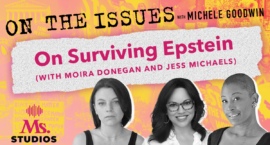
We go in search of the answers to these questions on the latest episode of On the Issues, where host Michele Goodwin is joined by Jackson Katz, Gary Barker and Cody Thompson to talk about the issues facing men—and how we can address them, in order to get our democracy back on track.

If you want to go even deeper, Katz also guest-edited a special “Report on Men” for our Summer issue (which you can get right now as a standalone for just $5)—including pieces that delve into the rise of the “bro-casts,” the clinicians combating the “male loneliness epidemic,” JD Vance and the performance of masculinity, and so much more.

If you’ve been enjoying the recently-released documentary Dear Ms. on HBO, and want to go deeper into the history and legacy of Ms., you’re in luck! Our latest podcast Looking Back, Moving Forward explores through the lens of Ms. not only how we got to where we are now, but how our shared histories illuminate the path toward an intersectional feminist future