The Abolitionist Origins of American Feminism

From Mary Wollstonecraft to Sojourner Truth, the fight for women’s rights emerged alongside—and was fundamentally shaped by—the struggle to abolish slavery and secure universal human rights.

On the 250th anniversary of the founding of the republic, it is timely to trace the history of American feminism, whose roots lie in the revolutionary era and are inextricably bound with the movement to abolish slavery. 

(This essay is part of the FEMINIST 250: Founding Feminists series, marking the 250th anniversary of America by reclaiming the revolution through the women and gender-expansive people whose ideas, labor and resistance shaped U.S. democracy.)

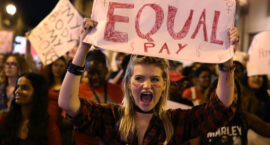
Equal Pay Is Getting Pushed Further Away. We’re Pushing Back.

Amid the celebrations of Women’s History Month, it is a bitter irony Equal Pay Day—marking how far into the year women must work to earn what men did in the previous year—has been pushed back to March 26. The end of the month is shadowed by the knowledge that the gender pay gap still exists and is widening.

Black women, women with disabilities, moms and all women of color are paid significantly less than white men in comparable positions. Affordability is already a concern, with prices rising at the gas station and the grocery store. The pay gap is compounding these concerns to create further financial disparities for women of color.

The Heritage Foundation’s New Policy Guidebook Wants to Push Women Out of Public Life

In honor of the 250th anniversary of the signing of the Declaration of Independence, the right-wing Heritage Foundation—developers of Project 2025, the policy guidebook written to influence the Trump administration’s legislative priorities—has issued a 168-page position paper, “Saving America by Saving the Family: A Foundation for the Next 250 Years.”

The document is intended to “restore the family,” by elevating a male-led, heterosexual model of social relations. 

The report is both absurd and terrifying—which is why the National Women’s Law Center (NWLC) is sounding an alarm about it. Emily Martin, the NWLC’s chief program officer and Amy Matsui, its vice president of childcare and income security, spoke to Ms. reporter Eleanor J. Bader about “Saving America by Saving the Family” in late February.

‘This Is Our Country Too!’: The Enduring Legacy of Spanish-Speaking Women in Early America

Centuries before the American Revolution, Spanish-speaking women crossed oceans and deserts to build communities whose legacies still shape the United States.

As anti-Latino sentiment coincides with the 250th anniversary of the United States, we must remember that long before the American Revolution, Spanish-speaking women inhabited territory that would become the United States. 

Like their English Protestant counterparts in New England, Spanish-speaking women were founding mothers of our nation. Their legacies live on through their descendants and the many other Latinas who immigrated to the U.S. over the past 250 years. Faced with the widespread detention of Spanish-speaking women, it is crucial to remember that it has long been their country too.  

(This essay is part of the FEMINIST 250: Founding Feminists series, marking the 250th anniversary of America by reclaiming the revolution through the women and gender-expansive people whose ideas, labor and resistance shaped U.S. democracy.)

America’s Founding Feminists: Rewriting America’s Origin Story

Two hundred and fifty years ago, a small group of men declared that “all men are created equal,” casting a vision of liberty that has shaped the American imagination ever since.

Yet even as they debated freedom in Philadelphia, women were writing, organizing, governing, resisting and insisting on their place within the nation taking form. Some, like Mary Katherine Goddard, literally set their names in print; others, like Phillis Wheatley, wrote themselves into intellectual existence against a backdrop of enslavement and doubt. Still others left their mark through acts of refusal and flight, choosing freedom when the republic would not grant it.

A new series, Founding Feminists—launching at the start of Women’s History Month—unfolds over two months, twice a week. On this semiquincentennial of the United States, Ms. turns to these “founding feminists” not as anachronistic heroines, but as architects of an unfinished democratic project. There is no nation without women at its core—no democracy without their labor, intellect, resistance and imagination.

From Haudenosaunee matrilineal governance, to Black women’s freedom-seeking acts, from revolutionary manifestos to quiet domestic rebellions, our Founding Feminists series reexamines the past to illuminate our present moment of backlash and possibility.

If the Declaration of Independence set forth a promise of equality, it was women—across race, class, sexuality and nationality—who pressed the nation to live up to it.

Two hundred and fifty years later, their questions remain ours: What does freedom truly mean, and who gets to claim it?


Texas A&M’s Women’s and Gender Studies Closure Signals a Wider Crackdown on Academic Freedom

Texas A&M University’s decision to eliminate its women’s and gender studies program is not happening in a vacuum. For years, the university has steadily rolled back programs, courses and resources tied to gender and LGBTQ+ studies, leaving students and faculty with fewer spaces to learn, teach and engage with these subjects.

Now, with the program gone and new classroom restrictions in place, the impact is being felt directly by the people who rely on these courses to study, teach and understand the world around them.

For many students and educators, this moment feels like part of a much larger shift unfolding across the country. As universities scale back programs and limit discussions around race, gender and sexuality, what can be taught—and who feels supported in the classroom—is rapidly changing. The closure at Texas A&M reflects a growing national pattern: one that raises urgent questions about the future of academic freedom in public higher education.

How Anti-ICE Organizing in Minnesota Reactivated Mutual Aid Networks Started After George Floyd’s Murder

The residents of the  metropolitan area known as the Twin Cities—Minneapolis and Saint Paul—quickly came together to try to prevent their neighbors being caught up in ICE raids.  As well as monitoring ICE activities, block by block, people organized mutual aid for neighbors fearful of going out in case of immigration raids.

Daniel Cueto-Villalobos, a doctoral candidate at the University of Minnesota, who lives in southern Minneapolis and studies race, religion and social movements, tracks the neighborhood groups that have sprung into action in response to the ICE presence, back to mutual networks set up during the 2020 COVID pandemic, and in the wake of the murder of George Floyd by a Minneapolis police officer.

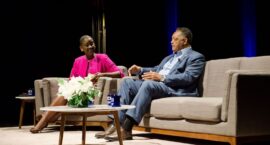
He Called Me ‘Doc.’ I Called Him ‘Rev.’ Remembering Jesse Jackson’s Moral Leadership

I knew Rev. Jackson beyond the conventions. He married me and my husband, Gregory Shaffer, almost 25 years ago. He always showed up and gave graciously of himself when I called—whether it was to host a convening on HIV/AIDS at Rainbow PUSH in the early 2000s, or to bring together hundreds of working-class residents from the South Side of Chicago to engage on matters of national healthcare, or to meet with (mostly women) academics coming together to figure out the intersections of law, family and reproductive rights at the University of Chicago Club 20 years ago. 

He called me “Doc” or “Doctor Michele.” I called him “Rev.”

A week ago, by his father’s bedside, Rep. Jonathan Jackson (D-Ill.) and I spoke by phone. He had just delivered a speech at the National Prayer Breakfast calling the president to account—to be more humane and just, and to “do what is right.” It was clear that Rev. Jackson’s legacy is already living on.

Who’s American? Whose America? Bad Bunny’s Radical Halftime Message

Thirteen minutes is how long it lasted, and global superstar Bad Bunny—full name Benito Antonio Martínez Ocasio—more than delivered. Set against pulsating Afro-Latin rhythms and brimming with the energetic dancing bodies of Black, Brown and other multicolored peoples, the 2026 Super Bowl halftime show transformed this historic moment of the first all-Spanish musical spectacle into a cultural reset. Now counted among the most watched halftime performances—with close to 130 million views—the Super Bowl was rightfully renamed the “Benito Bowl.”

Bad Bunny’s performance came just one week after he made history as the first artist recording exclusively in Spanish to win the Grammy’s top honor for Album of the Year. It arrived, too, amid escalating violence tied to ICE enforcement and the policing and deportation of Brown and Black communities. At a moment when the U.S. president is railing against diversity, equity and inclusion—and circulating virulently racist content targeting his predecessor and the nation’s first Black president and first lady during Black History Month—the cultural resonance of this halftime show feels all the more potent.

Bad Bunny’s dynamic performance is an affirmation of the same communities currently terrorized by state-sanctioned violence. At rallies and marches, people play Bad Bunny. In moments of grief and passion, people play Bad Bunny. His refusal to be silenced, to be forgotten, is an inspiration of hope and resilience for social movements. His music is music of the revolution, which was spectacularly televised in the middle of a widely watched football game.