As the U.S. reels from ICE violence and Donald Trump circulates racist imagery of the Obamas, Bad Bunny’s all-Spanish Super Bowl halftime show becomes a defiant reimagining of who gets to claim America.

Thirteen minutes is how long it lasted, and global superstar Bad Bunny—full name Benito Antonio Martínez Ocasio—more than delivered. Set against pulsating Afro-Latin rhythms and brimming with the energetic dancing bodies of Black, Brown and other multicolored peoples, the 2026 Super Bowl halftime show transformed this historic moment of the first all-Spanish musical spectacle into a cultural reset. Now counted among the most watched halftime performances—with close to 130 million views—the Super Bowl was rightfully renamed the “Benito Bowl.”
Bad Bunny’s performance came just one week after he made history as the first artist recording exclusively in Spanish to win the Grammy’s top honor for Album of the Year. It arrived, too, amid escalating violence tied to ICE enforcement and the policing and deportation of Brown and Black communities. At a moment when the U.S. president is railing against diversity, equity and inclusion—and circulating virulently racist content targeting his predecessor and the nation’s first Black president and first lady during Black History Month—the cultural resonance of this halftime show feels all the more potent.

Indeed, when the same conservative forces in this country bewail the so-called absurdity of the mere suggestion (and rumor) that the dark-skinned Kenyan-Mexican actor Lupita Nyong’o—known for her beauty, elegance and talent—would play the mythical role of Helen of Troy (“most beautiful woman in the world”) in Christopher Nolan’s forthcoming movie adaptation of The Odyssey, Bad Bunny’s choice to highlight the rich melanin of Afro-Latinas becomes that much more subversive.
Not surprisingly, their gyrating bodies—taking up more space than is ever allowed for national televised spectacles in these United States—have already prompted some pearl-clutching debates over “decency.”
Through the veneer of joy, community and the bold statement that ‘more powerful than hate is love,’ Bad Bunny struck a severe blow against the anti-diversity crowd.
Such sexy bodies coexisting alongside elderly men playing dominos or the entire community of mamis, children and couples salsa-dancing at a real-live wedding reception, or vibing outside neighborhood bodegas, heighten the very real threat of certain demographic explosions brushing up against white supremacist fears of demographic decline.
Through the veneer of joy, community and the bold statement that “more powerful than hate is love,” Bad Bunny struck a severe blow against the anti-diversity crowd. He brought all these bodies, and the history of the lands they inhabit, to life; he set the stage in a sugar cane plantation, serving as a living offering, or ofrenda, to the labor of Puerto Ricans and Afro recuperation of their legacies of cultural resistance. That the cane fields gave way to an island casita and a New York City block both expands and condenses these spaces of diaspora.
Previously, Bad Bunny refused to tour his album, DeBí TiRAR MáS FOToS, in the United States, for fear his concerts would be targeted by ICE and as a stand against xenophobia. But his decision to perform at the Super Bowl provided him the opportunity to sing about settler colonialism to an audience he would not have otherwise reached outside his own fanbase. Bad Bunny’s halftime performance was a statement of cultural pride which those across the nation were forced to watch, whether they believe in the multiculturalism of the United States or not.
Bad Bunny, being proudly from Puerto Rico, has stirred much discourse about whether this year’s NFL performance pick should have embodied the dominant idea of “American,” although Puerto Rico is a United States territory.
The NFL, also known as “the great American game,” is often used as a parallel or symbol for conservative white audiences, but in the past two years it has undergone a shift—with Kendrick Lamar as last year’s performance pick and Bad Bunny’s recent performance, both decentering whiteness on a national stage.
Popularly, in patriotic U.S.-centered discourse, “America” typically encompasses the United States, positioning white Americans as the dominant face of representation while leaving Latin America, the Caribbean, and Black and Brown people out of the conversation.
Language as a Tool Against Xenophobia
Bad Bunny’s voice speaks for a people marginalized in this country. Phrases like, “This is America, speak English!” or the history of banning Native American tongues during settler colonialism demonstrate the continued legacies of racism and xenophobia in this country through the contemporary weaponization of language and censorship of critical race theory in education.
Bad Bunny’s delivery of his performance in Spanish at the Super Bowl, in Santa Clara, Calif., on Native Ohlone land, in the Bay Area, which is heavily populated by immigrants, was neither one of code switching nor of catering to an Anglo audience. The music itself being reggaeton, and dembow, in the genre Urban Latino, or perreo, is a direct manifestation of Black culture and expression. His platforming of it through the NFL is an inspiring reclamation of language, culture and resistance during a time of demonization of immigrants in the media.
This merits discussion of the generations of colonialism in the Caribbean, including United States imperialism, and how through one game, Bad Bunny’s artistic political statement disrupts this very agenda on United States soil.
Legacies of Caribbean Resistance Through Culture
Bad Bunny’s captivating show implores a politics of perreo. Through a zambo consciousness, a culture of struggle and turning the violence of racial mixing into a creation of cultural artifacts, the presentation of racial diversity and his display of passionate movement of Brown and Black people strategically shifts them from margin to center, subsequently rewriting the history of the Americas. Bad Bunny and his taking up space in moments of erasure serves as resistant Afro-Caribbean visual political storytelling.
Through women’s bodies, queer bodies and bodies of color, Bad Bunny decolonizes the U.S. cultural landscape to make space for the Caribbean periphery and those included in the margins to encompass a wider America.
For instance, his performance of “EoO” meaningfully positions perreo as defiance. His refusal to allow Black and Brown women to be pacified or seen as agreeable—who instead confront the televised camera with facial expressions of attitude and neck-rolling audacity—forces the viewing audience to take them seriously. On view is their battle face, waging a war against racism. And following, he showcases a performance of queerness and gender, displaying two men dancing provocatively with one another, challenging homophobia and patriarchy.
Through women’s bodies, queer bodies and bodies of color, Bad Bunny decolonizes the U.S. cultural landscape to make space for the Caribbean periphery and those included in the margins to encompass a wider America.
La Anacaona
Due to the colonial legacy of white supremacy in the Americas, Blackness has historically been erased from the construction of Latinidad. However, Bad Bunny’s inclusion of Afro dances and music such as bomba, salsa, dembow and reggaeton stakes claim to Latinidad’s Afro roots. The coalescence of transnational urban music has been a powerful movement of oral histories of Blackness and their migrations. Through reggaeton and dembow—serving as texts of defiance—Bad Bunny calls upon the ancestors, much like the orishas of Santeria and Lucumi, who are often summoned through the power of music.
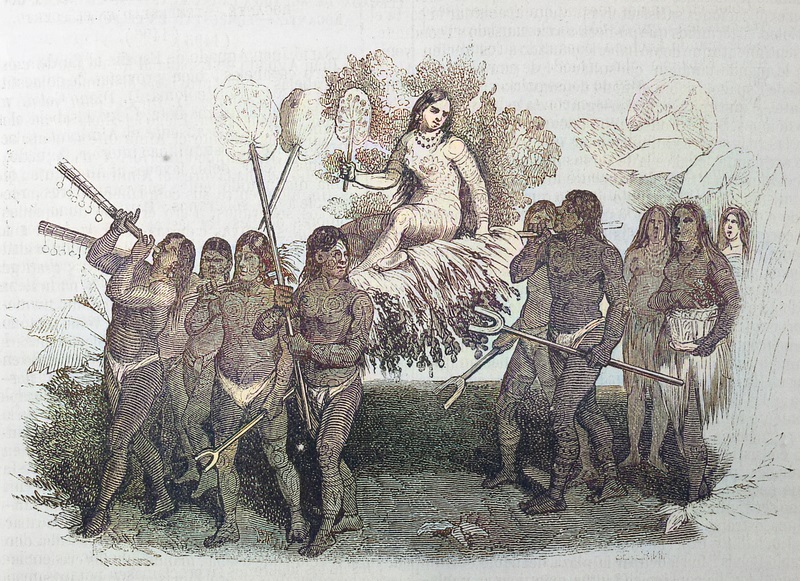
One such ancestor may be Anacaona, the first documented Afro Indigenous Taíno woman leader in the Caribbean during Spanish contact. She was a poet, a storyteller, a keeper of culture on the island of Hispaniola (present day Dominican Republic and Haiti) and a warrior woman who fought for the existence of Taíno people. She was also a translator and mediator between her people and the Spanish conquistadors in defense of her community.
Bad Bunny’s political statement invokes her spirit on stage.
Anacaona was one of the first documented figures of Indigenous women in the Caribbean in positions of power before and during colonization. Anacaona was known as a “caica” or governor and a “sanba” or guardian, preserver of song. The first written account of her existence appears in 1526 in the book Historia general y natural de las Indias written by Gonzalo Fernández de Oviedo. Anacaona’s Indigenous leadership, in combination with an African diasporic sensibility, weaves together a unified relationship between Afroindigenous and Afrolatina with music as a political tool.
Anacaona’s legacy demands us to honor Bad Bunny’s carrying of the torch and his creation of new ways to view, listen to, and understand the voices and aesthetics of the African Diaspora and Latino Diaspora in the Caribbean. His refusal to translate his messages in English is opposition to systemic racism. He refuses the rewriting and misrepresentation of his Puerto Rican narrative.
Bad Bunny’s references to his Taíno ancestors and their influence in Puerto Rico during “El Apagón,” his incantation “el sol es Taíno” or the sun is Taíno, opens a portal to the ancestors. In continuation he sings “todos quieren ser Latinos” or everyone wants to be Latino, referencing the appropriation of the culture but the continued dehumanization of its people.
From Inner Child to Global Citizen
Benito gives his younger self a Grammy, which has also doubled in meaning and significance as many viewers interpreted this also as a reference to the young boy Liam Conejo Ramos who was kidnapped by ICE. The message is clear: Young Latino children deserve to dream big, to be nurtured, and to be represented in dominant media as important and influential.
Afterwards, Benito emerges from the sugar cane fields, highlighting the domination of labor and land that afflicts the Puerto Rican people while carrying the Puerto Rican flag, but not just any flag: the original flag of Puerto Rico before it was banned in 1948 through the Gag Law (La Ley de la Mordaza) and changed by the United States to a darker blue to mimic the colors of the United States flag.
Here, Bad Bunny represents a call for sovereignty for Puerto Rico after implementing his song, “LO QUE PASÓ A HAWAii”—sung by Ricky Martin, the Puerto Rican Latin star from a previous generation achieving crossover English-speaking success. A callback to both the gentrification of music artists and the land itself, through the neo-colonialism and U.S imperialism in Hawaii, he follows up with “El Apagón” recalling Hurricane Maria, which led to months of power outages from lack of resources as a neglected U.S colony.
Bad Bunny mixes the Afro, Indigenous and Latino in his reggaeton to denounce colonial memories. The use of his voice, similar to how Anacaona used hers as a poet, uplifts and makes visible Afro ancestral voices while rewriting colonial narratives. Anacaona embodies this figure of Black Indigenous Caribbean independence, which is especially relevant in the context of Puerto Rico as a territory fighting for its representation under the United States.
Bad Bunny’s cultural reset is an affirmation of the same communities currently terrorized by state-sanctioned violence. At rallies and marches, people play Bad Bunny. In moments of grief and passion, people play Bad Bunny. His refusal to be silenced, to be forgotten, is an inspiration of hope and resilience for social movements. His music is music of the revolution, which was spectacularly televised in the middle of a widely watched football game.
Closing the show with the only uttered English phrase—“God Bless America”—while proceeding to name all the nations making up North, South and Central America, along with the Caribbean, Bad Bunny dared us to imagine a multiracial community beyond “U.S. exceptionalism” and towards “transnational togetherness.”
Across these multiple hemispheres, we truly and collectively are one America.