From the battlefields of World War II to the Super Bowl stage, The Six Triple Eight, Kendrick Lamar and Beyoncé expose the patriotic ironies of Black service, artistry and resistance in a nation that still struggles to honor its own ideals.

The Netflix film, The Six Triple Eight, directed by Tyler Perry, opens with a poignant quote by the great civil rights activist and educator, Mary McLeod Bethune (portrayed in the film by none other than Oprah Winfrey). The epigraph insists that Black Americans were part of the democratic project (and not “apart from it”)—as Bethune used her close connections with First Lady Eleanor Roosevelt (played by Susan Sarandon), to advance the titular all-Black, all-female battalion of the Women’s Army Corps, who took on the unprecedented task of delivering over 17 million letters from soldiers during World War II in the space of six months. They eventually completed the task in less than 90 days.
Given the current efforts of the present administration to remove thousands of workers from federal agencies—many of whom are African Americans—in efforts to push an “anti-DEI” agenda alongside establishment of “loyalty” positions and the re-segregation of the federal government, the significance of films like The Six Triple Eight—which debuted last December and documents the discipline, enthusiasm and patriotic fervor of Black servicewomen—could not be more urgent.
Fortunately, this Black History Month and the upcoming Women’s History Month provide ample opportunities for new screenings of this admirable and uplifting film.
The Netflix drama—featuring Kerry Washington in a strong performance as Major Charity Adams, leader of the Six Triple Eight battalion—captures the struggles and triumphs of these heroic women with an eager sentimentality. Certain scenes proved to be deeply moving: from their company march “in formation” through a bombed-out city on their arrival in Glasgow, Scotland, to the white male soldiers who saluted them as they headed back to a country that still treats them as second-class citizens.
We did not necessarily need the approval of these specific soldiers, as Major Charity Adams had already received glowing applause from her battalion when she valiantly stood up in defense of their bravery and efficiency against her commanding officer, who had threatened to unfairly dismantle their corps, based on so-called lack of performance. For the first time in this scene, we see Major Adams’ steely resolve melt away when she is moved to tears by their display of approval and appreciation.
The film took great pains to showcase how these women turned the dregs of a bombed-out church into a functional barrack with a meticulously organized system to complete their tasks (replete with a beauty parlor promoting the morale of the Black women keeping up their polished appearances). And despite their efforts, they were disregarded as incapable, as inefficient, as lacking—an aspect of Jim-Crow-era low expectations hurled onto Black people that echo eerily in present-day insults like the racially coded “DEI hire” pronouncements casually uttered across social and news media.
In the closing credits, the film featured actual footage of the real Six Triple Eight, including a more contemporary scene of the centenarian Lena Derriecott Bell King, who was filmed before she passed away in early 2024. While the depiction of Lena (played by Ebony Obsidian) in an interracial romance with a Jewish boy awkwardly served to connect the Black struggle with the Jewish one—both aligned to “fight Hitler”—it also brought home the significance of their postal mission: to boost the morale of those on the battlefields and beyond. Indeed, Lena receiving a blood-stained letter from her fallen friend—retrieved by one of her coworkers—was a heavy-handed attempt at highlighting this mission, but one that nonetheless hit the right sentimental notes.
More subtle was a scene depicting one of the more audacious recruits, Johnnie Mae Burton (played by Shanice Shantay), balling her fist in an exercise in disciplined restraint when confronted with the insulting, racist and misogynistic attitudes of her army superiors. If nothing else, the close-up on her balled fist was a reminder not just of the discipline of these trained servicewomen, but also of the way Black patriotism can only serve as an ironic commitment to the democratic project of America, which consistently seeks to erase or diminish us, despite how our very contributions make the democratic project a reality when it comes to the goals of “equality and justice for all.”
The close-up on her balled fist was a reminder not just of the discipline of these trained servicewomen, but also of the way Black patriotism can only serve as an ironic commitment to the democratic project of America.
It is this patriotic irony that underscored more recent halftime shows. Here, I refer to the Super Bowl halftime show featuring celebrated rapper Kendrick Lamar, which aired on Feb. 9, and the NFL halftime show by pop star Beyoncé, which aired last Christmas in Houston, Texas. While Black artists continue the great tradition of providing America’s entertainment, both Lamar and Beyoncé also served up another spectacle: patriotic irony, which has come to define the Black experience in the democratic project of America.
Beyoncé had already commented ironically on Americana through her engagement with country music for Cowboy Carter, her eight solo album that finally garnered her an Album of the Year Grammy award earlier this month, thus making her the fourth Black woman to receive this honor (and the first Black woman to win in this century).
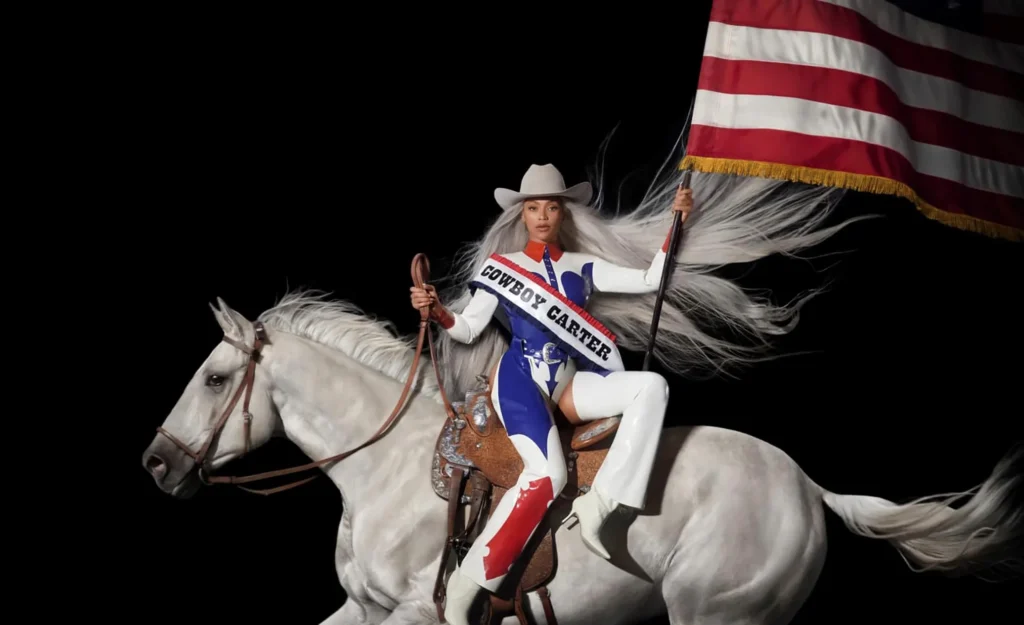
The same flag that she depicted ironically on her album cover (sans the stars against the blue backdrop) served as her red-and-white carpet moment, as she literally tramples on it while riding a white horse as she is decked out in all white replete with white cowboy hat.
That all her halftime participants are robed in white (save for some rodeo champions bedecked in red-white-and-blue uniforms) signify a number of things: the color of ancestry (in African tradition), the color of “all white” parties hosted by the Black middle class, and of course, the symbolic “good guys” who wear white cowboy hats in Hollywood country westerns.

The spectacle invited audiences to associate Blackness with virtue, and Black talent with Black excellence—from the Juneteenth carriages strewn in white flowers (celebrating Black emancipation after 400 years of chattel slavery in this country), to the “buckin’” and line dances and the HBCU marching bands highlighting unbridled joy on a Christmas night (the same night, interestingly, that often led to various freedom seekers fleeing slavery, most infamously Harriet Tubman rescuing three of her brothers in 1854 from the Eastern Shore of Maryland).
Incidentally, Tubman has recently received various military honors for her role in liberating over 750 bondspeople from slavery on the Combahee River in South Carolina in 1863, including recognition as an Army General on Veterans Day 2024 and as a spy, for which she was inducted into the U.S. Army Intelligence Hall of Fame and had received a statue at the CIA headquarters. Tubman demonstrates the great patriotic irony of honoring a Black woman as a veteran for engaging in the work that consistently undermined the economic forces upholding the nation’s reliance on chattel slavery.
If Beyoncé celebrated patriotic ironies of Black joy and freedom, Kendrick Lamar highlighted similar ironies of playing the “Great American Game” (or “GAG”), as highlighted by the character “Uncle Sam”—played to ironic perfection by Samuel Jackson, who invoked two iconic characters from his repertoire: the “Uncle Tom”-like Stephen from Quentin Tarantino’s Django Unchained, who enacted power by keeping other enslaved persons below him in check, and the radio DJ Mister Señor Love Daddy from Spike Lee’s Do The Right Thing, who served as the Greek chorus throughout the racially contentious drama.

In a meta performance, this Uncle Sam implored Kendrick the rapper to “play the game”—explicitly highlighted not just in the wider game of the Super Bowl between the Philadelphia Eagles and the Kansas City Chiefs, but also in the PlayStation controller that outlined the football field on which the halftime stage was erected.
Lamar played both within and outside these boundaries, most notably when his background dancers formed the American flag as he rapped the lyrics to “Humble” while standing in the middle of this divided symbol, whose colors simultaneously represent the nation as well as the divides across red and blue: Democratic “blue” states and Republican “red” states, or the L.A. gangs “Crips and Bloods” (even, as Kendrick once opined: “Democrips and Rebloodicans”).
That these bodies, which literally built the flag, eventually splatter across the “middle ground” in reference to slain youth in the “streets of L.A.” (that also double as a prison yard), speak to this American game of survival and societal cancellation. While Uncle Sam (whose symbol was used to recruit for U.S. soldiers) barks orders for respectability and discipline—not unlike Major Adams in The Six Triple Eight—Lamar consistently demonstrates resistance through the ironic recreation of discipline through dance.
This was especially highlighted, not just in the various formations of dancers in step with one another—such as the snake-like “S” shape that introduces fellow performer SZA, who joined him on the performances of “Luther” (in tribute to R&B legend Luther Vandross) and “All the Stars” (in tribute to the diasporic blockbuster Black Panther and in memory of Chadwick Boseman in the titular role)—but in the joyous abandon that accompanied his performance of the “out of bounds” hit song “Not Like Us,” for which he received Grammy’s top honors with Record and Song of the Year awards and for which he also was sued by Drake, the subject of his diss record.
Intriguingly, tennis champion Serena Williams was brought out on the stage to dance her infamous “crip walk,” which had caused controversy when she did the same dance after winning a gold medal at London’s 2012 Summer Olympics. Here, Williams (who is defended in the lyrics to “Not Like Us”) recreates her victorious dance in homage to her and Lamar’s hometown of Compton, as a reminder that dance is the ultimate in both discipline and abandon.
This joyous dance—much like the lindy hop during the World War II era, which is shown in a scene of The Six Triple Eight depicting the women experiencing joy during their off hours—reinforces the ironic nature of Black dance, which embodies both the discipline of the body trained to step in formation, and the pleasure that emanates from the very body adhering to the rigidity of choreographed steps.
This is the patriotic irony that pulsates across the Netflix drama and the halftime shows conceived by Kendrick Lamar and Beyoncé.
These pop culture moments offer us valuable lessons for Black History Month. If nothing else, Serena Williams’ crip walk, Beyoncé’s line dancing, Kendrick Lamar’s dancers, and the lindy hop performed in The Six Triple Eight emanate from the true values of American democracy. They epitomize the joy that comes with discipline, the freedom that arose from chattel slavery, and the commitment to a patriotism for a country that routinely fails to love us back. Our patriotic irony insists on the ideals that America has promised but has yet to deliver.
At some point, though, we will all learn to step outside the bounds of this “great American game” and resist those who seek to control us in our efforts to unite as we lock step in pursuit of equality and justice for all.
The nonprofit Foundation for Women Warriors is hosting a free, virtual screening of The Six Triple Eight on March 26 at 4 p.m. PT / 7 p.m. ET. Register here.