How the SAVE Act Could Impact Women’s Participation in Democracy

Weekend Reading on Women’s Representation is a compilation of stories about women’s representation in politics, on boards, in sports and entertainment, in judicial offices and in the private sector in the U.S. and around the world—with a little gardening and goodwill mixed in for refreshment!

This week:
—Republicans’ rebranded SAVE America Act seeks to expand federal oversight of elections and ban ranked-choice voting. Policies that appear neutral on paper can land very differently in lived experience; nearly 90 percent of married women change their last name, which means that the undue burden will fall on women.
—Women candidates win special elections across the country.
—Women gain majority status in Democratic caucuses in state House of Representatives.

… and more.

What This Moment Requires of Us: Women, Voting Rights and the Battle for Representation

Weekend Reading on Women’s Representation is a compilation of stories about women’s representation in politics, on boards, in sports and entertainment, in judicial offices and in the private sector in the U.S. and around the world—with a little gardening and goodwill mixed in for refreshment!

This week:
—As February begins and we mark Black History Month, I’m reminded that the fight for a more representative democracy has always been carried forward by women who refused to accept exclusion as inevitable.
—”Republicans in Congress have unveiled a new bill that would impose the most extreme voting restrictions ever proposed at the federal level,” warns Democracy Docket of the so-called “Make Elections Great Again” (MEGA) Act.
—Washington, D.C.’s legendary delegate to Congress, Eleanor Holmes Norton, will not run for re-election this year after 35 years in office.
—Republican state Sen. Ileana Garcia, a Coral Gables resident who co-founded Latinas for Trump, is now concerned about the overt racial profiling and indiscriminate aggression against citizens, legal immigrants, and undocumented people alike. 
—In Minnesota, Peggy Flanagan leads polls and just secured the endorsement of incumbent Sen. Tina Smith in her bid for the Democratic nomination for Senate.

… and more.

Resistance, From the Red Carpet to the Courts: Grammy Winners Denounce ICE, Immigrant Families Challenge Trump’s Visa Ban

In every issue of Ms., we track research on our progress in the fight for equality, catalogue can’t-miss quotes from feminist voices and keep tabs on the feminist movement’s many milestones. We’re Keeping Score online, too—in this biweekly roundup.

This week:
—For the first time, more Americans support than oppose abolishing ICE.
—Senate Democrats refused to pass a DHS bill that would fund ICE for this fiscal year. Instead they passed a two-week continuing resolution to give them time to negotiate reforms designed to prevent further brutality from ICE and CBP agents. 
—Artists use Grammy acceptance speeches to denounce Trump and ICE: “Our voices matter,” urged Billie Eilish. “We are humans and we are Americans,” said Bad Bunny.
—Organizations raise alarms about Grok AI spreading nonconsensual intimate images on Twitter.
—Virtual reality may be a tool to change opinions about catcalling.
—Access to IVF has led to more unmarried women in their 40s choosing to have babies.

… and more.

How We Build a Better System: Celebrating Ranked-Choice Voting Day

Weekend Reading for Women’s Representation is a compilation of stories about women’s representation in politics, sports and entertainment, judicial offices and the private sector—with a little gardening mixed in!

This week:
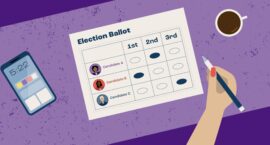
—Friday marks is Ranked-Choice Voting Day, an annual event held every Jan. 23 (1-2-3) to celebrate a proven, people-powered reform that strengthens democracy by giving voters more choice and candidates a fairer path to office. 
—Steven Hill and Paul Haughey call a 2023 study from the University of Minnesota repeatedly cited by opponents of ranked-choice voting “one of the most error-prone” they encountered—relying heavily on cherry-picked citations, simulated elections and surveys disconnected from how voters actually behave in real contests. 
—We honor the life and legacy of Claudette Colvin, an icon of the Civil Rights Movement.
—The Vermont Voting Rights Act seeks to codify key federal voting protections in the state.
—Portland reaches an important compromise in their City Council elections.

… and more.

‘Every Vote Counts’: What Women Leaders Know About Fixing Broken Political Systems, From Iceland to Washington

At the Reykjavík Global Forum on Women Leaders in Iceland, women political leaders gathered with warmth and purpose to confront the most pressing challenges of our time.

We talked about democracy, leadership, activism and power-building. We talked about fear. About childcare. About boys who aren’t sure where they fit in this “new” world. About deadlines and death threats, ranked-choice voting—and the deeper reasons why they keep doing this work despite the challenges.

Amid those conversations, three interviews in particular stayed with me: Liz Berry, a Washington state representative who campaigned with a 6-week-old baby; Eliza Reid, Iceland’s former first lady and author of Secrets of the Sprakkar: Iceland’s Extraordinary Women and How They Are Changing the World; and Alison Comyn, an Irish journalist-turned-senator from a country that’s used proportional representation—a form of ranked-choice voting—for generations.

Taken together, their stories sketch a kind of roadmap: how we change the rules, how we change ourselves and how we do this work together. They also leave us with a question: Could my city, state or party pilot a system where “every vote counts,” and more than two parties can breathe? And, if so, how can I help make that change a reality?


Project 2026 Declares Open War on Women’s Rights

When The Heritage Foundation released its new policy blueprint for 2026 this week—an extension of the now-infamous Project 2025—it did so with the calm confidence of an institution convinced no one will stop it. The document is shorter than last year’s 900-page “Mandate for Leadership,” but no less dangerous. It is, in fact, more candid.

Project 2026 lays out a government redesigned to control women’s bodies, erase LGBTQ+ lives, dismantle civil rights protections and roll back decades of hard-won progress. Wrapped in the language of “family,” “sovereignty” and “restoring America,” it is a direct attempt to impose a narrow, rigid ideology on an entire nation.

Make no mistake: This is a plan for forced motherhood, government-policed gender and the end of women’s equality as we know it.

But Project 2026 is not destiny. It is a warning—and one we must answer with the full force of a movement that has never accepted a future written for us by someone else.

Women in Politics Weekly Roundup: Miami’s First Woman Mayor; Congress Moves to Reform How We Vote; Forbes Ranks World’s 100 Most Powerful Women

Weekend Reading for Women’s Representation is a compilation of stories about women’s representation in politics, sports and entertainment, judicial offices and the private sector—with a little gardening mixed in!

This week:
—A seachange in New Mexico’s new women-majority legislature.
— The Ranked Choice Voting Act has been introduced in Congress, which would require RCV for all primary and general congressional races beginning in 2030, allowing voters to express their ranked support for multiple candidates.
—Eileen Higgins is elected as Miami’s first woman mayor. She ran on a platform of structural reforms: affordable housing, climate resilience, improved municipal governance and expanded representation.
—Australia enacts a nationwide ban on social media accounts for children under 16.
Forbes 2025 ranking of the world’s 100 most powerful women spotlights an increasingly diverse and influential generation of female leaders across business, politics, technology, media and culture.

… and more.

Seventy Years After Rosa Parks’ Arrest: How We Commit to Carrying the Work Forward

Weekend Reading for Women’s Representation is a compilation of stories about women’s representation in politics, sports and entertainment, judicial offices and the private sector—with a little gardening mixed in!

This week:
—The 2025 elections prove that voters across the country want women as their leaders.
—Democratic leaders are exploring ranked-choice voting for the 2028 presidential primaries.
—In a Tennesee special election, Democratic nominee Aftyn Behn surpassed electoral expectations for her congressional district.
—Fort Collins, Colo., elected Emily Francis as mayor in its first use of ranked-choice voting.
—College student Any Lucía López Belloza was deported in Massachusetts on her way home to Texas for Thanksgiving.

… and more.

Two Roommates, Two Governorships—and a Blueprint for Women’s Power

From governors’ mansions to city halls, legislative chambers to ballot measures, voters across the country affirmed a simple but powerful truth: When we design systems that work for women, women lead and democracy strengthens. 

This year’s races showcased both the momentum and the mechanics of progress. Record numbers of women ran in state legislative contests. Cities across the country tested reforms like ranked-choice voting to create fairer elections. And two of the most closely watched gubernatorial races in the nation—in Virginia and New Jersey—produced groundbreaking results for women’s representation that will reverberate far beyond their state lines. 

The Witch Was Never the Villain. She Was the Beginning of Women’s Power.

Weekend Reading for Women’s Representation is a compilation of stories about women’s representation in politics, sports and entertainment, judicial offices and the private sector—with a little gardening mixed in!

This week:
—Long before Halloween became a night of costumes and candy, it was Samhain: a Celtic festival marking the end of harvest and the beginning of winter’s half-dark. Communities gathered to honor what had ended, prepare for what was to come, and find renewal in letting go. At the heart of those gatherings were women. When patriarchal religions spread across Europe, that spiritual authority became a threat.
—When my children were young, during the Halloween season, I remember thinking how natural it is for young children, especially young girls, to believe they can transform … to step boldly into whoever they want to be.
—As we approach another Election Week, women once again stand at the threshold between what is and what could be: Women could sweep governor elections in New Jersey and Virginia. And Women are posed for gains in city elections across the country.
—New York Attorney General Tish Janes is targeted by the DOJ.
—Ireland elects Independent Catherine Connolly as its third woman president.

… and more.