A Jim Crow-Era Voter Suppression Tool Is Back: Mass Voter Challenges

In March 2025, two members of the DOGE team communicated with a political advocacy group that was seeking to “find evidence of voter fraud and to overturn election results in certain States.” The group was trying to match Social Security records with copies of voter files that it had acquired. One of the DOGE team members even signed a “Voter Data Agreement” with the group. While it’s still unclear whether DOGE members shared any personal Social Security data, the revelation raised a scary prospect: The federal government might collaborate with election deniers seeking to block American voters from the ballot box.

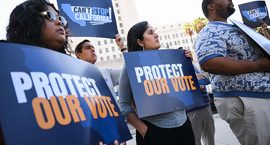
Most states have laws that allow voters to challenge other voters’ eligibility. Baseless mass challenges to hundreds or thousands of voters at a time are a growing problem. They threaten voters. They swamp overburdened election officials with unnecessary work. And they fuel mistrust in our elections.

The Myth of the ‘Perfect Birth’: What America Gets Wrong About Pregnancy, Birth and Maternal Care

Project 2026’s pronatalist vision insists that America needs more babies—but largely ignores the conditions that make pregnancy and childbirth unnecessarily dangerous in the first place. In this interview with Ms., The Perfect Birth Myth co-authors Avital Norman Nathman and Deborah Wage argue that improving maternal health requires more than rhetoric about “family values.” It demands investments in midwives, doulas, paid family leave, prenatal and postpartum care, and policies that address the racial and economic inequities driving the nation’s maternal mortality crisis.

Drawing on surveys of nearly 3,000 parents and healthcare providers, Nathman and Wage dismantle persistent myths about birth while exposing the structural failures of the U.S. maternity care system—from hospital closures and Medicaid cuts to the medical establishment’s resistance to alternative models of care. They explain why Black women continue to face disproportionately poor outcomes regardless of income or education, why conservative pronatalist policies fall short, and what it would take to build a maternal healthcare system that truly supports families.

Even in Summertime, We Can’t Lose Focus: State-Level Democracy Dispatches From Maine, Kansas, Idaho and Virginia

Summertime—and the fight for democracy—is sizzling, especially in the states. Here’s what is happening across the country.

Sudden shakeups in U.S. Senate elections have foisted reproductive rights front and center. The upcoming primary in Maine to replace Graham Platner as the Democratic candidate, combined with deep antipathy voters there have toward Republican incumbent Sen. Susan Collins, is a golden opportunity to elevate abortion in the midterms—especially given Collins’ recent comment that she has no regrets about her pivotal vote to confirm Brett Kavanaugh to the Supreme Court.

In South Carolina, Sen. Lindsey Graham’s unexpected death last weekend has created a surge of public attention and momentum for the Democratic candidate, Dr. Annie Andrews, a pro-choice, pro-science pediatrician (with an A+ Instagram game).

Too often, summer is a season all too ripe for sneak attacks on direct democracy. Ohio Republicans made a case study out of the strategy when they orchestrated a special election in August 2023 to quietly raise the threshold for ballot measures—all in service of attempting to thwart a popular abortion proposal. In the end, voters saw the power grab for what it was and rejected the rules change while turning out in force that November for abortion.

Now Kansas is resurrecting the play and will hold an August election to decide how state Supreme Court justices are chosen.

In Maine, a measure was also proposed, but Secretary of State Shenna Bellows (one of the potential U.S. Senate candidates) invalidated more than 12,000 signatures on the citizens’ petition that had been forged and/or duplicated. Last week a judge upheld blocking the referendum; any appeal will need to be resolved by Aug. 25 for it to appear on the November ballot.

It is a tough balancing act—the need to revel in the lazy, hazy days of summer and grasp the reality that these fights require our constant vigilance. This is where we have to hold each other up. Please take the time to refresh and rejuvenate, and be ready to come back swinging.

Trump’s Education Department Claims It’s Focused on Educator Sexual Misconduct. Is It Real Commitment or Political Messaging?

Trump’s Department of Education issued a Dear Colleague Letter on July 10 warning schools they risk losing federal funds if they fail to protect students from sexual misconduct by school employees. The accompanying press release announced that the Department’s Office for Civil Rights (OCR) will open 20 directed investigations into school districts whose Civil Rights Data Collection submissions suggest they may have mishandled allegations of staff sexual misconduct.

The question is not whether educator sexual misconduct deserves federal attention. It is why the Education Department has elevated staff-on-student sexual misconduct, while devoting comparatively little attention to peer sexual harassment and assault, which occurs far more frequently.

One possible explanation is that educator sexual misconduct allows the department to demonstrate visible action on an issue that is politically uncontroversial, while helping restore public confidence in its commitment to protecting students.

The letter follows criticism from 112 gender equity organizations, survivors’ advocates and Sen. Bernie Sanders (I-Vt.) over the administration’s dismantling of OCR and its shift away from investigating many forms of sex discrimination. Critics argue the administration has increasingly weaponized Title IX to advance political objectives, particularly through investigations involving diversity initiatives and transgender students’ participation in girls’ sports, while reducing enforcement in other areas of sex discrimination.

Todd Blanche Suggests He Is Open to Using the DOJ to Restrict Mailing the Abortion Pill

Antiabortion Republican senators scored a major win from embattled acting Attorney General Todd Blanche during his contentious confirmation hearing to lead the Department of Justice.

Texas Sens. John Cornyn and Ted Cruz used Wednesday’s hearing to press Blanche to restrict access to the abortion pill mifepristone, and Blanche ultimately agreed to revisit the current Department of Justice interpretation of the 1873 Comstock Act, which allows the nationwide mailing of the abortion pill under certain circumstances.

‘The Wrong Kind of Girl’: Feminists Warn of Fallout After Supreme Court Says States May Exclude Trans Girls From School Sports Teams

The Supreme Court ruled 6-3 on Tuesday, June 30, that states may prohibit transgender students from participating in school sports consistent with their gender identity, holding that the Equal Protection Clause of the 14th Amendment does not prohibit such bans. The decision leaves in place laws already enacted in 27 states and marks another major setback for transgender rights after months of escalating attacks on LGBTQ+ communities.

Feminist organizations, reproductive justice advocates, physicians, civil rights leaders and lawmakers swiftly condemned the ruling, arguing that it harms transgender youth, undermines Title IX’s protections against sex discrimination and fits into a broader campaign targeting marginalized communities.

Human Rights Campaign president Kelley Robinson argued the ruling would fuel suspicion and harassment not only toward transgender athletes but toward girls more broadly.

“When politicians convince the public that any girl could be ‘the wrong kind of girl,’ they invite harassment, intimidation, invasive questioning or even an inspection of their body by a total stranger. While we know this administration and other anti-equality politicians won’t stop obsessing over trans kids, we must all call on states to adopt inclusive policies so that no one gets left behind for being their authentic selves. We must show up in large numbers for every school board, local and state and federal election to be sure our communities are heard. We must continue this fight with full force until freedom, justice and equal opportunity are not flimsy promises but nationwide guarantees.”

The Most Popular Supreme Court Justices Are Women

Weekend Reading on Women’s Representation is a compilation of stories about women’s representation in politics, on boards, in sports and entertainment, in judicial offices and in the private sector in the U.S. and around the world—with a little gardening and goodwill mixed in for refreshment!

This week:
—Knowing that whoever is nominated will face intense scrutiny for potential sexual misconduct, a woman could be Maine Democrats’ safest choice.
—”It’s worth remembering that in moments of past darkness we have triumphed not by moderating our opinions or softening our asks, but by dreaming big and daring boldly,” writes Janai Nelson.
—The justices who have most visibly pushed back on executive overreach, including on birthright citizenship and Trump’s tariffs, happen to be the three women on the liberal wing. And they are also, by a significant margin, the most popular justices in the country.

… and more.

Can You Believe They Put This in Writing? The Wildest Quotes From Heritage’s ‘Project 2026’

The Heritage Foundation has once again taken it upon itself to craft a plan for how to supposedly save America. The report—”Saving America by Saving the Family: A Foundation for the Next 250 Years”—focuses on marriage, family and the American Dream, and has become widely known as “Project 2026,” a follow-up to Heritage’s infamous Project 2025 blueprint.

Project 2025 clocked in at 900 pages; the sequel is around 150. We read the whole thing and pulled out the passages that gave us chills, made us laugh out loud, compelled us to suddenly need to take a long walk and hug our dogs, or inspired another donation to our local abortion fund.

This isn’t intended to be a fact-check or a line-by-line rebuttal. It’s intended to show you how some of the country’s most influential conservative thinkers are talking about feminism, contraception, abortion, LGBTQ+ people, higher education, marriage, motherhood and the role government should play in all of it—because you’re probably too busy to read hundreds of pages of anti-feminist slop.

And because, as former Vice President Kamala Harris famously said about Project 2025: “Can you believe they put that thing in writing?” They did—twice now!

This is the roadmap they’re offering. These documents tell us how their authors understand the country, the family and women’s place in both. We should know what it says.

The Mask Is the Message

Most of us have seen the photograph by now.

I keep coming back to the masks.

Masks have always carried meaning. A surgeon wears one to protect a patient. Someone recovering from an illness wears one to protect themselves and others. A firefighter wears one to survive long enough to save someone else.

But when someone covers their face while intimidating another person, threatening a community, or committing a crime, the purpose isn’t protection. It’s concealment. It’s a way of saying: I want to do this, but I don’t want anyone to know it was me. That’s why Patriot Front marches with their faces covered.

Federal immigration agents carrying out arrests in public places wear face coverings for the same reasons: They create anonymity. They make accountability harder. They allow participants to disappear back into ordinary life once the march is over. They make denial easier.

I’ve participated in protests and marches over the years alongside hundreds—sometimes thousands—of people. Not one of us wore a mask. We stood behind our words and convictions. We accepted that our names belonged with our beliefs.