The documentary is an intimate portrait of a fascinating and indomitable woman who treated life as the ultimate adventure.

One of the most striking moments of director Brydie O’Connor’s new documentary Barbara Forever, which chronicles the life and work of prolific lesbian feminist filmmaker Barbara Hammer, comes midway through. After being diagnosed with ovarian cancer in 2007, Hammer’s film corpus turned to questions of mortality. But she also began to reflect on what she wanted to do with her archive. In addition to donating many of her papers and films to Yale University, she decided to give away some of her old film stock to other artists so they could make something with it anew. One such collaboration was with trans filmmaker Joey Carducchi, who requested clips of Hammer’s 1995 autobiographical Tender Fictions. As we see in Barbara Forever, with the gifted cuts, Carducchi makes Coming Outtakes (2019), a short, heartfelt meditation on his transition and the political and emotional stakes of solidarity between lesbian and trans-masculine creators.
While the brief clip from Coming Outtakes only takes up a few minutes of O’Connor’s documentary, it’s particularly moving in the way it crystallizes the poignant vitality of Hammer’s legacy and her lasting importance to feminism, queer and experimental filmmaking, and art. It’s also fitting that Barbara Forever received Sundance’s Jonathan Oppenheim Editing Award for U.S. Documentary (the film’s editor is Matt Hixon), with its whirling, dynamic, and comprehensive array of film and archival footage from an artist who voraciously documented her own life and the lives of others.
Hammer married just after college and travelled the world with her then-husband. When she returned to her home state of California, she began to take filmmaking classes at San Francisco State University, and, a few years later, started to take part in 1970s feminist consciousness raising groups. She came out as a lesbian at age 30. In 1974, she shot what is often considered one of the first lesbian experimental films, the four-minute experimental Dyketactics, which celebrated the physicality of bodies through touch and sight.
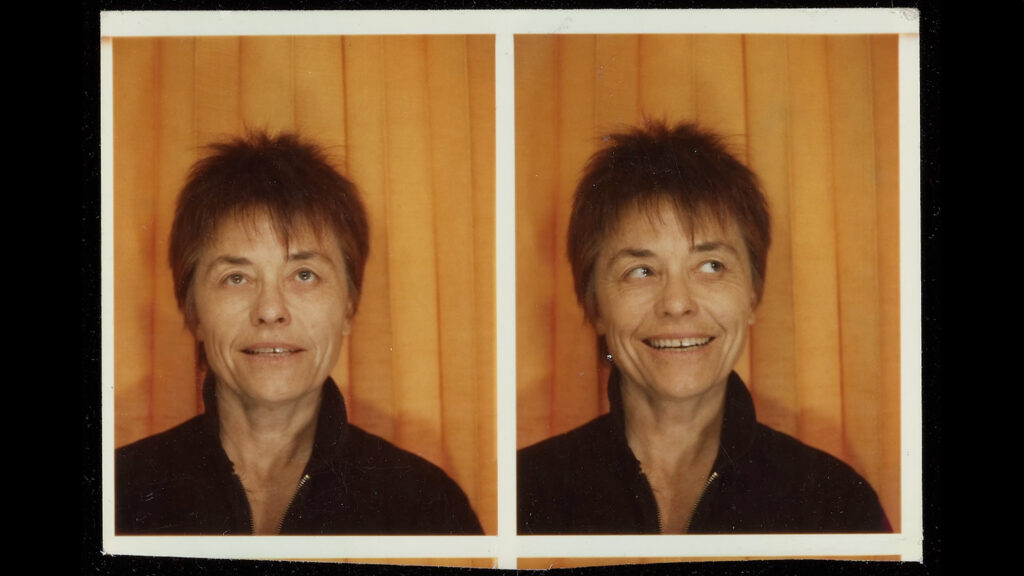
Even though other filmmakers counseled Hammer that she had to choose between being a lesbian filmmaker or an avant-garde filmmaker, she refused, wanting to “[bring] back emotion to structural cinema.” Her early focus on same-sex love, touch, and sensation, led to Hammer’s creation of a kind of “lesbian aesthetic” that was both erotic and intellectually rich, allowing her to explore questions of body, self, and other. Almost obsessive in her practice, Hammer filmed her relationships with all her lovers and hustled tirelessly to make a name for herself in the art world even after finding out her work had been flagged as overly erotic for government grants by the National Endowment for the Arts.
Hammer’s refusal to be written out of history paid off, and Barbara Forever is full of evidence of the impact Hammer, both herself and her work, made on those around her. In 1992, she shot her first feature-length film, Nitrate Kisses, which documents the history of gay and lesbian culture as interwoven with scenes of four couples. The film went on to screen at Sundance and other major festivals to much acclaim, and made its way into the annals of film history as part of the 1990s wave of New Queer Cinema (a term coined by film critic B. Ruby Rich).
At age 48, Hammer met Florrie, her life partner, who helps frame key moments in the documentary and speaks into Hammer’s absence. But even though Hammer died in 2019, the breadth of her oeuvre and the vibrancy of her work makes her presence still felt in their bright, cheery apartment. Since she was such a meticulous archivist of her own life, Hammer also speaks through the film, which swells with her liveliness.
Barbara Forever charms and inspires. Beyond just telling the story of the life of a trailblazing lesbian filmmaker, the documentary is an intimate portrait of a fascinating and indomitable woman who treated life as the ultimate adventure.