We have proof of who he is and how he regards girls and women—and we bring the receipts.

This story was originally published by The Contrarian.
When the White House issued a presidential message to kick off Women’s History Month (WHM), my first reaction was genuine surprise. Honestly, I did not think WHM was still recognized by the federal government.
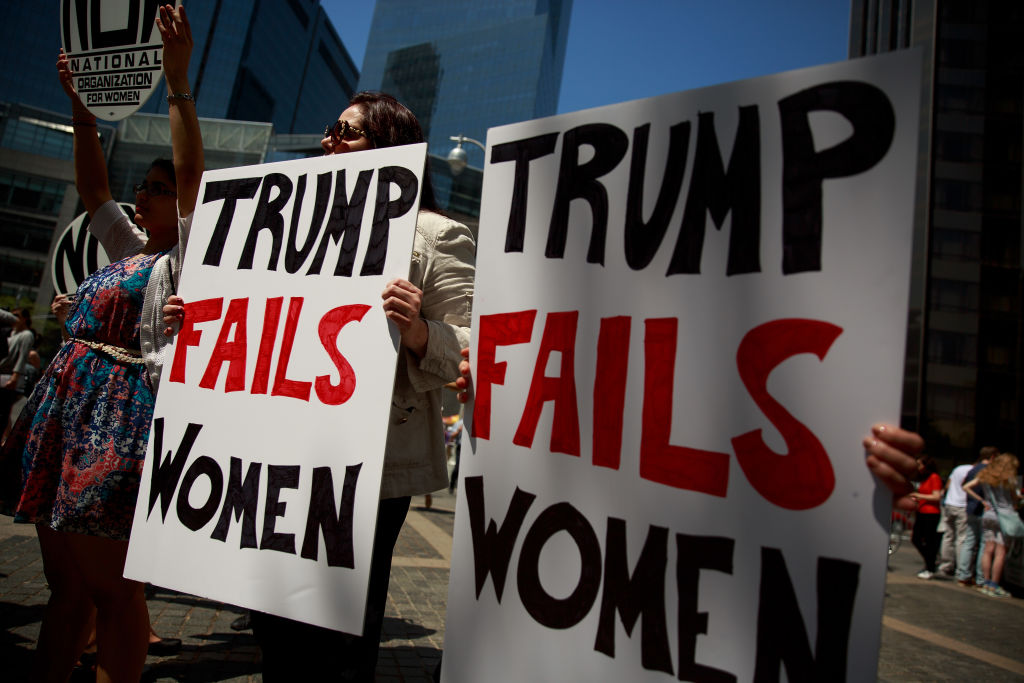
President Donald Trump’s brief (four paragraphs) public statement doubled down on the administration’s regressive societal vision, casting women primarily as caretakers and pillars of the “American family,” while pointing to a slate of policies he claims empower them. But a closer look at the statement reveals a familiar mix of culture-war signaling, selective policy claims, and omissions that obscure the real impacts of the administration’s agenda on women and families.
I think often about the role of the media at this moment—an obligation intrinsically greater than reporting the verbiage that comes out of the White House. It is on all of us to explicitly counter double-speak and lies and to leave a paper trail of truth for posterity.
This week’s column does just that: It dissects Trump’s WHM proclamation line by line and tests each claimed reform against the record.
“Since I returned to office last year, we have increased access to fertility treatments, protected women’s sports, returned parental rights to our classrooms, and expanded the child tax credit—because we want American women and their families to grow, thrive, and flourish.”
- Increased access to fertility treatments. Neither the president’s initial executive order nor subsequent proposed prescription plan does much to lower costs or make the procedure more accessible. In October, the White House flagged a forthcoming “employer benefit option” to encourage more workplaces to offer IVF coverage directly to employees, but there is no apparent progress to report since then.
- Protected women’s sports. Ask most athletes what would be beneficial for girls and women who play and compete, and they’d likely call out the need for equal school budgets, equal access to quality facilities, equal professional pay, equal time in the spotlight. (Maybe even equal access to the White House for gold medalist hockey players … nah.) Instead, the White House is fixated on targeting a minority of athletes: transgender people. Its multiple executive orders and threats over funding and compliance have elevated the issue, and two cases at the U.S. Supreme Court (from Idaho and West Virginia) appear likely to succeed in prohibiting transgender women and girls from competing on school sports teams. This solves none of the pressing equity issues for the vast majority of student athletes.
- Returned parental rights to our classrooms. White House action amounts to bombastic executive orders and a fact sheet, along with moves to dismantle the Department of Education. Just last week, the U.S. Supreme Court released a related decision about a case out of California—late at night, on its shadow docket—stating that a policy preventing teachers from disclosing to parents when their child changes their name or pronouns in school is likely a violation of parents’ constitutional rights. Again, trans kids are the canaries on the coalmine.
- Expanded the child tax credit. The “One, Big, Beautiful Bill Act” signed into law last summer did increase the total amount of the tax credit to $2,200 (up from $2,000). But beware the fine print: Children and at least one parent or guardian will now need to have a Social Security number to qualify, shutting out an estimated 2.7 million American kids, by one estimate. In addition, according to the Center on Poverty and Social Policy, the increased child tax credit is structured in a way that excludes many families, who will need higher levels of income to be eligible for the full amount. Don’t forget that same law also decimated other economic supports for families: the Supplemental Nutrition Assistance Program (a.k.a. food stamps) lost $186 billion in funding through 2034; $1 trillion was cut from Medicaid and the Children’s Health Insurance Program over the next decade.
… The U.S. Supreme Court … appears likely to succeed in prohibiting transgender women and girls from competing on school sports teams. This solves none of the pressing equity issues for the vast majority of student athletes.

“Affordable costs, safer neighborhoods, and common sense in our Government all empower women to build successful careers and foster thriving homes, and my Administration will never stop fighting to ensure the American Dream is within their reach.”
- Affordability. That word is a major sticking point for the administration, and it constantly insists affordability is a partisan poke by Democrats, not a real-time crisis for families struggling with persistently high prices on the basics—food, housing and healthcare. This MoneyWatch report breaks down current costs. Trump’s war in Iran caused gasoline costs to skyrocket, and with them shipping, commuting and travel costs, too.
- Safety. Immigration and Customs Enforcement’s and Border Patrol’s infiltration of cities and communities across the country has made neighborhoods less decidedly safe. (But on the bright side for democracy, extraordinary laboratories for mutual aid and support sprang up.)
- Building successful careers and thriving homes. What women and families are really clamoring for? Affordable childcare. A new LendingTree study reports the average American family doesn’t come close to having enough income to make it work: federal guidelines deem childcare “affordable” if it is no more than 7 percent of household income; for a family of four (two adults, two kids) this translates to $28,000 a year — and a household income of more than $400,000 to meet that benchmark. This is where reform is sorely needed, but of course working mothers aren’t envisioned by the Heritage Foundation blueprint Saving America by Saving the Family: A Foundation for the Next 250 Years, which leans in heavy on tradwife life.
As with everything Trump says and does, we have written, video and audio proof of who he is—whether that be as a citizen, candidate, defendant or president—and how he regards girls and women. The White House WHM puffery is absurd. But we cannot just roll our eyes and move on to the next affront. Continuously bringing receipts is our shared obligation in the fight for democracy.
***
Check it out: The New York Times launched a WHM project, “100 Years of Women Who Changed History,” that highlights obituaries of women who made a mark on the world and helped shape American democracy—jurists, writers, plaintiffs, activists, artists—many for the better, some for the worse. The site includes archival audio, photo, and video content, along with the real-time obituaries.
It is a cool installation, but it harkens back to the remark above about the role of the media: Please recommit to feminist and independent outlets, so many of which tell these stories in real time, rather than as a post-mortem, and treat women as important enough to cover when they’re alive and their contemporaries can witness their contributions.