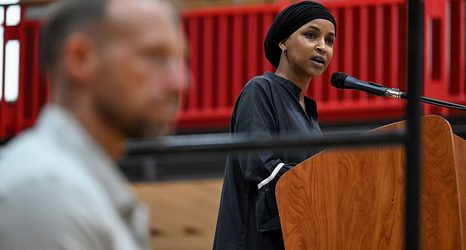


Highlights from the Golden Flyer II tour as activists retrace the spirit of the suffrage movement to press for recognition of the Equal Rights Amendment.

Inspired by the 1916 suffrage road trip that helped win women the vote, activists behind Driving the Vote for Equality are traveling across the country in the restored Golden Flyer II to build support for recognizing the Equal Rights Amendment as the 28th Amendment.
Each week, Ms. will share highlights from the road.
During its first week on the road, the Golden Flyer II carried the push for the ERA through the Mid-Atlantic. (Read the highlights here.)
Its second week took the Golden Flyer II through Virginia, North Carolina and Georgia—stopping in cities and towns where activists, students, historians and local leaders gathered to sign petitions, share suffrage history and press Congress to recognize the ERA as the 28th Amendment.
March 8: Richmond, Va.
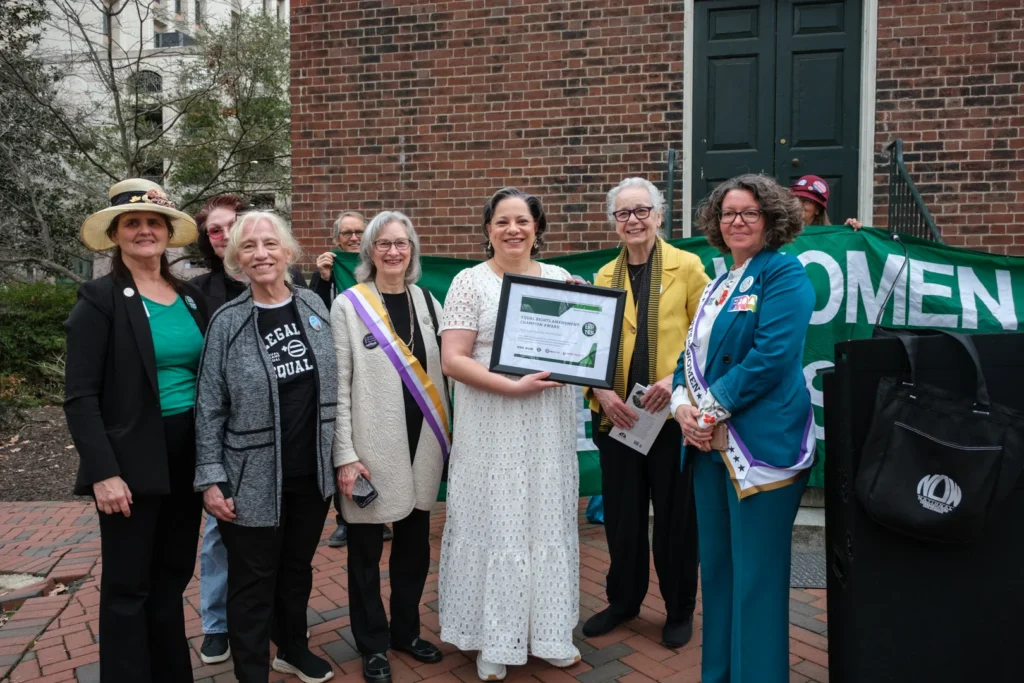
There was something fitting about arriving in Richmond, Va., on International Women’s Day. This is the capital of the last state to ratify the Equal Rights Amendment—the state whose ratification in 2020 finally pushed the ERA across the constitutional finish line: 38 states, three-quarters of the nation, exactly what Article V requires. And still Congress has not acted. Richmond knows what it means to be on the right side of history and still have to fight for recognition.
The day began in the historic Jackson Ward neighborhood—one of Richmond’s most storied communities, just steps from the Maggie L. Walker Historic Site. Walker was the first woman in the United States to charter and serve as president of a bank—an African American woman who built economic power for her community in the teeth of Jim Crow, at a time when both her race and her gender were deployed as arguments against her right to participate in American life.
Parking the Golden Flyer II down the street from her historic site on International Women’s Day was not an accident. It was a salute.

Later, the Golden Flyer II rolled through downtown Richmond to the Bell Tower on the Capitol grounds, where a crowd was waiting. Speakers connected the historic suffrage fight to the unfinished work of constitutional equality today.
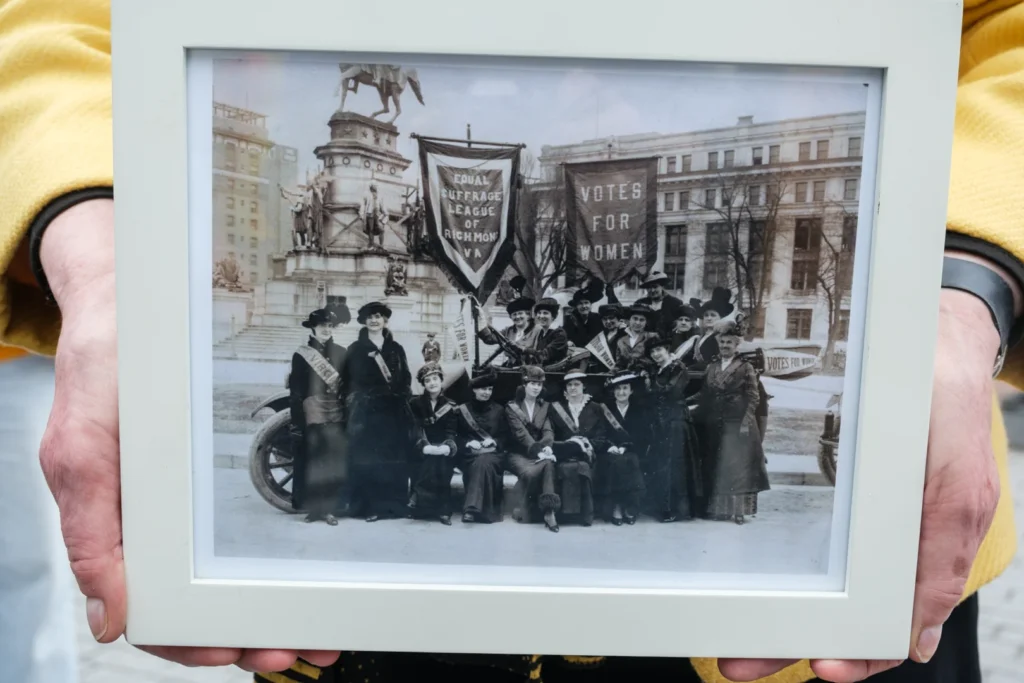
At one point, activist Eileen Davis held up a photograph taken in the early 1900s of 17 suffragists of the Equal Suffrage League of Virginia standing together in Capitol Square and invited the crowd to walk to that same statue and recreate it. They did, making visible in 2026 the line that runs unbroken from their fight to ours.
The rally closed with a call to action on the Sign4ERA.org petition. Because in the end, the history, the speeches, the photographs and the drive all point to the same unfinished task: one million signatures and a Congress that finally acts. Richmond offered a reminder that the struggle for equality has always stretched across generations and that the road forward continues.
March 9: Henderson and Raleigh, N.C.
Early in the morning, the Saxon crew drove through dense fog toward Henderson. It lifted just as the Golden Flyer II pulled into Henderson City Hall—and what it revealed was one of the most memorable stops of the journey. School buses arrived one after another, unloading more than a hundred students who gathered in the parking lot waving, clapping and pinning on Sign4ERA.org buttons as the suffrage-yellow car rolled into the mayor’s reserved parking spot.

Henderson Mayor Melissa Elliott addressed the crowd with a call to action.
“Dignity, opportunity and equality belong to every person,” she said. “The Equal Rights Amendment is about ensuring that the promise of equality is not just an ideal we talk about but a protection guaranteed.” She urged the students and community members gathered there to show “justice, mercy and the courage to move forward.”
One of the morning’s most powerful moments came when Henderson Collegiate student McKenzie Spellman led the Pledge of Allegiance and then paused, turning to her peers with a question: “If we pledge liberty and justice for all—does that not include women?”
The crowd fell quiet for a moment and then erupted, with students chanting “ERA NOW” and lining up to take photos inside the Golden Flyer II.
Later that afternoon in Raleigh, ERA champions gathered at the Woman’s Club of Raleigh to mobilize around both North Carolina ratification and the national campaign urging Congress to recognize the ERA as the 28th Amendment. As Marla Barthen of the ERA-NC Alliance put it, capturing the spirit of the gathering: “Equality for All Y’All—because it is for everyone.”
March 10: Greensboro and Charlotte, N.C.

The Golden Flyer II arrived at the Greensboro History Museum on a sunny morning that felt like the campaign had finally found its weather. Local ERA activist and League of Women Voters member Barbara Carter was already there, clipboard in hand, collecting signatures for the Sign4ERA.org petition—proof that advancing the cause doesn’t require being part of the tour.
As ERA-NC Alliance co-president Audrey Muck reminded the crowd with a laugh, North Carolina did not ratify the 19th Amendment until 1971. “We’re really hoping it doesn’t take North Carolina another 50 years to join the party this time.”
Greensboro Mayor Marikay Abuzuaiter drew cheers with a memorable comparison: Alice and Nell reminded her of Thelma and Louise—“not the criminal part, but I’m sure they were looked at as criminals because they were doing something that no one had done before.” She connected the century-old journey to the work still ahead, noting that Greensboro passed a resolution in 2019 urging the state legislature to ratify the ERA. She then made it official, issuing a proclamation declaring March 10, 2026, “Driving the Vote for Equality Day” in Greensboro.
Later that day in Charlotte, the Golden Flyer II arrived at the Belk Theatre, where the Broadway musical Suffs was playing to packed houses. After a complicated parking maneuver involving locked bollards and an “inky black puddle of muck,” the team finally threaded the century-old Saxon roadster into place outside the theater. The crowd quickly gathered—some asking how to get into the car, others asking where to sign the petition—as organizers handed out ERA information, stickers and copies of Ms. magazine.
Inside the theater, the message of Suffs resonated with the day’s events. The Tony Award-winning musical follows the final years of the suffrage movement and ends with a reminder that progress is possible—but not guaranteed. As the show concludes, Alice Paul celebrates the victory of suffrage while insisting the work is unfinished: The Equal Rights Amendment is next.
Outside, the Golden Flyer II was waiting—parked exactly where it belonged, in front of a theater full of people who now understood why the fight for equality is still on the road.
March 11: Charlotte, N.C.

A 1918 photograph of Alice Paul opens the story: composed, direct and certain. The suffrage movement was still two years away from victory with the ratification of the Nineteenth Amendment to the United States Constitution, but Paul was already looking beyond it. For her, the vote was never the end of the fight—it was the beginning of the next one.
When the 19th Amendment was ratified in 1920, Paul did not stop. Three years later, in 1923, she wrote the Equal Rights Amendment—a single sentence declaring that equality of rights under the law shall not be denied or abridged by the United States or any state on account of sex. She would spend the rest of her life advocating for its passage. As she once said, “I never doubted that equal rights was the right direction… to me there is nothing complicated about ordinary equality.”
Today, that legacy is reaching new audiences through Suffs. Each night, as the Golden Flyer II parks outside the theater, conversations begin on the sidewalk. Many theatergoers know Paul as the suffragist who was jailed, hunger-struck and force-fed during the protests at the Occoquan Workhouse. What surprises many is what came next: After suffrage was won, Paul immediately turned to the unfinished work of constitutional equality.
Inside the theater, the show ends with Paul insisting the fight isn’t over—that the Equal Rights Amendment must come next. Outside, the Golden Flyer II waits, turning that history lesson into a call to action. The conversations that follow—about the 38 states that have ratified the ERA and the recognition that has still not come from Congress—often end the same way: with people signing petitions, taking clipboards and asking what they can do to help finish the work Paul began.
March 12: Asheville, N.C.

The Golden Flyer II rolled into Asheville on a chilly mountain morning and into a city still rebuilding after devastating floods—but still fighting for the Equal Rights Amendment. More than a century earlier, when suffragists Alice Burke and Nell Richardson drove through North Carolina in 1916, Asheville was in the midst of its Gilded Age glory, anchored by George Vanderbilt’s Biltmore Estate and the wealth that surrounded it. That same year, back-to-back hurricanes sent the French Broad River surging across the region, destroying rail lines and cutting the city off from the world. The mountains, as locals say, always remind people who is really in charge.
The parallels with today were hard to miss. In September 2024, Hurricane Helene again sent the French Broad roaring through Asheville, flooding the River Arts District and leaving neighborhoods rebuilding piece by piece. Yet the city has responded with determination. Under the leadership of Mayor Esther Manheimer, Asheville has worked to rebuild as what supporters describe as an “arts-saturated, equitably resilient community”—one that sees the ERA as part of the same broader project of climate resilience, equity and shared recovery.
At Asheville City Hall, activists gathered alongside members of the American Association of University Women and other local organizers to support the campaign urging Congress to affirm the Equal Rights Amendment as the 28th Amendment. Mayor Manheimer spoke forcefully about the ERA’s relevance in a city confronting multiple challenges at once, making clear that equality under the law is not an abstraction but part of the same effort to ensure communities rebuild stronger and more inclusive than before.
Later that afternoon, the conversation moved to the Battery Park Book Exchange & Champagne Bar, an independent bookstore that has become a gathering place for Asheville’s civic life. There, members of the touring team shared stories of the suffrage journey that inspired the Golden Flyer II—connecting the road trip of Burke and Richardson more than a century ago to today’s campaign to secure constitutional equality. The event ended with a familiar call to action: sign the petition, take clipboards home and keep the movement moving forward.
March 13: Augusta, Ga.

The Golden Flyer II arrived in Augusta, Ga. on a bright morning along the Savannah River after leaving the frosty mountains of Asheville just hours earlier. The stop came together thanks to retired Air Force four-star Major General Perry Smith and his wife, Connor Cleckley Dyess Smith, longtime Augusta residents who immediately threw their support behind the campaign to secure the Equal Rights Amendment in the Constitution. Smith, chairman of the board of the Augusta Museum of History, connected the tour with museum leadership, turning the visit into a centerpiece event for Women’s History Month.
For the first time on the tour, the century-old Saxon roadster was driven indoors—rolling directly into the rotunda of the Augusta Museum of History to serve as the featured exhibit for the day. Before the main program began, a group of local schoolchildren gathered around the car, drawn in by the unusual vehicle before learning the story behind it: the 1916 suffrage road trip that inspired the modern campaign to push the Equal Rights Amendment across the finish line.
A panel discussion followed, bringing together historians, activists and members of the touring team to connect the 1916 suffrage drive with today’s movement for constitutional equality. Historian Lee Ann Caldwell of Augusta University placed the story in local context, noting that Augusta played a significant role in the fight for women’s suffrage in Georgia and that the automobile itself once symbolized a new independence for women—allowing them to travel and organize beyond the constraints imposed by society.
By the end of the conversation, the focus turned to the present: what people in Augusta could do to help. As the meeting wrapped up, attendees pressed organizers with questions about the tour and the broader strategy to secure recognition of the ERA as the 28th Amendment. Outside the museum, the Saxon’s engine was cranked to life once again and the Golden Flyer II was loaded back onto its trailer—ready to head for the next stop on the road to Atlanta.