When Iceland’s women went on strike in 1975, they ushered in historic gains for women and girls. Today, a new generation of feminist activists is continuing—and expanding—their fight.

“How is it that we still, after 50 years of struggle, must gather and protest once again?”
The crowd quieted as Marta Ólöf Jónsdóttir, chair of the Kópavogur Municipal Workers’ Union in Iceland, took the stage in Lækjartorg, a square in downtown Reykjavík, on Oct. 24, 2025. On the hillside before her, some 50,000 attendees waved signs reading “Equal Rights Now!” and “Future Is Female.”
“Women’s jobs are still undervalued,” she declared in Icelandic. “Women still bear the burden of childcare and home care. Forty percent of women have experienced gender-based violence in their lifetime.”
Jónsdóttir issued a warning to those who have ignored the demands of the decades-strong women’s strike movement in Iceland: “We will show up until we no longer must show up.”
The Women’s Strike
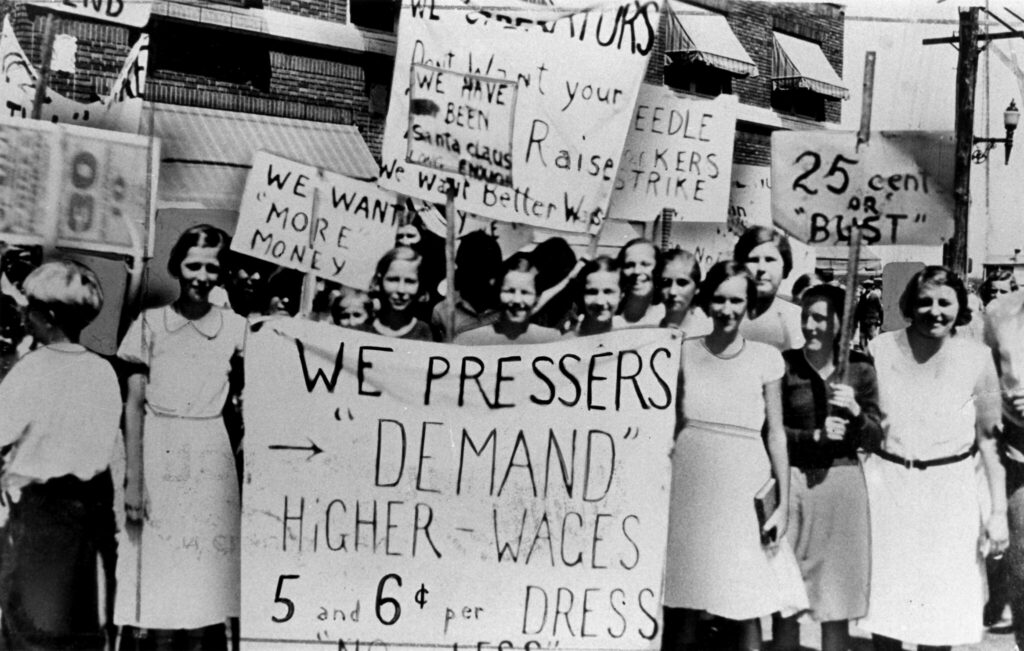
On Oct. 24, 1975, 90 percent of the women in Iceland refused to go to work, care for their children or cook for their families. Instead, thousands gathered in Reykjavík and villages nationwide to demand gender equality.
Schools closed. Flights were canceled. Businesses shuttered.
Factories came to a standstill. Phone service was off.
Men called it “The Long Friday.” Organizers called it Kvennafrídagurinn: Women’s Day Off.
As part of the United Nations International Women’s Year, Iceland had convened a Women’s Congress that June. The more than 200 women who attended were frustrated with wage inequality, women’s segregation into low-paying jobs and their disproportionate burden of domestic work. Abortion had become legal in 1935, but only in specific medical and social circumstances and with permission from a committee. Only a handful of women had ever served in Parliament.
“We said, What can we do that will be remembered always?” recalls Guðrún Ágústsdóttir, who attended the congress with members of the feminist group the Redstockings. “One of us, we are not sure who … said, ‘Why not take a strike?’”
When conservative women pushed back, Women’s Rights Society member Valborg Bentsdóttir made the suggestion to call it a day off.
Over the next four months, women sent letters, activated phone trees, papered bulletin boards, canvased workplaces and reached out to the media to raise awareness.
“They decided to do this strike and work tirelessly,” explains Rakel Adolphsdóttir, team leader at the Women’s History Archive. “This really was a huge group effort.”
Iceland’s tight-knit culture made it easy for women to build networks, hold consciousness-raising sessions and share information. And the legacy of nonpartisan organizing within Icelandic women’s associations was a powerful foundation for cultivating solidarity across lines of class, geography and politics.
During a guided tour of the archive’s “We Are Many” exhibit at the National and University Library of Iceland, Adolphsdóttir pointed to a half sheet of paper inside a glass box that lists the names and phone numbers of the first Women’s Day Off committee: “an assistant with sick people at home, a seamstress, a housewife, a data operator, teacher, interior decorator, another teacher, housewife, one from the fishing industry and an office manager,” she reads aloud. On another committee listing, she notes, “Someone has marked socialist, Democrat, progressive party, right party.”
An estimated 25,000 women flowed into Lækjartorg that October, making it the largest of more than 20 demonstrations across the country that day—and in Icelandic history. (In October 2023, 100,000 women strikers topped their own record.) “There was a lot of talk that women would lose their jobs,” Adolphsdóttir says, “and there were some companies threatening it.”
But women were undeterred. In the new documentary The Day Iceland Stood Still, strikers recount walking out of office buildings shoulder to shoulder with their female colleagues. The housekeeping staff on a boat headed to Russia locked themselves in a room on board and refused to work. Women on staff at one of the nation’s largest newspapers agreed to come in after hours so the paper could go out the next day—but only if the protest was featured on the front page.
“All our victories happen because we stand together,” Ágústsdóttir observes. “We have to unite and fight together. Then we succeed.”
Fifty Years of Feminist Progress
One year after the original Women’s Day Off, Iceland passed its first Gender Equality Act. Five years after the demonstration, Vigdís Finnbogadóttir, a divorced single mother, was elected president of Iceland—making her the world’s first democratically elected woman head of state. Shortly after the 1975 demonstration, women won the right to join the Farmers Association, a national trade union, for the first time in 140 years. Within a decade, the first women’s shelter in Iceland opened its doors.
There was an almost instant shift at Ágústsdóttir’s office. Before the day off, “the men would say, ‘Well, your work doesn’t matter,’” she recalls. “They never, ever tried to say that again. … Before, they looked at us, and it was as if we were on mute—because we moved our mouth but nobody heard us. Now they heard us.”
“Women are waking up!” Aðalheiður Bjarnfreðsdóttir, representing a trade union for low-wage women, proclaimed in Lækjartorg in 1975. “I believe that this world will change when women start ruling it equally with men. … I believe that in 10 years we will meet at Lækjartorg many more times, and then the time will come when the words we now see as visions will have become commonplace.”
Women returned 10 years later and five times after that, including at this October’s demonstrations—and much of Bjarnfreðsdóttir’s vision has become commonplace. Iceland has enshrined gender equality into its constitution. Its laws guarantee paid maternity leave to all working women, mandate a minimum of 40 percent representation of each gender on corporate boards and equal pay at all companies, grant women the full right to abortion and recognize nonbinary genders.
In 1986, Guðrún Erlendsdóttir took a historic seat on Iceland’s Supreme Court. In 2009, Jóhanna Sigurðardóttir became the first out lesbian prime minister in the republic— and the world. In 2024, 75 percent of voters cast ballots for women candidates, and Halla Tómasdóttir became Iceland’s second woman president. In 2025, a coalition government led by three female party chairs assumed office. Iceland’s prime minister, foreign minister, minister of justice and director of health are all women, as is the mayor of Reykjavík. So are 48 percent of members of Parliament—and the speaker.
Daughters of the Day Off
“My mother was one of the founders of the all-women’s party in Iceland, and was actually a member of Parliament,” Oddný Arnarsdóttir, head of Visit Iceland, shared during a press reception. “Us standing here today … it came from them saying, ‘Yes, you can. We paved the way. It’s your turn now.’”
“I was with my mom out there,” Speaker Þórunn Sveinbjarnardóttir remembered during a tour of the Alþingishúsið (Parliament House). “It has had a great impact on my political life. It’s the reason I’m a feminist.”
Being in the crowd, it just was palpable that everything was gonna change. It gave me shoulders to stand on.
Hrafnhildur Gunnarsdóttir
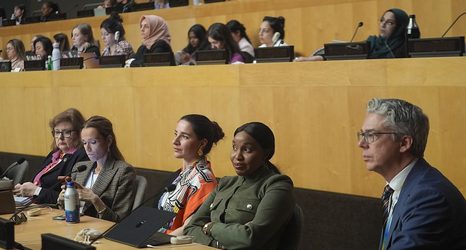
The day off was “the first day that I recall that [my mother and aunts] were not doing any baking or cleaning or fussing around, and the first time I saw my dad and the other husbands and brothers do the housework,” Tómasdóttir recounted during a panel discussion. In conversation with The Day Iceland Stood Still’s producer Hrafnhildur Gunnarsdóttir and director Pamela Hogan, Tómasdóttir was reminded of the reason those women gave for refusing their labor: “‘Because we want to show that we matter.’ Isn’t that, at the end of the day, what we all want to do? To matter, to be seen, to be valued, to be heard, to contribute.”
Gunnarsdóttir noted, “Being in the crowd, it just was palpable that everything was gonna change. It gave me shoulders to stand on.” During an interview with Ms., Hogan revealed that one of the 1975 strikers attended a recent screening in the Twin Cities. “People said: ‘Well, what’s your take- away? … She said, ‘Dream big.’”
This revolutionary legacy continues to fuel the Icelandic women’s movement. “We are the best in the world in many ways,” Ágústsdóttir enthuses. “But that’s not enough for us.”
Continuing the Fight
While organizers of the 2025 Women’s Strike, or Kvennaverkfall, are proud of Iceland’s progress, they’re far from satisfied. Ragnheiður Daviđsdóttir says, “I’m not interested in talking about this as an equality paradise.” She’s vice chair of Kvenréttindafélag Íslands, the Icelandic Women’s Rights Association.
For the past 16 years, Iceland has been recognized as the world’s most gender-equal nation by the World Economic Forum for closing more than 90 percent of gender gaps in health, education, economic participation and political empowerment. But Iceland’s adjusted gender wage gap has grown in the past year, as have reports of gender-based violence, and women continue to shoulder a lion’s share of domestic work. Asked about a backlash, Elva Hrönn Hjartardóttir, head of digital marketing at U.N. Women Iceland, notes, “We see it in … how people discuss women’s rights … and we also see it very much towards gay people.” Daviđsdóttir adds, “There has been a narrative shift … when it comes to immigrants … [as in] ‘This is a problem that needs to be fixed.’”
This year’s strike was part of a coalition effort marking the 50th anniversary of the Day Off with action to address gender inequality. “Sexism, and this male-oriented way of thinking, is still embodied in our community,” Hrönn says. “We are on top of many lists when it comes to equality, but we are also fighting the same fight as our sisters all over the world.”
The 2025 demands included revising wage valuation systems and creating rules for wage transparency; expanding preschool services and ensuring adequate maternity leave payments; improving services for survivors, strengthening laws against gender-based violence and implementing antiviolence education in schools; and making hate speech a crime.
“We gave our demands to heads of political parties on the 24th of October last year,” says Tatjana Latinovic, president of Kvenréttindafélag Íslands and cofounder of Women of Multicultural Ethnicity Network (W.O.M.E.N.) in Iceland. “We had elections a few weeks after that, and everybody said they will do something about it.” One year later, she notes, “nothing has happened.”
When Latinovic, the first foreign-born chair of Kvenréttindafélag Íslands, moved to Iceland in 1994, immigrants accounted for just 2 percent of the population. “Now it’s around 20 percent,” she says, and advocating for the equal rights of immigrant women has become central to the women’s movement.
Immigrant women are more likely to experience violence, and they’re disproportionately represented in low-wage jobs, where their wages are lower than for the average Icelandic woman. “Not all the women living in Iceland are enjoying the fruits of the labor of the women that came before them,” Latinovic says.
The 1975 Women’s Day Off demands did not specifically address violence. But the platform and program of this year’s strike were explicit in their inclusion of trans and gender nonconforming folks, immigrants and survivors. That was on purpose.
“We are celebrating everything that we have,” Hjartardóttir says, “but at the same time, we’re also emphasizing that we are not there yet. … We are honoring our legacy, but we are also moving forward together.”
“We cannot replicate what they did back in ’75,” Latinovic adds. “We need to expand it.”
The World We Want
The feminist anthem “Áfram stelpur” (Onward girls) rang through Lækjartorg in 1975. “This is exactly the world that I want,” the crowd sang. “Let’s build a new world with the hands of strong women in all countries!”
Half a century later, a group of young people in the square echoed the sentiment.
“I want a world where my voice carries the same weight as any man’s,” testified Sóley Lóa Smáradóttir.
“I want a world where gender-based violence is not a reality for most women and nonbinary people,” demanded Áróra.
“I want a world where I make my own decisions about my body,” called out Júlí Mjöll.
“I want a world where women and nonbinary people live in equality,” demanded Dýrleif Gígja.
They invited attendees to hold hands and “imagine this new world together” before a familiar rhythm filled the square. As Anya Shaddock performed, strikers recited the lyrics venerated in Iceland’s feminist memory: “The time has come! Let’s all join hands and hold fast to the cause … I dare, I can, I will!”
In the crowd, Hogan watched a young mother and daughter. “Her daughter was dancing, and everyone was singing,” she says, “and she was mouthing it very carefully so that her daughter would learn the words.”
This article originally appears in the Winter 2026 print issue of Ms. Join the Ms. community today and you’ll get issues delivered straight to your mailbox.