They Dare, They Can, They Will: The History of Iceland’s Decades-Strong Women’s Strike Movement

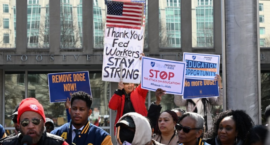
On Oct. 24, 1975, 90 percent of the women in Iceland refused to go to work, care for their children or cook for their families. Instead, thousands gathered in Reykjavík and villages nationwide to demand gender equality.

Schools closed. Flights were canceled. Businesses shuttered. Factories came to a standstill. Phone service was off.

Men called it “The Long Friday.” Organizers called it Kvennafrídagurinn: Women’s Day Off.

In Serbia, Women Journalists Say Death Threats Have Become Routine

In 2019, Jovana Gligorijević wrote a damning profile of a Serbian influencer who had connections to political power players and alleged criminal networks. 

Gligorijević works at Vreme, an independent news magazine founded in 1990 by intellectuals and activists fighting state censorship. Aside from her political reportage, she’s covered stories on sexual violence and, specifically, how Serbia’s judiciary treats rape victims. She notes wryly that in her experience, “when you report on politics and human rights, sooner or later you come across the far right as the root cause of the problem.” 

Other independent women journalists like Gligorijević that are critical of the Serbian government face sexual insults, threats of lawsuits, surveillance, smear campaigns and online rage.

Trump-Era Federal Layoffs Hit Black Women Hardest

There is a shift happening in the labor force that favors men in general, and white men in particular. And Black women—who historically have found more job security and upward mobility in federal employment—are now seeing those federal jobs slip away in record numbers.

“What we are seeing happening is a federal government that is intent on creating a DEI boogeyman to radically change how workplaces operate in ways that disadvantage women, people of color and LGBTQ workers,” says Gaylynn Burroughs, vice president for education and workplace justice at the National Women’s Law Center.

Who Controls Mifepristone? The Politics Blocking a New Era of Contraception

Mifepristone “works against endometriosis. It works against myoma [fibroids]. We are now involved in a study group that looks at whether it can prevent breast cancer,” says pioneering reproductive-health advocate Dr. Rebecca Gomperts. “It has so many potential uses, and it hasn’t been [developed].

“If we as women don’t make sure that it becomes available to meet our needs … then it won’t happen.”

This is the final installment of a new series, “The Moral Property of Women: How Antiabortion Politics Are Withholding Medical Care,” a serialized version of the Winter 2026 print feature article.


Mifepristone Could Treat Endometriosis, Some Cancers, Depression and Chronic Illness—If Politics Didn’t Interfere

Across a range of conditions that disproportionately affect women, research into mifepristone’s potential has been slowed, defunded or blocked altogether. Nowhere is that clearer than in the treatment of endometriosis and other serious illnesses that leave millions of women in chronic pain.

Endometriosis—when endometrium cells grow outside the uterus—afflicts an estimated 10 percent of reproductive-age women. It can lead to chronic pelvic and back pain, heavy or abnormal bleeding, pain during sex or bowel movements, fatigue, bloating, digestive issues, infertility, anxiety and depression.

Mifepristone can help—it blocks the progesterone causing the cellular growth and decreases the size of existing endometrial lesions, thereby relieving painful symptoms. But antiabortion politics have obstructed the development of the medication for these uses in the U.S.

Researchers have also produced studies showing mifepristone is effective for treating ovarian and breast cancer, chronic inflammatory diseases, and several psychiatric disorders, including major depressive disorder, post-traumatic stress disorder (PTSD) and psychotic depression.

This is Part 2 of 3 in a new series, “The Moral Property of Women: How Antiabortion Politics Are Withholding Medical Care,” a serialized version of the Winter 2026 print feature article.

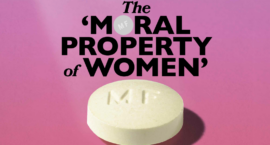
‘The Moral Property of Women’: Mifepristone, Fibroids and the Stakes of Suppressed Science

Despite mifepristone’s broad medical promise, its development has been repeatedly stymied by abortion opponents who fear wider availability would weaken their attempts to suppress abortion access.

More than 26 million women in the U.S. are affected by fibroids, which are noncancerous growths of the uterus that can reach the size of a grapefruit or larger. Treatment too often defaults to invasive surgery, either removing the fibroids or performing hysterectomies.

In China today, a three-month regimen of 10 milligrams of mifepristone per day is the approved protocol for treating fibroids. Meanwhile, American women still do not have access to this very effective nonsurgical treatment.

This is Part 1 of 3 in a new series, “The Moral Property of Women: How Antiabortion Politics Are Withholding Medical Care,” a serialized version of the Winter 2026 print feature article.

Driving the Vote for Equality Launches, Reviving a 1916 Suffrage Tour for the ERA

In 1916, two adventurous, gutsy women—Alice Snitjer Burke, 39, and Nell Richardson, 25, both members of the National American Woman’s Suffrage Association—were determined to spread the message about the importance of women’s suffrage. With support from NAWSA, they volunteered to make an epic car trip across the country and back in a small Saxon roadster for “the cause.” At the time, few women drove cars, and automobiles were a big part of a major cultural shift from horses and buggies. Such a trip would be symbolic on many levels.

Their journey often made front-page news due in part to the novelty of seeing a woman drive a car, but Alice and Nell kept the focus on “votes for women.”

The Driving the Vote for Equality tour officially launched on March 1, 2026, at the New York Historical in Manhattan. A restored 1914 Saxon automobile—matching the make and model driven by Burke and Richardson in 1916—has begun retracing their cross-country route to promote congressional recognition of the Equal Rights Amendment. Former Rep. Carolyn Maloney, a longtime ERA champion, is spearheading the campaign.

Sneak Peek: What’s in the Winter Issue of Ms.? Groundbreaking Reporting on Women’s Health and Power

Mifepristone has shown potential to treat a striking range of diseases and conditions, some life-threatening: fibroids, breast cancer, depression, endometriosis, Gulf War illness and maybe even other autoimmune diseases, such as chronic fatigue syndrome and multiple sclerosis. Research also suggests that mifepristone may help prevent some forms of breast cancer and can serve as an effective weekly contraceptive without the side effects of hormonal birth control.

Yet despite the drug’s promise, its development has been repeatedly stymied by abortion opponents who fear wider availability would weaken their attempts to suppress abortion access. 

The result? Women are left in needless pain and subject to invasive and unnecessary surgical procedures like hysterectomies.