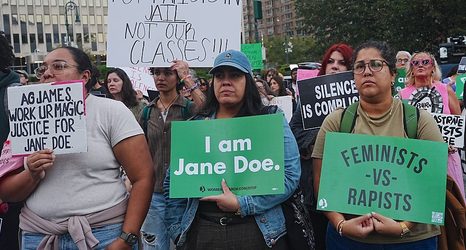
As Women’s History Month is quietly dismantled, a collective refusal is taking shape.

Since 1987, the United States has celebrated Women’s History Month every March. For nearly four decades, the country has paused—if only briefly—to recognize the contributions of American women across science, politics, art, labor, medicine and every other field that makes up our national story.
We have used this month to correct the record. To make sure that the women who built this nation—who are often systematically written out of history books and erased from the stories we tell ourselves about who we are—are named out loud and recognized. It is a national reminder that women are not a footnote to the American project. We are central to it.
But just shy of its 40th anniversary, we may be witnessing what could become the last Women’s History Month as we know it.
Across the country, Women’s History Month celebrations are quietly disappearing. Events that were once public and proudly advertised are now being removed from calendars, canceled altogether or held quietly behind closed doors. Schools, museums, libraries and universities that once hosted panels, exhibits and community events are stepping back. Not because communities stopped caring—but because an administration decided that honoring women is a threat.

In January 2025, the Trump administration issued executive orders eliminating DEI programs across the federal government and all federally funded institutions. One order—”Ending Illegal Discrimination and Restoring Merit-Based Opportunity“—directed agencies to terminate DEI offices and investigate any institution receiving federal funds that maintained identity-based programming.
Universities, nonprofits, museums and schools that depend on federal support quickly took notice. Many have pulled back from Women’s History Month programming entirely out of fear that simply acknowledging women’s history could be interpreted as violating new restrictions.
This Was Always the Plan
The constraints on Women’s History Month do not exist in isolation. It is one thread in a much larger design—and that design has a name.
Project 2025, the more than 900-page governing blueprint developed by the Heritage Foundation and affiliated conservative organizations, lays out an explicit vision for the role of women in American life. The extensive document calls for eliminating federal offices focused on gender equity, dismantling Title IX protections and rolling back workplace rights that allow women to participate in public and economic life as equals. It frames the two-parent, male-headed household as the fundamental unit of American society and treats any policy that supports women’s independence as an attack on the family. They backed that up with Project 2026, explicitly outlining their attacks on gender.
The attacks on reproductive rights fit the same blueprint. Since the fall of Roe v. Wade, more than 20 states have enacted abortion bans or severe restrictions, disproportionately affecting Black women, low-income women and women in rural communities. Medicaid—the program that covers nearly half of all births in the United States and is the primary healthcare lifeline for low-income women—is under sustained assault, with proposed cuts that would strip millions of women of access to prenatal care, contraception and cancer screenings.
The pronatalist movement, gaining influence in and around the administration, goes further still. Figures like Elon Musk and networks affiliated with figures like the late Phyllis Schlafly’s Eagle Forum have openly advocated for policies designed to steer women away from careers, education and public life and toward domestic roles defined by childbearing and dependency. This is not a fringe position. It is increasingly the animating vision of one of the two major political parties in the United States.
Taken together, the picture is clear: This is a coordinated effort to remove women from public life, from our history books, from our healthcare system, from our economic independence, from the story of who America is and who gets to shape its future.

However, Women’s History Month exists precisely because this is not the first time women have been told we do not belong in the story.
The women who built this country, who fought in its revolutions, survived its genocides, labored in its fields and factories, led its movements, invented its technologies, raised its children, were systematically excluded from the history that was written down and taught. Women’s History Month was not a gift. It was a correction, won after decades of advocacy.
Our long and embedded history in this country means we know something important: This is not the first erasure of women from history. We have fought it before, and it’s time to do it again.
This is a moment of resistance, and of renaissance.
Across the country, women are running for office in record numbers. We in the reproductive justice space are engineering the future of reproductive freedom, one that is intersectional, expands community health networks and trains the next generation of advocates. Women’s movements are connecting the dots between bodily autonomy, economic independence and the freedom to participate fully in public life.
We are not just trying to hold on to what we have. We are trying to build what should have always existed.
That is what Women’s History Month has always really been about, not nostalgia, rather orientation. A moment to look back so we know where we are going. To name what was taken so we understand what we are building. To honor the women who carried this forward before us, so we understand the weight and the dignity of the baton we now hold.

Harriet Tubman did not free herself and stop. Fannie Lou Hamer did not survive a Mississippi jail cell to just go home. Shirley Chisholm did not run for president, unbought and unbossed, so that we could sit down now.
We owe them more than memory. We owe them continuation.
Women are not a footnote in the American story. We are not a special interest, a demographic, a voting bloc to be managed. We are the American project and the American future.
It’s up to us now to saddle up and make sure that future generations of women and girls can not only know about the incredible shared history of the bad ass women that helped shape the world, but can feel the full freedom of it—which means we now have work to do.
We ride at dawn.