Congress should implement bystander training to prevent future scandals.

This analysis was originally published on In the Arena with Jackson Katz.
Rep. Eric Swalwell (D-Calif.) has ended his California gubernatorial primary campaign and resigned from Congress amidst a flurry of allegations about sexual assault and misconduct that involved female members of his staff, interns and others.
When the story first broke, many of his fellow Democrats were quick to denounce the now-former legislator’s alleged behavior. Rep. Pramila Jayapal (D-Wash.) spoke for many when she said on X that she was “sick and tired of men in positions of power getting away with sexual harassment, assault and abuse.”
She called on both Swalwell and Texas Republican Tony Gonzales, who has faced his own sexual misconduct scandal, to resign. “Otherwise,” she said, “I would vote to expel them.”
Many of Swalwell’s friends and colleagues distanced themselves from him; all of them deny they knew anything about the congressman’s alleged exploitive behavior.
For his part, Swalwell denies raping anybody, but acknowledges he made some “bad decisions.”
Swalwell’s resignation from Congress punctuated a surprisingly swift fall from grace for the talented and ambitious politician. The seven-term congressman served on the Judiciary and Intelligence committees, and was a consistently vociferous critic of Donald Trump.
The extent of political fallout that will ensue from this scandal remains to be seen. What is clear is that Swalwell’s withdrawal has already altered the California governor’s race.
But leaving aside its electoral implications, the Swalwell scandal has prompted renewed attention to sexual misconduct and repeated abuses of power by privileged and influential men.
It has also revived #MeToo era discussions about the roles and responsibilities of people around Rep. Swalwell—specifically his friends and colleagues. How could they not have known anything about what observers have described as an “open secret”?
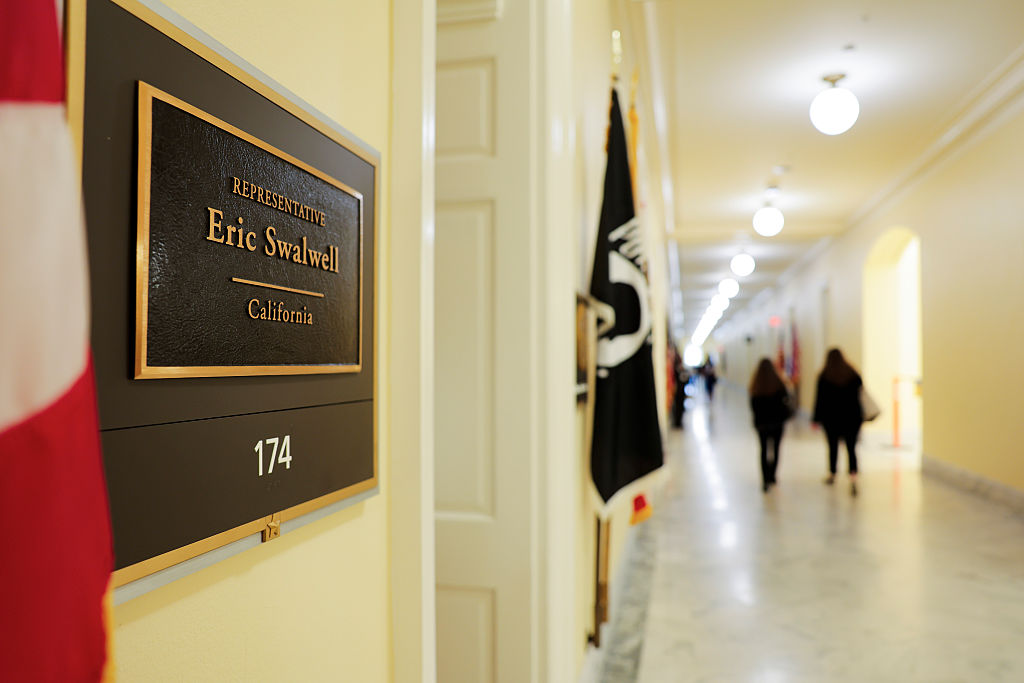
One of Swalwell’s friends, Sen. Ruben Gallego (D-Ariz.), acknowledged in a press conference on Tuesday that he had long heard rumors that Rep. Eric Swalwell was “flirty” with women, but had allowed his longtime friendship with the California Democrat to cloud his judgment, and never said or did anything about it.
Gallego said he regretted not having confronted Swalwell about the rumors.
As Michael Gold reported in The New York Times, Gallego’s account provided a glimpse into the roots of “a culture of secrecy and silence” on Capitol Hill that, years after the #MeToo movement, has continued to allow men like Swalwell to serve and ascend the ranks of power even when there are whispers of misbehavior toward women.
Rep. Alexandria Ocasio-Cortez (D-N.Y.) said that Congress was at a “resetting point” after the back-to-back resignations.
“I don’t think our work is done,” she said. “I think that a lot of the underlying structures that silence victims of sexual harassment and abuse still exist.”
Bystander Education Is Part of the Solution
This is an altogether familiar—and tired—exercise.
The pattern is predictable, whether it involves famous men—like Fox News founding chairman and CEO Roger Ailes, movie producer Harvey Weinstein, or hip-hop mogul Sean Combs—or it occurs in less glamorous institutions like private companies, colleges and universities, and the military.
When word gets out that a woman or women (or men) have made credible allegations of sexual misconduct against a well-known man, people around him scramble to distance themselves, and downplay or deny any knowledge about his bad behavior.
Serious leaders issue somber calls for greater accountability. They say this needs to stop, and we need to “do better.”
Right up until the next scandal.
What rarely happens is what sexual assault prevention educators have said for decades needs to happen: systemic implementation and institutionalization of prevention education. Not check the box, online training that focuses on acquainting people with school or workplace policies and procedures, as mandated by law. That sort of informational training is a necessary, but not sufficient, component of robust prevention education.
What’s needed is regular, in-person educational programming that equips everyone in a given school, organization, company or government entity with the tools to identify misogynous abuse, from the most casual to the most extreme, and the encouragement and permission to do something about it.
Whether that means taking your friend aside for an uncomfortable (but honest) chat, consulting with friends or colleagues to strategize an informal group plan of action, filing an anonymous complaint, reporting the offending behavior to the appropriate authorities, or any number of other creative options.
This is all part of the bystander approach to prevention. The organizing principle behind the bystander model is that it moves beyond the perpetrator-victim binary. Instead, it focuses on what everyone in a given peer culture can do:
- to support the targets of harassment and abuse, and
- to interrupt abusers.
Not because the abuse contravenes company policy or is illegal, but because members of the group don’t approve of the behavior. This is not how we treat each other here. The peer culture in effect polices itself.
Bystander training is one of the most popular forms of gender violence prevention education in North America, and other parts of the world. I’m one of its early architects. I conceived and co-created the Mentors in Violence Prevention (MVP) program at Northeastern University’s Center for the Study of Sport in Society, which introduced bystander training to the field.
In 1993.
At its best, bystander training addresses the very sorts of questions raised by the Swalwell debacle: What could people around him have done? What were the pros and cons of various interventions? More generally, what are some of the ethical considerations that colleagues and co-workers need to take into account in order to make good decisions about fraught interpersonal and professional situations, such as when a popular figure in a workplace crosses lines?
Whether they’re personally outgoing or shy, socially assertive or conflict-avoidant, bystanders need to consider numerous factors before they act. These include group norms (e.g. Do men in this group ever interrupt each other’s sexism?) and many other peer culture dynamics. Have they ever spoken up about these sorts of things in the past? If not, what held them back? If they’re white, have they ever challenged a white friend who made a racist comment? Are the ethical considerations any different?
From the beginning, my vision was that trainings that raised these sorts of questions should become a normative part of institutional life—for everyone. People in formal positions of leadership should receive even more focused training, because they have more responsibility than anyone for establishing the right tone and enforcing the group’s shared values.
(I discuss all of this in much greater detail in my new book Every Man: Why Violence Against Women is a Men’s Issue.)

Men as Bystanders
Of course, women and non-binary people play important roles as bystanders, too. But I have long argued that changing the social acceptability of misogyny in male culture at all levels—from high school hallways to the halls of Congress—is the beating heart of sexual assault prevention work.
In order for that to happen, men must make it clear to their friends, teammates, colleagues and co-workers that misogynous behavior—from catcalls to gang rape and everything in between—is not only wrong and sometimes illegal.
It’s also uncool, unwelcome and unacceptable to their fellow men.
This is a seemingly simple thing to grasp in principle, but it’s been incredibly difficult to achieve in practice, because millions of men who see themselves as “good guys” and not part of the problem nonetheless routinely fail to act when they could make a difference.
What are some of the main obstacles to them doing so?
For one thing, it can be enormously awkward and anxiety-producing for a man to challenge another man about the way he acts toward women. Many men hesitate to do so because they’re unsure of how to do it without causing irreparable harm to the friendship.
This is especially the case when the behavior in question falls into a “gray zone,” when it’s unclear if it’s abuse, or abuse of power, as opposed to crude or even sexist behavior that doesn’t rise to the level of criminality or actionable misconduct.
In addition, adult men—not just young men and boys—continue to face intense pressure to be “one of the guys” and not rock the boat—or risk facing the consequences. This pressure is impossible to quantify, but it’s also impossible to overstate how powerful it remains in keeping men silent about men’s mistreatment of women.
The pressure to remain silent in order to fit in affects men across the board, but it’s intensified for men who are part of cohesive organizational cultures. These can be informal, such as street or motorcycle gangs, or formal, such as (men’s) sports teams, college fraternities, law enforcement agencies and military units.
Men in these male-dominated subcultures share not only mutual goals, but often deep bonds of camaraderie and friendship.
The downside is that individuals are expected to conform to the rules of hierarchy and not challenge group norms, or risk social penalties and in some cases social or professional suicide. These norms can encourage and reward either prosocial or antisocial behavior.
The respect for status hierarchies in most male-dominated social or professional peer cultures has obvious implications for bystander behavior, because men who are younger, or who have less social status or power, know they risk a great deal if they call out misogynous behavior by more senior or more popular colleagues—regardless of what it says in the team’s code of conduct or workplace employee handbook.
The social dynamics in peer cultures can make it difficult for people to intervene—even when it’s their job to do so. Whether it’s called a boy code, a guy code or a bro code, a set of unwritten rules governs the behavior of individuals in all-male or male-dominated groups.
This is especially true of groups engaged in aggressive competition and “us versus them” battles with other groups. This is certainly the case in sports and politics, where there are strong disincentives to say or do anything that reflects poorly on a fellow group member, or the group itself.
There Is Opportunity in Crisis
The good news—as it relates to the latest round of sexual misconduct scandals in American politics—is that sexual assault prevention educators have at least some answers to the problems that have bedeviled institutions like Congress for far too long. They know how to help people develop the tools for better decision-making, and more effective bystander interventions, in the face of misogynous harms.
What they haven’t been able to do as well is navigate the politics. How do you get institutional buy-in for the kinds of prevention training that, when implemented systematically over time, encourages and rewards active bystander behavior, and thereby helps to shift social norms? How do you provide sustainable funding for these sorts of initiatives, that is not subject to the whims of passing political majorities or movements? At this point, is it even possible to do this on a bi-partisan basis?
Maybe a group of Congress members, working together with sexual assault prevention educators, can at long last find answers to these critical questions, and propose workable solutions. Not only for the safety and well-being of women and others in the congressional workplace, but as a model for others as well.
At the very least it’s worth a try.