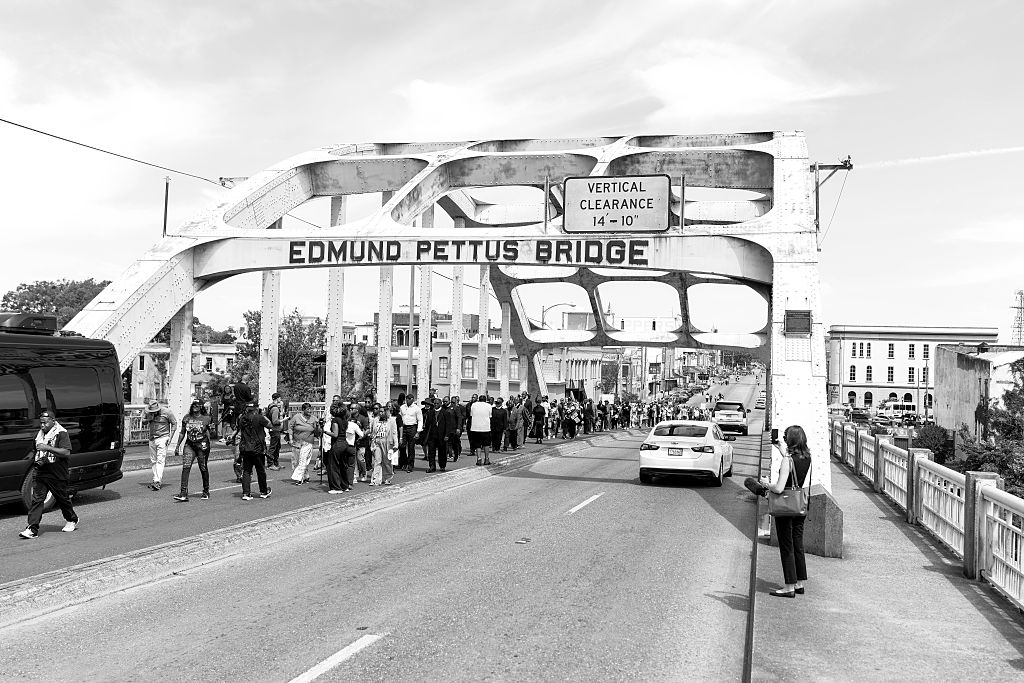
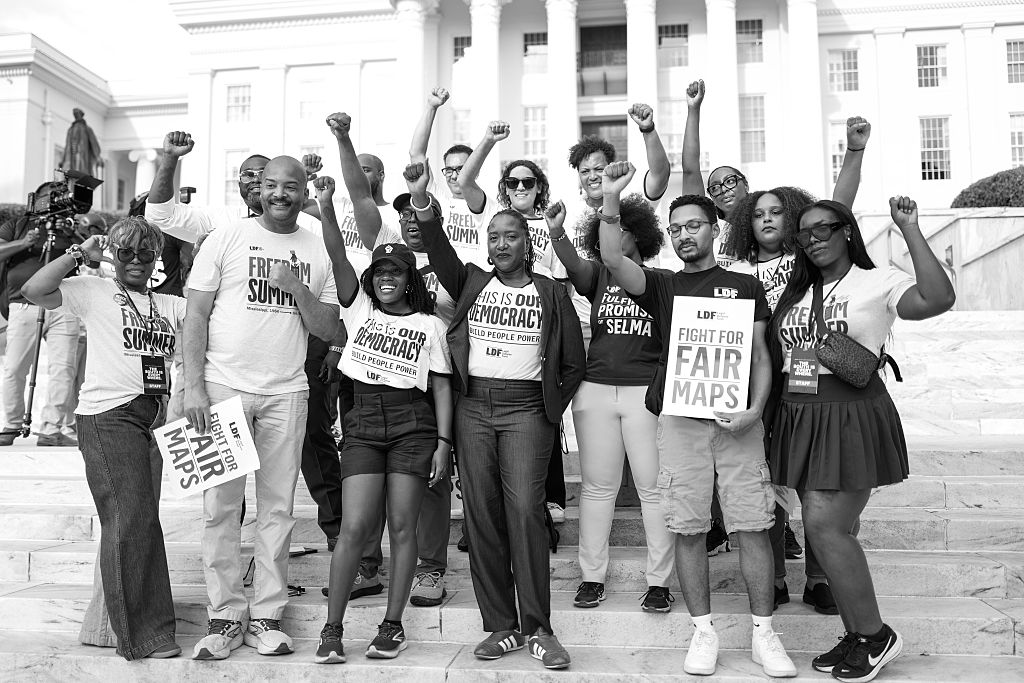
On the morning of Saturday, May 16, in Selma, Alabama, activists and organizers gathered near the Edmund Pettus Bridge before traveling to Montgomery for the “All Roads Lead to the South” national day of action protesting attacks on voting rights and Black political representation across the South.

More than 5,000 voting rights advocates gathered for the event, which also inspired nearly 100 satellite actions nationwide and brought together roughly 160 organizations in Alabama alone, according to organizers.
The demonstrations came just weeks after the Supreme Court’s decision in Louisiana v. Callais, a ruling civil rights groups warn will accelerate racial gerrymandering and weaken protections under the Voting Rights Act across the South.
Organizers at the Montgomery rally repeatedly referenced growing fears that Republican-led legislatures in states including Alabama, Louisiana, Mississippi, Tennessee and Missouri could move to redraw district maps in ways that dilute Black political power.
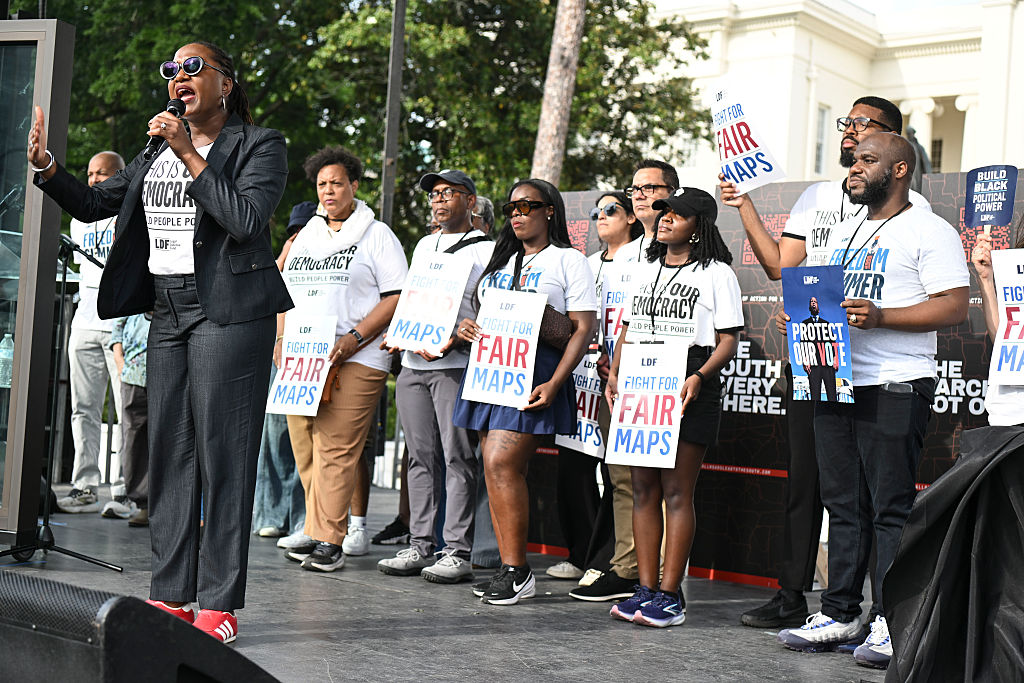
The chants echoed through downtown Montgomery:
“The power is with the people.”
“Vote, vote, vote.”
“We won’t go back.”
“Fired up. Ready to go.”
Held in the birthplace of the Civil Rights Movement, the rally connected present-day redistricting battles to the long history of voter suppression in the South.
Watch the full livestream below, then read on for a curated collection of the voices and messages that moved the crowd in Alabama.
Rep. Alexandria Ocasio-Cortez (D-N.Y.) asked the crowd to reflect on the history surrounding them. “Can you believe that this sanctuary of just 300 people changed the world?” she said, referencing the movement roots stretching from Ebenezer Baptist Church to Dexter Avenue Baptist Church in Montgomery.
“It was right here in Montgomery where we saw some of the most cruel repression in the history of America. Where we also saw the highest angels of American history rise to create our democracy. Because it wasn’t until the Voting Rights Act that was passed that we even had a democracy in this country. There was no democracy in America until every human being born here was guaranteed and protected the right to vote.”
She tied voting rights to broader fights over education, healthcare and democracy itself:
“When Black Americans have the right to vote and that vote is protected, our schools get funded. When voting rights are protected, healthcare gets expanded. When voting rights are protected, our country moves forward. And Montgomery, that’s what they are actually afraid of.”
Her sharpest warning drew one of the loudest responses from the crowd:
“They think they can draw us out of power. They do not know the sleeping giant that they just awakened.”
Throughout the day, speakers framed the South not as a political afterthought, but as the center of the fight over democracy.
Tennessee state Sen. Charlane Oliver declared:
“They may draw some racist maps, but we are the South, this is our South. The South belongs to us. The South got something to say, and we gonna speak real loud and clear in November.”
Birmingham Mayor Randall Woodfin emphasized long-term organizing and urged attendees to organize “at every church, and every campus, and every union hall” ahead of upcoming elections,
“This fight is more than about May 19. This fight is more than about the first Tuesday in November of 2026. We’re in this fight for the long game, and that requires you to not give up. … There’s never been a moment in this country where progress was made [where] someone didn’t intentionally try to take us back.”
Sen. Cory Booker (D-N.J.) connected current voting-rights battles to generations of civil rights activism.
“The ground we walk on was watered with the tears and blood of our ancestors. … When you’re so afraid of Black voters, when you’re so afraid of fair elections that you’re going to do everything you can to rig them to stop Black voters from participating, then you know we have the power. We have to respond with the power of the people.”
Several speakers referenced other recent legal battles over congressional maps and Black representation, including the Supreme Court’s 2023 decision in Allen v. Milligan.
Lead plaintiff Evan Milligan warned attendees that the fight is far from over:
“We don’t have to accept that this will be the reality for the next 10 years or two years or forever.”
Shalela Dowdy, another plaintiff in Allen v. Milligan, was even more direct:
“We are not going down without a fight. We are not going down to Jim Crow maps.”
Organizers repeatedly described attacks on voting rights across Southern states as coordinated and intentional.
Co-founders of Black Voters Matter LaTosha Brown and Cliff Albright said together:
“Sixty years after Bloody Sunday, we are once again being called to meet this moment with collective action. The attacks on voting rights across the South are not isolated incidents, they are part of a coordinated effort to weaken Black political power.”
That theme surfaced throughout the rally.

Rodreshia Russaw, executive director of the Ordinary People Society, told the crowd:
“If Alabama can be used to test drive attacks on our democracy, then Alabama can be used as a blueprint for resistance.”
Skye Perryman of Democracy Forward framed the moment this way:
“This is an old fight in a new time.”
As the rally closed, Montgomery Mayor Steven Reed reminded attendees that the gathering was meant to be a beginning, not an endpoint.
“We’re here in Montgomery not as a stopping point, but as a starting point.”
Giovanna DeStefanis, Rebecca Quist Larsen and Claire Masquida provided important research and editorial assistance with this article.