


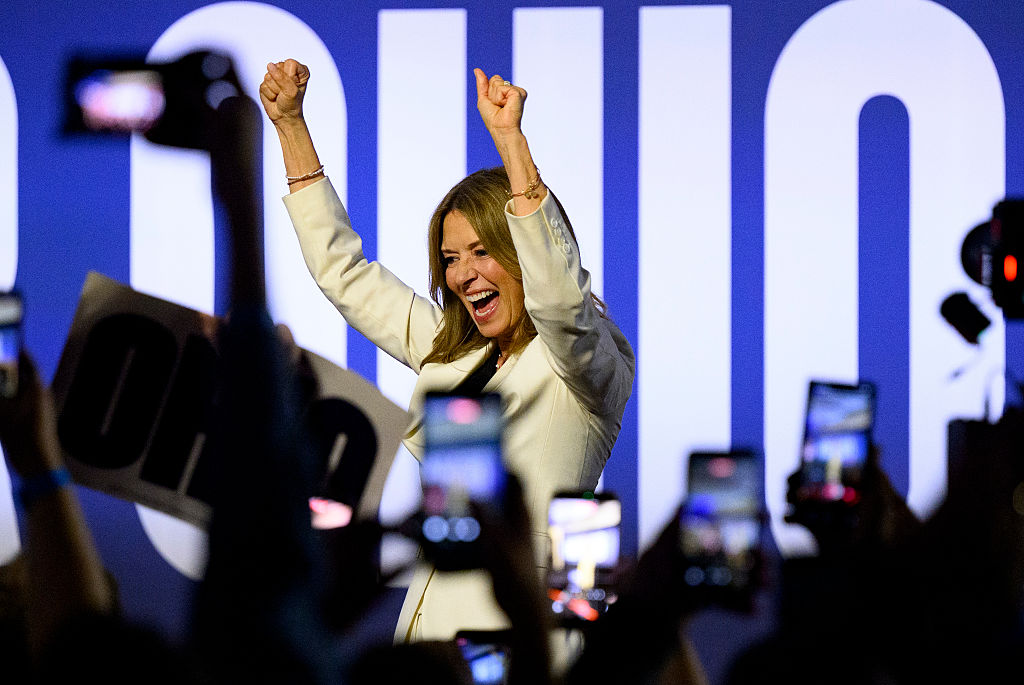
Tuesday night brought historic victories for women: In New Mexico, Deb Haaland became the nation’s first Native American woman elected governor. In Georgia, Keisha Lance Bottoms became the first Black woman elected governor in U.S. history, winning in Georgia. And in Ohio, Amy Acton became the state’s first woman elected governor and its first Jewish governor.
But Acton’s victory over Vivek Ramaswamy is especially meaningful for survivors of sexual violence.
Just weeks before the midterm elections, Ramaswamy aired an attack ad featuring Acton’s estranged mother, whose husband sexually assaulted Acton when she was a child. (Court records and contemporary reporting corroborate key elements of Acton’s account, which her brother has also publicly supported.) The attack ad, released in October, featured Acton’s birth mother, Donna Arthur, calling her daughter a liar and urging Ohioans not to elect her. But the ad omitted a crucial piece of context: Arthur lost custody of Acton and her brother after her husband was indicted for raping Acton when she was 12 years old.
While Ramaswamy continued to defend the ad along the campaign trail—with support from President Trump and Vice President JD Vance—Acton spoke honestly about the sexual abuse and homelessness she experienced throughout her childhood. “I won’t normalize somebody who has said that my childhood is just something I’m complaining about.”
Instead of mobilizing support for Ramaswamy, the attack ad divided the GOP and garnered widespread public criticism. Four former Ohio governors and current Republican Gov. Mike DeWine (a former colleague of Acton) criticized the ad. “It’s wrong to run this ad,” DeWine said, calling it “deeply, deeply troubling.” DeWine urged Ramaswamy to take it down, but Trump pushed back, accusing the governor of trying to help Acton win. Trump also posted on social media that “Vivek should keep it up, and let everyone listen to the mother of a defective, dishonest, and incapable Candidate.”
Despite what Trump said about Acton, voters were not convinced. A physician from Youngstown who helped lead Ohio’s COVID-19 pandemic response, Acton campaigned on affordability, healthcare access and her working-class roots.
Just days before the election, Ramaswamy took the controversial ad off the air. Ramaswamy told reporters that the ad “ran to completion” and he wanted the final days of his campaign to “really be about policy.”
But Ohioans did not forget this vicious attack on one of their own or the fact that “he took it off the air in the most cowardly way possible, without even a hint of an apology to Dr. Acton, her family, or to the people of Ohio,” said Addie Bullock, a spokesperson for Acton.
On Tuesday, Ohioans elected Acton their next governor, making her the first woman elected to lead the state and the first Democrat to win the office in 20 years.
After a campaign in which her childhood trauma was exploited for political gain, Acton’s victory is one for all survivors, as well as a critical reminder of the importance of holding powerful people, including President Donald Trump, accountable.
We may never know whether Ramaswamy’s attack ad clinched Acton’s victory. But to survivors and their supporters, it was a pointed reminder of how easily experiences of sexual violence and abuse can be dismissed, questioned and exploited for political gain.
Trump’s defense of the ad was also a reminder that men like Ramaswamy and the president view sexual assault as something to be taken lightly, overlooked and exploited for political gain. The president himself was found civilly liable for sexually abusing E. Jean Carroll in 2023, and he has faced renewed scrutiny over his connections to Jeffrey Epstein.
This election also unfolded amid a growing national reckoning over sexual violence, including revelations surrounding the seven Cornell University fraternity members accused of sexually assaulting a student identified as Jane Doe. Her allegations, the disturbing Snapchat messages that have emerged and the threats and harassment she has reportedly faced have sparked protests across the country.
Survivors and their allies have also rallied around Louisiana State University student Kendall Francis and the family of Fashion Institute of Technology student Annabel Richter, who died after an alleged drugging and sexual assault. Girls, women, boys and men have showed up in protest, carried signs and wore clothing reading “I am Jane Doe.” They demanded survivors be heard, believed and protected, and that perpetrators and institutions be held accountable. Against that legal and political backdrop, Ramaswamy’s decision to attack a survivor of child sexual abuse was especially disturbing—yet familiar to those who have experienced sexual violence themselves.

Before the election, Rep. Robert Garcia (D-Calif.) told Ms. that a Democratic House majority would provide the subpoena power necessary to compel testimony and obtain financial and business records related to Epstein’s network, including his connections to the modeling industry. Now, Democrats have won that majority … and the opportunity to follow through.
Investigations should extend to the president—and beyond. In “The Pipeline to Predators,” a four-part Ms. investigation, Justine Andronici documented how Epstein and other powerful men exploited young women’s ambitions in the modeling industry, and how agencies and industry gatekeepers allegedly helped put them in harm’s way. The survivors she interviewed want investigators to follow the money, examine the institutions and individuals that helped make abuse possible, and give survivors meaningful paths to justice.
Ohio’s rejection of a type of politics rooted in cruelty, misogyny and the dismissal of survivors, is a victory for all who have long been calling for justice. It is a victory for every person who has spoken out about their assault and fought for acknowledgment and accountability. It is a victory for survivors who have refused to back down despite death threats, doxxing and harassment, like Cornell’s Jane Doe. And it is a victory for every survivor, loved one and ally who gathered in early October as part of the “I am Jane Doe” rallies, horrified by what they read in that Cornell Snapchat group and what they heard in Ramaswamy’s attack ad—because of how familiar it all sounded.
To platform a parent who stood by as their child was sexually abused by their partner was just the kind of exploitative, sexist rhetoric that voters have come to recognize from the president. Just as Trump defended the “Cornell 7,” voters—especially women voters—recognized the political climate in which Ramaswamy felt safe and emboldened to create and run this ad.
Trump responded to the midterm results by claiming that if he had been on the ballot, Republicans would have won in a landslide. But for survivors and allies, he was on the ballot. Even if his name was not printed in ink next to one of the bubbles, his policies and his sexist, violent rhetoric were. And voters gave Democrats majorities in both the House and Senate to challenge his administration.
As one woman posted online, “for my daughters. For your daughters.”
May we all celebrate this nationwide rejection of Trumpism as a victory clinched not just by survivors but by women of color (who themselves are strikingly more likely to experience sexual violence) who fought and flipped former Jim Crow states. Women and Black voters, particularly across the South, helped deliver historic victories despite efforts to dilute their political power.
With Democrats set to control both the House and Senate in January, survivors have an opportunity to see their demands for justice taken seriously. That means pushing for the full release of the Epstein files while protecting survivors’ identities and personal information. It also means congressional hearings, subpoenas and investigations into the powerful individuals and institutions that enabled Epstein’s abuse.
As Andronici reported in the final installment of “The Pipeline to Predators,” lawmakers already have legislation they can advance: the REDACT Act, which would allow Epstein survivors to sue the Justice Department for failing to protect their private information; the Survivors Rights Restitution Act, which would provide financial relief to survivors whose rights were violated by the federal government; Virginia’s Law, which would eliminate certain statutes of limitations that have prevented survivors from pursuing civil justice; and the Courtney Wild Reinforcing Crime Victims’ Rights Act, which would require prosecutors to consult victims before finalizing plea agreements.
And the fight for survivors cannot stop with Epstein. Congress must also restore and strengthen Title IX protections for students and pursue broader reforms to address sexual violence. As Ms. executive editor Kathy Spillar wrote in response to the Cornell case, recognizing the Equal Rights Amendment could provide a constitutional foundation for stronger federal laws against gender-based violence, including restoring the civil rights remedy in the Violence Against Women Act. States can also lead the way, as California did with Senate Bill 1056, which establishes safeguards for reviewing sexually explicit evidence in criminal trials.
Acton’s victory is a reminder that survivors can refuse to be silenced, even when powerful people try to turn their trauma against them. But celebrating survivors is not enough. They deserve justice, meaningful legal protections and accountability for those who harmed them—and for the institutions that failed to protect them.
As U.S. representative and incoming chairman of the House Oversight Committee Robert Garcia told Trump as the election results poured in, it’s time to “lawyer up.”
*
A note from Ms. editors: We want to hear from you for The Majority, a new campaign collecting stories about how reproductive freedom has enabled readers to build the lives they want and need.
Poll after poll shows a majority of Americans support reproductive healthcare access. Yet public debate overlooks the lives shaped by abortion access, contraception, IVF, miscarriage care, maternal healthcare or comprehensive sex education—countless women who chose to pursue an education, have children, not have children, protect their health and chart their own future. What’s your reproductive freedom story? Add your voice. Together, these stories will help show not only why reproductive freedom remains a majority value, but also what it makes possible.