‘We Need Equal Rights in the Constitution’: NOW’s New Leaders Kim Villanueva and Rose Brunache See ‘a Lot of Energy for Advocacy’

Almost 60 years ago, in 1966, Pauli Murray, a queer Episcopal priest and legal scholar, approached noted feminist Betty Friedan about the need for an organization to push the Equal Employment Opportunity Commission to enforce the Civil Rights Act. Although the Act had passed in 1964 and banned discrimination based on race, color, national origin, sex, and religion, Murray understood that the law’s promise would remain unfulfilled without vigilance and pressure from activists. Friedan agreed, and later that year, the National Organization for Women (NOW) was created.

Newly-installed president Kim Villanueva—the former president of NOW’s Illinois chapter, cofounder of the Asian American and Pacific Islander Caucus and chair of the National Election Committee—and vice president Rose Brunache, former president of the DC chapter, spoke to Ms. reporter Eleanor J. Bader one month after taking office.

Mary Beth Tinker Is Still Teaching the World How Kids Can Change It

Five students, including Mary Beth Tinker, were suspended from school in 1965 for wearing black armbands to support a Christmas truce in the Vietnam War and mourn the deaths of Vietnamese people and U.S. soldiers. Tinker was an eighth grader at the time. Represented by the ACLU, the students sued for freedom of speech after their suspension.

On Feb. 24, 1969, the Supreme Court reached a landmark ruling on student speech in Tinker v. Des Moines, cementing the precedent that students and teachers retain their First Amendment rights in public K-12 classrooms so long as they do not substantially disrupt education.

More than 50 years later, Mary Beth Tinker is still an activist for demilitarization, children’s rights, free speech, LGBTQ+ rights, environmental protection and transnational feminism.

The War on Drugs Was a War on Black Mothers

In the late 20th century, the so-called “crack baby epidemic” became a media obsession. Politicians, prosecutors and even physicians bought into a false narrative: that poor Black women who used cocaine during pregnancy were dooming their children to lives of permanent brain damage, misery and crime. The stories were sensational—and wrong. What these accounts ignored were the actual conditions of women’s lives: poverty, lack of healthcare, untreated trauma and mental illness. Instead of compassion, women like Regina McKnight—raped, grieving, depressed and self-medicating—were met with prosecution, prison sentences and public shaming.

The truth is, there was no epidemic of “biologically inferior” babies. Rigorous scientific research—largely disregarded by mainstream media—showed that cocaine exposure did not cause the catastrophic outcomes predicted by pundits. Yet the racialized panic over “crack babies” justified criminalizing pregnancy, targeting Black mothers, and fueling the broader war on drugs. These myths, and the policies they spawned, continue to shape how our legal and healthcare systems treat women—especially women of color—today.

[An excerpt from Michele Goodwin’s book Policing the Womb: Invisible Women and the Criminalization of Motherhood, published by Cambridge University Press in 2020.]

***

The road to recovery—and the right to recovery—is essential to a free and fair democracy. This essay is part of a new multimedia collection exploring the intersections of addiction, recovery and gender justice. The Right to Recovery Is Essential to Democracy is a collaboration between Ms. and the O’Neill Institute for National and Global Health at Georgetown Law, in honor of National Recovery Month.

From Veterans to Caregivers—The Importance of Expanding Remote Education for Women Worldwide

We need to continue normalizing and destigmatizing nontraditional remote learning opportunities as valid, accessible pathways toward women’s realization of their right to an education. 

This means expanding the number of hybrid and remote learning options available through well-established colleges and universities.

It means rethinking the types of technological adaptations deemed as “undue hardships” in the context of student disability.

It means investing in longitudinal research regarding best pedagogical practices—the impacts of evidence-based instructional interventions in the remote learning milieu—and in the professional development of online instructors in synchronous and asynchronous online programs to ensure impact. 

To do so is to ensure that those who fight to pursue their education in nontraditional ways are not shortchanged, but rather equipped with the social and intellectual capital needed to work against the existential threats of our time.

From Berlin to Beijing to U.S. Congress, Women’s Courage to Convene Propels Us Forward

Weekend Reading for Women’s Representation is a compilation of stories about women’s representation in politics, sports and entertainment, judicial offices and the private sector—with a little gardening mixed in!

This week:
—We mark 60 years since former President Lyndon Johnson advanced equal opportunity in employment.
—When women come together, share our strength, and lift one another up, the impossible becomes possible. 
—In a landslide victory, Adelita Grigalva becomes Arizona’s first Latina to Congress.
—Of the four Republican House members signing the petition about the actions and allies of sexual predator Jeffrey Epstein, three are women.
—A record number of U.S. legislators won’t run for reelection next year.
—Hillary Clinton “sees a dangerous moment for women’s rights and democracy.”
—Akshi Chawla, who writes the #WomenLead Substack and is a valuable resource on international women’s representation, on the great question: “How do I get started?”
—The Marshall Islands, a rapidly vanishing Oceania nation, is led by the region’s first-ever woman president, Hilda Heine.
—Who was the first American woman to have an airport named in her honor?

… and more.

A Message From the Life of Urvashi Vaid: Do Not Remain Silent

When the 18-minute documentary There Are Things To premiered in Provincetown, Mass., in 2023, it was never meant to be a global statement. It was meant to be a love letter, a short community film about a long legacy. But like the woman it honors— activist Urvashi Vaid—it refused to stay small.

And how could it? We are living through a time when naturalized citizens are being threatened with denaturalization, children are being separated from their parents during immigration raids, people are crossing state lines just to access basic reproductive healthcare, and pregnant women who desperately want children are dying in homes and hospitals or on their way to seek medical care because doctors delay or deny treatment under strict abortion laws. These are not fringe headlines—they are daily realities in one of the most powerful nations in the world.

Against this backdrop, There Are Things to Do (now available for streaming on PBS) arrives like a gentle ambush. Its power is subtle, but the provocation is clear: What if the most radical thing an immigrant could do in America is not assimilate, but organize?

Twenty-Five Years of Mifepristone: How Activists Brought the Abortion Pill to America and Changed Reproductive Health Forever

At the urging of antiabortion advocates and politicians, and based on a flawed and biased report put out by an antiabortion group, the Trump administration announced the launch of a new review of mifepristone—despite 100 peer-reviewed scientific studies proving the safety and efficacy of these medications and safe use by over 7.5 million U.S. women.

On the 25th anniversary of FDA approval of mifepristone, reproductive rights supporters are celebrating the creative, determined and courageous advocates who brought this medication to market.

One organization that played a critical role in bringing mifepristone, known as RU-486, to the United States was the Feminist Majority Foundation (FMF)—today the publisher of Ms.

The Return of the Tradwife Gospel

When Erika Kirk took the stage at her husband’s memorial, dressed in white and preaching about virtue, guardianship and motherhood as women’s highest calling, it was not just a moment of personal grief. It was also a sermon drawn directly from the playbook of the 19th-century Cult of Domesticity, which elevated piety, purity, domesticity and submission as the cornerstones of “true womanhood.” While Kirk framed these ideals as a source of women’s strength, history shows that they have long functioned as tools of confinement and control.

The irony, of course, is that Kirk is now CEO of Turning Point USA—a position she could never hold without the very feminist progress she disavows. Tradwife rhetoric may promise dignity and purpose, but as the Cult of Domesticity and later social purity movements revealed, these ideals have always come at women’s expense. They strip away autonomy, enshrine patriarchal power and ultimately sacrifice women—even those who embrace the gospel themselves.

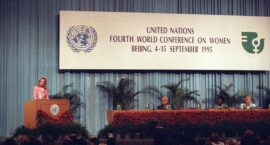
The Beijing Conference Was a Victory for Women’s Movements. It’s Time to Believe in Them Again.

Thirty years ago this month, 45,000 women from around the world converged in Beijing and neighboring Huairou for the historic United Nations Fourth World Conference on Women. In today’s hyperconnected world, it’s easy to miss how groundbreaking the mere fact of this gathering was: The largest number of women at that point in history assembled to lobby the world’s governments for their rights. As Gertrude Mongella, the legendary Tanzanian leader who served as Secretary General of the conference, told the crowd: “The time has come for women to receive their rightful place in all societies and be recognized once and for all, that they are no more guests on this planet. This planet belongs to them too.” 

For funders, governments and individuals—including those gathered at the U.N. General Assembly this week—the message is clear. If you don’t already support and fund women’s movements, start. If you already fund them, stand by your investments, which pay dividends for all the issues you care about. And if you’re marking the Beijing anniversary, know that any progress made since then was no accident. 

The Health of a Democracy Is Measured by Its Leaders: Celebrating Women’s Political Leadership in Mexico, Iraq, Nepal and More

Weekend Reading for Women’s Representation is a compilation of stories about women’s representation in politics, sports and entertainment, judicial offices and the private sector—with a little gardening mixed in!

This week:
—Suhikla Karki is the new prime minister of Nepal, following demonstrations that toppled the previous government and negotiations between Gen Z demonstrators and the military.
—On Oct. 24, an open-seat contest for Ireland’s next president is taking shape for a seven-year term, with two of the three candidates already on the ballot being women; the field will be finalized later this month.
—Mexican President Claudia Sheinbaum has one of the highest approval ratings of national leaders a year after her trailblazing elections.
—As the United Nations prepares to open its General Debate for the 80th session in New York next week, I’ve been carrying Jacinda Ardern’s words with me: “I really rebel against this idea that politics has to be a place full of ego and where you’re constantly focused on scoring hits against one another. Yes, we need a robust democracy, but you can be strong, and you can be kind.”
—Iraq will hold its next parliamentary elections in November. Women hold 28.9 percent of seats in its Parliament, just about the same as the 28.7 percent held by women in the U.S. House of Representatives. 

… and more.