
The Donald J. Trump and Jeffrey Epstein Memorial Reading Room—a traveling exhibit that organizes the 3.5 million pages of DOJ’s released Epstein files into 3,437 bound books—is going on tour.


More Than A Magazine, A Movement

Ms. offers stories about the abuse of children related to feminist issues and the pursuit of human rights for all. Abortion, adoption, sexual abuse, criminalization of women, drug criminalization and harmful legislation all intersect with the issue of child abuse.
The Donald J. Trump and Jeffrey Epstein Memorial Reading Room—a traveling exhibit that organizes the 3.5 million pages of DOJ’s released Epstein files into 3,437 bound books—is going on tour.
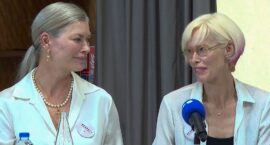
A new legal door opened earlier this month in the fight for survivor justice. But it’s not in the United States, where survivors and advocates continue to press for transparency and investigations into Jeffrey Epstein’s larger network and the modeling industry’s potential role in it. It’s in France.
Carré Otis, a U.S.-based former supermodel and board member of the Model Alliance, filed a criminal complaint in French court alleging rape of a minor and human trafficking by Gérald Marie, a former giant of the modeling industry who led Elite Model Management’s European operations from 1985 to 2010.
The complaint alleges that Otis was 17 when Elite sent her to Paris in 1986 and housed her in Gérald Marie’s apartment, where she “mistakenly believ[ed] that he wanted to support her modeling career.” While living there, Otis alleges that Marie raped her on multiple occasions and later arranged for her to be “provided to other wealthy men across Europe.” The complaint also says Otis was never paid for her modeling work.
Marie has denied Otis’ allegations, and because of France’s statute of limitations, cannot be criminally prosecuted for these particular allegations.
Still, Otis’ recent filing could prove consequential well beyond her own case.

There is no shortage of cases of torture in the headlines. Across today’s crises—from Ukraine to Sudan, Myanmar to Gaza—the allegations are graphic and devastating. But once a legal case closes or the news cycle moves on, another story begins: What happens to those who survive torture?
As U.N. special rapporteur on torture, I have met survivors around the world who carry its effects long after the physical wounds have healed. Survivors spoke to me about stigma, economic struggles, permanent disabilities, fractured relationships and the exhausting fight to be believed, gain access to care and secure justice. Too often, torture is treated as an event that ends when the abuse stops. That is far from survivors’ realities.
That is why survivors themselves helped create the first global Charter of Rights for Victims and Survivors of Torture and other cruelty—a framework demanding access to specialized healthcare, long-term psychological support, legal recognition, financial stability and meaningful involvement in shaping the laws and systems that affect their lives.

An excerpt from Allison T. Butler’s The Judgment of Gender: How Women Are Centered and Silenced in Pop Culture, published March 8, 2026:
While Sinead O’Connor was roundly criticized for ripping up the picture of the pope, the passage of time has revealed: She was right.
O’Connor was labeled a pop star, but she never saw herself that way. From Rememberings: “Everyone wants a pop star, see? But I’m a protest singer. I just had stuff to get off my chest. I had no desire for fame.”

In the wake of newly reported sexual abuse allegations against labor leader César Chávez, our hearts are with our long-time Ms. advisor, Feminist Majority Foundation (publisher of Ms.) board member, friend, and feminist and labor icon Dolores Huerta. The fact that she felt she had to bear this in silence speaks to the layers of harm that women who suffer sexual assault must bear.
In the wake of going public for the first time, Huerta writes, “I have never identified myself as a victim, but I now understand that I am a survivor—of violence, of sexual abuse, of domineering men who saw me, and other women, as property, or things to control.”
“The knowledge that he hurt young girls sickens me. My heart aches for everyone who suffered alone and in silence for years. There are no words strong enough to condemn those deplorable actions that he did. César’s actions do not reflect the values of our community and our movement.”

Releasing the Epstein files without real consequences risks turning a long fight for truth into yet another moment of exposure that leaves survivors without justice and systems of abuse intact.

Over 30 years ago, world leaders came together in Beijing and made a promise: Gender equality would be a global standard, not a distant aspiration. This March, as the United Nations Commission on the Status of Women convenes for CSW70 under the theme of strengthening access to justice and eliminating discriminatory laws, that promise remains not only unfinished, but increasingly under coordinated assault.
Since 1999, Equality Now’s Words & Deeds reports have tracked laws and policies that discriminate against women and girls, documenting progress when legal reform has been achieved and holding governments accountable when words fail to translate into action.
Our new Words & Deeds update, Progress and Backlash: Accountability for the Rights of Women and Girls, shows that we are at a perilous moment of global regression in women’s rights. Across regions, protections once considered settled are being diluted, defunded and, in some cases, deliberately dismantled.

Grok, the AI chatbot used on Musk’s platform X, has been under fire for generating nude or sexualized images of real people, including individuals who are minors. In one estimate, Grok produced one nonconsensual sexual image per minute over a 24-hour period. Prompts such as “put her in a transparent bikini” produced altered images that were then circulated publicly, some accumulating thousands of likes. The targets are real women and underage girls whose images were manipulated without their knowledge or permission.
Elon Musk responded by making a joke, requesting a Grok-generated image of himself in a bikini and reacting with laughing emojis. When the platform’s most powerful figure and one of the country’s most powerful men treats the abuse as a punchline, it sends a message about what is actually harmful versus what he thinks should be considered humor—and provides a tacit granting of consent to young men on the platform to keep making these images.
Much of the public conversation about young people and AI has focused on cheating in school or declining literacy. Far less attention has been paid to what it means when a middle school boy can type a sentence and produce a sexualized image of a female classmate in seconds as a joke or for attention—or to pretend he received it from her for status.
For girls growing up in this online environment, the message is unmistakable: Your image is not protected as yours. Your body can be altered, distributed and consumed for entertainment. Its violation can be dismissed as a joke.
Teachers, parents, lawmakers and platform leaders are behind. The question is not whether this will shape the next generation’s understanding of power and intimacy—but what we will step in to do about it.

The U.S. ranks as the 19th most dangerous country for women, 11th in maternal mortality, 30th in closing the gender pay gap, 75th in women’s political representation, and painfully lacks paid family leave and equal access to healthcare. But Ms. has always understood: Feminist movements around the world hold answers to some of the U.S.’s most intractable problems. Ms. Global is taking note of feminists worldwide.
This week: stories from Iran, Afghanistan, the Netherlands and more.
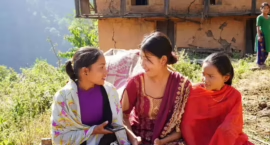
As the world goes digital, so does the ancient practice of child marriage.
More than half a billion women and girls living today are, or were, child brides. Among young adult women aged 20 to 24, one in five was married before age 18.
But that doesn’t mean that child marriage has stayed the same. There has been gradual progress in ending child marriage (around a decade ago, one in four women was married under 18). And technology is playing a growing role, both in cases where girls say “I do” and in cases where they say “I don’t.”