Virginia Will Choose Its First Woman Governor in November’s High-Stakes Election

Over the next month into Election Day on Nov. 4, 2025, Virginia voters will decide not only the state’s next governor, but also control of the House of Delegates. The outcome will determine the direction of Virginia’s policies for years to come, and will send powerful signals about the nation’s political climate. 

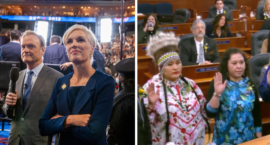
The race is already historic. For the first time, both major party candidates for governor are women: former U.S. Rep. Abigail Spanberger (D) and Lt. Gov. Winsome Earle-Sears (R). Whoever wins will become the state’s first woman governor. 

From Berlin to Beijing to U.S. Congress, Women’s Courage to Convene Propels Us Forward

Weekend Reading for Women’s Representation is a compilation of stories about women’s representation in politics, sports and entertainment, judicial offices and the private sector—with a little gardening mixed in!

This week:
—We mark 60 years since former President Lyndon Johnson advanced equal opportunity in employment.
—When women come together, share our strength, and lift one another up, the impossible becomes possible. 
—In a landslide victory, Adelita Grigalva becomes Arizona’s first Latina to Congress.
—Of the four Republican House members signing the petition about the actions and allies of sexual predator Jeffrey Epstein, three are women.
—A record number of U.S. legislators won’t run for reelection next year.
—Hillary Clinton “sees a dangerous moment for women’s rights and democracy.”
—Akshi Chawla, who writes the #WomenLead Substack and is a valuable resource on international women’s representation, on the great question: “How do I get started?”
—The Marshall Islands, a rapidly vanishing Oceania nation, is led by the region’s first-ever woman president, Hilda Heine.
—Who was the first American woman to have an airport named in her honor?

… and more.

Community Is as Important to the Fight for Democracy as Everything Else

It has been a hell of a week for gridlock in my hometown, New York City, as global leaders convene for the 80th United Nations General Assembly—where on Monday, President Donald Trump delivered an hour-long rant calling climate change a hoax and claiming to have personally ended seven wars in his first seven months in office.

It wasn’t all grievance and gloom. Monday also marked the 30th anniversary of the historic United Nations Fourth World Conference on Women in Beijing, where 189 nations adopted an ambitious “Platform for Action” to acknowledge and advance women’s rights. It was there that future Secretary of State Hillary Rodham Clinton famously pronounced “women’s rights are human rights.” For more about the anniversary, read this extraordinary report, released this week and co-authored by Contrarian contributor Jennifer Klein, “Beijing+30: A Roadmap for Women’s Rights for the Next Thirty Years.” It details the myriad ways regression on women’s freedom is also an early sign of weakened democracy and outlines critical priorities to advance women’s rights in the immediate future.

Mayoral Candidates Tout Plans—But Feminist Infrastructure Is What New Yorkers Need

Frantic, I keep checking my phone for the arrival of the New York City public bus I am waiting for. It finally arrives, 10 minutes after the scheduled time, meaning I will be late for school. With each stop it makes, the bus fills with students like me and people heading to work. Women and toddlers also board in force, lugging more baby strollers than I can count. As the strollers pile up, I scan the bus, wondering how many more can possibly fit. It is a Jenga-like ordeal, and I overhear a group of caregivers confidently affirm how five strollers can be tilted, folded and configured to fit in the bus.

This is the silent role public infrastructure plays in action. Infrastructure greets us on our daily commute, provides livable spaces for us outside, shepherds kids to and from school. Infrastructure is fundamental to our well-being as citizens, essential to a functioning democracy. And to work for all of us, it must be considered through a feminist lens.

Urban infrastructure loomed large in the New York City mayoral primary in June and will continue to be a major discussion point through the general election in November. I can’t help but question who is making decisions about urban transportation infrastructure and the people who use it.

Celebrating Women’s Equality Day—105 Years After the 19th Amendment

Weekend Reading for Women’s Representation is a compilation of stories about women’s representation in politics, sports and entertainment, judicial offices and the private sector—with a little gardening mixed in!

This week:
– Marking 105 years since the 19th Amendment certified women’s right to vote.
– Democrat Catelin Drey wins a special election in Iowa, breaking the GOP’s majority in the state’s chamber.
– Australia’s youngest-ever senator, Labor Senator Charlotte Walker, delivers her first speech to Parliament.
– Women’s Emergency Response Rooms in Sudan are signs of Democracy.

… and more.

From Alligator Alcatraz to National Guard Patrols: What Is the Cost of the Trump Administration’s Cruelty?

Reserve forces of the U.S. Army, 800 National Guardsmen, and for some reason, 120 FBI agents, are being newly assigned by El Presidente to patrol our national capital—citing crime as his motive, though it’s dropped by a third in recent (Biden) years. He’s already done this in Los Angeles for the last 60 days and predicts other cities are on his list: Baltimore, Chicago, Oakland, New York City—all places that just happen to vote blue.

Early on, the Pentagon testified it would spend about $134 million for the LA deployment, which sounds like a low-ball figure to anyone who’s recently shopped for groceries to feed 5,000 hungry young men three meals a day. And now, California’s governor is asking for the total cost to taxpayers of this “unlawful” deployment—because whether it’s political theater or not, we’re the ones footing the bill.

Women’s Voices Are the Only Way Forward for Climate Change Solutions: ‘As Women, We Have to Stand Up and Back Up Women’

Every year since 1995, member nations of the U.N. have come together to discuss the planet’s climate crisis during COP meetings. This year marks the 30th annual meeting, which will be held Nov. 10 to 21 in Belém, Brazil. 

What COP30 won’t say out loud: The green transition is accelerating colonialism, and women are paying the price. Climate justice starts with women, ecology and an end to extractive capitalism.

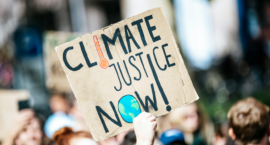
Doesn’t Gen Z Have the Right to Life? Young People Sue Trump Administration Over Climate Catastrophe as State-By-State Battle Continues

At least 137 people are dead after devastating flash-flooding in Texas in early July, including many children. As climate change induced disasters grow more common and the Trump administration rolls back environmental protections, several organizations are pursuing creative legal strategies to defend children’s fundamental right to a safe, healthy and stable natural environment.

On behalf of 22 young people, Our Children’s Trust filed Lighthiser v. Trump in May as part of its multi-case Youth v. Gov effort, asserting that three of the president’s pro-fossil fuel executive orders violate their constitutional rights to life, health and safety.

On July 16, hundreds gathered outside the U.S. Capitol to hear from Lighthiser plaintiffs and members of Congress at a press conference hosted by Our Children’s Trust and several organizational partners.

The same day, the Children’s Fundamental Rights to Life and a Stable Climate System resolution was introduced by Sen. Merkley (D-Oreg.) and Reps. Schakowsky (D-Ill.), Jayapal (D-Wash.) and Raskin (D-Md.). More than 50 additional senators and representatives joined the resolution as cosponsors.

Eva Lighthiser and Lander Busse were also plaintiffs in Held v. State of Montana, in which the Montana Supreme Court ruled that state law restricting consideration of climate change in environmental reviews violated youth plaintiffs’ right to a clean and healthful environment. The suit saw success largely because Montana has a Green Amendment—a constitutional amendment in the Bill of Rights section of the state Constitution explicitly declaring the legal right to a safe, healthy and stable natural environment for all people. Thus far, only Montana, Pennsylvania and New York have Green Amendments. The organization Green Amendments for the Generations (GAFTG) is working state-by-state alongside community partners to get new state-level Green Amendments passed.

Floods, Fear and Family Crisis: The Impact of Texas’ Natural Disasters on Domestic Violence

Devastating floods began sweeping across Central Texas on July 4, causing the Guadalupe River to surge at an alarming rate: 20 feet in the first three hours. The disaster ranks among the deadliest and most catastrophic in the state, claiming at least 136 lives, with four individuals still missing.

The floods captured national attention and served as yet another chilling reminder of the real and rising consequences of climate change. And as climate-driven disasters only grow more frequent and intense, Texans continue to suffer the fallout—both seen and unseen.

Among these unseen and overlooked consequences: increased risk of domestic violence.

Extreme weather events—floods, heatwaves and hurricanes—not only displace families and destroy homes, but they also strain financial resources and fracture essential support systems. These stressors can intensify existing inequalities and create volatile conditions increasing the risk of violence, particularly against women and girls.