‘Tap Someone In’: Mini Timmaraju on Mentorship, Motherhood and Mobilizing Indian American Women

Mini Timmaraju, president and CEO of Reproductive Freedom for All (formerly NARAL), doesn’t just rise—she brings others with her. This ethos of tapping in challenges Indian American women to move from individual achievement to collective empowerment.

As my conversation with Timmaraju unfolded, we explored her childhood, her professional journey and the simplest yet most impactful action she believes Indian American women should take right now. It’s clear that Timmaraju’s story is not just about her own path, but about building pathways for others.

“We need to build our own villages—not just for family, but for career and leadership, too,” she said. “We shouldn’t do it alone.”

Why Trump’s Pronatalist Agenda Is Actually Anti-Motherhood

This Mother’s Day, for the 111th year in a row, families across the nation will gather to celebrate all the love, care and work provided by the mothers in their lives. Woodrow Wilson declared Mother’s Day a federal holiday nearly a year after he established the basis of today’s modern income tax system, allowing him to lower tariff rates on many of the basic necessities American families relied on in 1914.

It is darkly ironic that more than a century later, the Trump administration is attempting to reverse these pro-family policies, while at the same time promoting a pronatalist agenda aimed at creating more mothers and larger families. 

Despite promoting motherhood, Trump’s policies threaten the economic stability of the 45 percent of mothers who are primary breadwinners—especially single moms and women of color.

To Protect Children, We Must Protect Abortion

My child is front of mind in every single decision I make—from the obviously big ones, like where we live and our travel plans for the year, down to the smallest, like what color shirt I’m wearing for the day. (My son’s in a “match with Mom” phase right now.) Most parents will tell you the same: that our entire world revolves around the needs of our children. We operate in ways that we hope center their best interests because as parents, we want nothing more than for our children to thrive.

My third abortion was just that—a decision I made with my son in mind. 

My child deserves the happiest and healthiest version of his mom, as do all children who already exist to people who are having abortions! The happiest version of my son’s mom is the one who had an abortion. 

Immigrant Kids Trapped in U.S. Custody: The Hidden Crisis Inside the Office of Refugee Resettlement

A new form of family separation has been quietly engineered at the Office of Refugee Resettlement’s Unaccompanied Minors program, the HHS office responsible for the care and custody of immigrant children who enter the U.S. alone. Under President Trump’s border closures, the number of unaccompanied children entering the United States has dropped significantly, and yet, on average, each child is remaining in government custody weeks longer—even when a parent is available to reunite with their child.

Children are being detained for longer periods of time as the government increases the requirements for releasing them to parents or other family members, often with heartbreaking consequences.

Cutting the Workforce at HHS Undermines the Social Safety Net. Families and Kids Will Suffer the Most.

The Administration for Children and Families plays a quiet but crucial role in upholding the American social safety net—administering billions in federal funds to programs that support children, families, and vulnerable communities. But devastating cuts to ACF staff and offices threaten to unravel this lifeline, with immediate consequences already surfacing.

Without experienced civil servants to oversee grants, answer questions and approve disbursements, the very programs meant to catch people in crisis are being pushed to the brink. And in the long term, it’s families and kids who will pay the highest price.

The Pregnant Workers Fairness Act Saved My Livelihood. Women Nationwide Need to Know About This Important Law.

When I was pregnant and working as a custodian in South Carolina, my employer sent me home after I asked for some simple changes to protect my health. Since my requests were so simple, I wasn’t expecting my employer to tell me to stop working. I was blindsided, made to feel like I was the one who did something wrong.

Looking for answers, I came across A Better Balance’s free legal helpline. They told me about a new law called the Pregnant Workers Fairness Act (PWFA), which required that workers in my situation receive accommodations—including changes to their usual work duties—to stay healthy and on the job. I returned to work with the adjustments I needed, and worked right up until I had my baby. On top of this, my employer put up posters—one by every time clock—about the PWFA, so that other workers who might need pregnancy accommodations would know about it.

(This essay is a part of Ms. and A Better Balance’s Women & Democracy installment, all about the Pregnant Workers Fairness Act—a groundbreaking civil rights law ensuring pregnant and postpartum workers have the right to reasonable workplace accommodations. Bipartisan, pro-family and boldly feminist, the PWFA is both a lesson in democracy and a battleground for its defense against antidemocratic attacks.)

Explainer: How Does Family Planning Save Lives?

When a war forcibly displaces tens of thousands of people, UNFPA, the United Nations sexual and reproductive health agency, equips displacement camps and medical personnel with critical supplies—including condoms, oral and injectable contraceptives, contraceptives implants and intrauterine devices. 

When an earthquake tumbles whole city blocks, UNFPA puts contraceptives onto emergency relief convoys, alongside kits for delivering babies and medicines to stop internal bleeding.

When a cyclone slashes through remote island communities, UNFPA sends contraceptives just as it sends sterile medical equipment.

Why? Because contraceptives are part of life-saving humanitarian care.

The Hidden Majority: Indian Americans Support Abortion Rights—So Why Aren’t We Speaking Out?

Indian Americans have built a reputation as one of the most successful and influential immigrant communities in the United States, celebrated for our dedication to education, hard work and family values. Yet, when it comes to reproductive rights, our community has largely remained silent, even as these rights come under increasing attack across the country. This silence, quite frankly, is no longer acceptable.

To my fellow Indian Americans, especially women: this is our moment to step forward. Speak up in your communities, join organizations fighting for reproductive rights, and vote for leaders who prioritize these freedoms.

It’s Not ‘Divorce Month.’ It’s ‘Starting to Think About Divorce Month.’

For years, many have nicknamed January “Divorce Month” and the first working Monday as “Divorce Day,” as if floods of filings hit courthouses across the country right after the ball drops. But that’s not the case.

March is a bigger month for the D-word. August is nothing to sneeze at either, according to a study by the University of Washington. So what’s the big deal with January? You could say the first of the year pushes sideline spectators, who’ve watched others split, to start dipping their toes in the divorce waters. In the end, nearly 70 percent of divorces are initiated by women.

‘When Power Curdles Into Violence’: Escaping the Tradwife Lifestyle

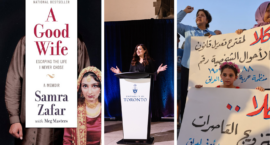
Brides shouldn’t be thinking about homework just before their wedding day. But when I entered into an arranged marriage with a 28-year-old stranger, I was still just a 17-year-old girl who loved her private British school and her books and cricket—and so I found myself thinking about a creative-writing assignment I had recently finished. I’d written a story about a young woman who wore jewelry in the shapes of snakes. I wrote that they suddenly came to life and they slithered up to her throat, strangling her. 

As someone who was forced into a life I never chose, I am appalled that women, who are more empowered than ever, are effectively choosing a life without choice—putting themselves in a prison of their own making.