


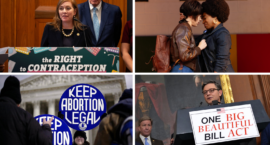
Keeping Score: Abortion Bans Cost $140B Per Year; Federal Courts Protect Trans Youth and Incarcerated Trans Women; Feminists React to FBI Raid on Ohio Voting Rights Organization

In every issue of Ms., we track research on our progress in the fight for equality, catalogue can’t-miss quotes from feminist voices and keep tabs on the feminist movement’s many milestones. We’re Keeping Score online, too—in this biweekly roundup.

This week:
—Rep. Lizzie Fletcher (D-Texas) is working to get Republicans on the record on the Right to Contraception Act.
—ICE has already reported the deaths of 18 detainees this year, on pace to surpass the highest number of deaths in decades.
—Abortion restrictions could cost the U.S. economy $140 billion annually in lost earnings.
—”I love the inflation,” says Trump.
—The EEOC will no longer require federal agencies to report on race, ethnicity, sex or gender identity.
—83 percent of American voters agree that emergency contraception should be easily accessible.
—Abortion ban states are slowly losing a generation of women medical students and doctors.
—More than 770,000 children have already lost access to SNAP benefits after last year’s funding cuts.
—A new study found trans women athletes have no significant physical advantages over cis women.
—Missouri has restored access to medication abortions after a Jackson County judge struck down key state restrictions, allowing clinics to resume providing the service and marking the first time medication abortion has been available in Missouri since 2018.
—Republicans passed a reconciliation bill that provides roughly $70 billion for ICE and CBP, sending it to President Trump’s desk. (This is on top of more than $140 billion Republicans already provided for those agencies last year.)

… and more.

A Feminist Historian’s Year-End Reading and Viewing Guide

As the year winds down, I find myself returning—as I always do—to the stories, performances and ideas that have shaped my teaching and thinking. Feminism’s past is never really past; it’s a living archive we carry with us, full of unresolved questions, missteps, breakthroughs and beautiful, complicated people. This year’s reading and viewing list reflects that sensibility.

Liberation forces its contemporary narrator—and its audience—to reckon with the impossible expectations we’ve placed on small groups of women in church basements.

Molly Jong-Fast’s memoir presses on the tender, maddening ties between feminist foremothers and the daughters who grew up in their shadow.

Sarah Weinman’s study of spousal rape laws exposes just how recently the law stopped treating wives’ bodies as open territory—while showing how fiercely survivors and advocates have had to push for change that should never have been controversial.

‘Liberation’ Playwright Bess Wohl on Theater as Resistance: ‘Theater Is Dialogue. Autocracy Is a Monologue.’

At the Feminist Majority Foundation (publisher of Ms.) Global Women’s Rights Awards on Nov. 18 in Los Angeles, FMF honored the team behind the Broadway smash hit Liberation: playwright Bess Wohl, director Whitney White and Lisa Cronin Wohl, an OG Ms. writer from the 1970s.

“Theater is made up of dialogue. Autocracy is a monologue. Theater is about community: We watch a play together. Autocracy seeks to isolate us. Theater is about curiosity: A good play asks a question. Autocracy is not interested in questions, only in control.

“So, thank you, because in honoring this play, you honor the role of dialogue, community and questions in creating social change.”

‘Liberation’ Opens on Broadway—And Ms. Magazine Is at Its Heart

The feminist revolution has taken center stage. Liberation, written by Bess Wohl and directed by Whitney White, officially opened on Broadway on Oct. 28, 2025, at the James Earl Jones Theatre, following a critically acclaimed Off-Broadway run earlier this year.

In an interview with Vogue, Wohl said she was inspired by her mother’s work as an editor at Ms.: “The arc of history is so much longer than we realize. Already in 1970 women were feeling frustrated, like, ‘When is this gonna happen?’ … And I think that that urgency really powers so much of the story of the play.”