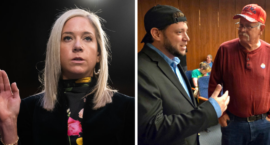
Amarillo residents will vote on an abortion travel ban—which would ban the use of the city’s roads and highways to seek an abortion out of state—in the November election.


More Than A Magazine, A Movement

Human trafficking is a crime involving the capture, transport or harboring of people through coercion or force to exploit them for profit. This can include sex trafficking, but also includes forced labor. People of all genders and backgrounds can become victims of global trafficking, though women and girls of color are disproportionately targeted.
Amarillo residents will vote on an abortion travel ban—which would ban the use of the city’s roads and highways to seek an abortion out of state—in the November election.
From the Summer 2010 issue of Ms.: “In 10 years, we will look back and consider it ludicrous that we ever prosecuted children for prostitution.”
(For more ground-breaking stories like this, order 50 YEARS OF Ms.: THE BEST OF THE PATHFINDING MAGAZINE THAT IGNITED A REVOLUTION, Alfred A. Knopf—a collection of the most audacious, norm-breaking coverage Ms. has published.)

Dark money anti-abortion and pay-to-play groups are predictably responding to the FDA’s over-the-counter birth control pill decision with a disinformation campaign.
Access to a prescription-free contraceptive pill, the second most widely used form of contraception—more than ever—is an essential tool in the fight for reproductive justice.

Idaho’s anti-abortion legislature and governor created a new crime this year: “abortion trafficking,” a fallacious and deliberate attempt to spread misinformation on abortion. Laws like this will likely begin to appear in another anti-abortion states and state legislatures.
Equating abortion-seeking to ‘trafficking’ undermines the brutal and inhumane realities that youth trafficking survivors endure. Ultimately, for vulnerable children, so-called anti-‘abortion trafficking’ laws codify the human rights and bodily autonomy abuses that true anti-trafficking laws aim to reduce. Adolescent health professionals and advocates must remain vigilant and continue to mobilize a multi-strategy response to ensure adolescents’ reproductive rights amid current assaults.

After nearly 20 years of failed attempts to deter cross-border abortion travel by teens, anti-abortion lawmakers in Congress largely gave up the fight. However, last week’s victory in Idaho makes clear that their long sought-after goal of restricting cross-border abortion access has been resurrected in the wake of the Supreme Court’s decision in Dobbs. This first-of-its-kind law in the nation brings to fruition a long-standing goal of the anti-abortion movement—namely, preventing teens from cross-border access to abortion.

Like the Trump administration before it, the Biden administration is prioritizing the appearance of border control over saving people’s lives.

Andrew Tate has been called “The King of Toxic Masculinity.” TikTok videos that feature him or his ideas have received an estimated 11.6 billion views. But many of his most controversial—and widely shared—pronouncements are those about women.
He says he dates women aged 18–19 because he can “make an imprint” on them. He said women in heterosexual relationships “belong to the man.” He once lectured a group of young women that their career aspirations don’t matter and that the “happiest women” have children and a man who is paying their bills. Tate has helped to normalize expressions of overt misogyny.

Indigenous women leaders from the Great Lakes are sounding the alarm about the social and ecological impacts of a new Enbridge tar sands pipeline project, Line 5.

We need to socialize men differently and create a united force of activists. Men need to be a part of the larger conversation, and work to dismantle the idea that reproductive choice is simply “a women’s problem.”
Reproductive choice is not just a women’s issue. We all are well aware that it does not take just a single person to get pregnant. If Roe falls, it will affect everyone.

History shows us that women, children and LGBT+ people face a particularly high threat of violence during armed conflicts, and it’s critical to get emergency humanitarian aid as well as long-term rebuilding efforts into communities.
For philanthropists with $5 million to give or individual donors chipping in $5, we know gender justice funders will move that money *faster* to the organizations on the ground who specialize in helping the people who are most impacted.