


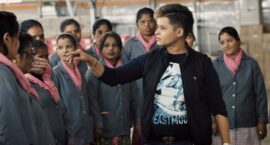
‘Pink Belt’ Documentary Follows Aparna Rajawat’s Mission to Train Women and Girls in Self-Defense Across India

Even as a child, Aparna Rajawat could see how boys in India were more respected, safer and freer than girls.

Wanting a way to defend herself, Rajawat cut her hair short and disguised herself as a boy, attending karate lessons behind her father’s back with the help of her mother and sister. By the time he discovered her secret, she was so good her coach was able to convince her father to let her continue. She went on to become a national champion and compete internationally, all while she was a teenager.

But that’s only the beginning of Rajawat’s story—a story in which her own achievements are only a backdrop to a life-long quest to inspire other Indian women and girls to achieve their dreams and protect themselves in a country where, despite its many advancements, incidents of sexual assault are still rampant and survivors struggle to get justice.

Enter Pink Belt Mission, Rajawat’s nonprofit, through which she works as a motivational speaker as well as training thousands of girls and women in self-defense.

It’s also the subject of a new documentary directed by John McCrite. A remarkable film, Pink Belt starts with Aparna Rajawat’s story, but goes much further, illuminating a path for anyone who cares about human rights to take that first step towards making a difference in their own communities and beyond.

Ms. Global: Energy Crisis in Cuba, Feminist Activist Assassinated in Iraq, Gay Asylum-Seeker Deported and More

The U.S. ranks as the 19th most dangerous country for women, 11th in maternal mortality, 30th in closing the gender pay gap, 75th in women’s political representation, and painfully lacks paid family leave and equal access to healthcare. But Ms. has always understood: Feminist movements around the world hold answers to some of the U.S.’s most intractable problems. Ms. Global is taking note of feminists worldwide.

This month:
—Seoul holds the 41st Women’s Strike in South Korea for International Women’s Day.
—Hospital patients suffer during Cuba’s three major blackouts.
—The U.S. is at fault for the missile strike that hit the Shajareh Tayyebeh Girls’ School in Minab, Iran, on Feb. 28, killing 175 people.
—Yanar Mohammed, a leading Iraqi feminist and human rights defender, was killed in an armed attack in Baghdad.
—IOC restricts transgender participation in Olympics.
—Amid widespread displacement, poverty and institutional collapse during the ongoing war in Gaza, families are increasingly turning to child marriage for their daughters.

… and more.

Abandoned by the Department of Education, Advocacy Organizations Demand Action on Student Sexual Violence

In a powerful rebuke, 112 gender equity and survivor advocacy organizations sent a letter to U.S. Secretary of Education Linda McMahon and Assistant Secretary for Civil Rights Kimberly M. Richey on Feb. 23 condemning the Department of Education for “neglecting to protect students from actual sexual violence while pursuing an ongoing dangerous and unlawful campaign of discriminating against transgender students under the guise of preventing sexual violence.” 

The heart of this crisis is the weakening of Title IX enforcement by the Department’s Office for Civil Rights. OCR oversight has been essential in compelling schools to respond appropriately to sexual harassment and assault. Federal enforcement elevates school districts’ Title IX awareness and compliance, reducing barriers to reporting, and motivating schools to adopt preventive action. For the vast majority of students, the federal complaint process has been the only mechanism to seek redress beyond local decision-makers.

“We finally had hope,” said Elizabeth Stewart-Williams, who filed an OCR complaint claiming sex and race discrimination under Title IX and Title VI at her daughter’s Texas high school. “But it wasn’t very long before we learned that the OCR office was closed. It is crushing. It is cruel. The OCR complaint process was our only pathway for help. If the department and its investigative and protective roles are diminished, what remedies do our children truly possess?”

Women Make Our Movements Powerful. They Shouldn’t Have to Suffer in Silence.

A New York Times investigation released this week broke news of shocking sexual abuse allegations against labor leader César Chávez—from two women who were young teenagers at the time, and from Dolores Huerta, our long-time Ms. advisor, Feminist Majority Foundation (publisher of Ms.) board member, friend, and feminist and labor icon who co-founded the United Farm Workers with Chávez.

In fighting the culture that makes these actions not only possible, but permissible—and that encourages women like Huerta to remain silent for over 60 years—we must consider the role of men.

Men, argues Ms. contributor Jackson Katz, are essential to shifting the narrative. In describing the case of Gisèle Pelicot, a woman who had been secretly drugged by her husband and set up to be raped by dozens of men over a 10-year period, Katz mentions the evocative nickname the case acquired in French media reports: Monsieur Tout-le-monde. Mr. Everyman. 

If the 50 men who assaulted Pelicot were just “ordinary men” (“many were married and had kids. They were blue- and white-collar workers: a restaurant manager, nurse, computer technician, prison guard, firefighter, journalist, soldier,” Katz writes), then consequently, every man has a role to play in dismantling systemic violence against women.

The Radical Potential of Traditional Femininity 

In the 1700s and 1800s in the U.S., women were presumed to be subordinate to men: naturally helpless, emotional, vulnerable.

Reading through the thousands of petitions submitted by revolutionary-era women to the state, one might get the impression that all women accepted their subordinate status to men with humility and grace.

But what if they didn’t? What if their engagement with the discourse of feminine dependence was merely a shrewd tool, effectively deployed to cater to precisely what their readers—white, male elites—wanted to hear? What if the radical act of seeking a divorce in the 18th century contradicted the conservative language they employed? 

In most cases, we’ll never be able to deduce these women petitioners’ true feelings on their social and legal status. Many women petitioners in the revolutionary era left no trail for the historian to follow. 

What we can know is that the employment of this discourse of dependence, cunningly constructed in a sympathetic narrative neatly packaged for a patriarchal audience, was immensely effective. For the most part, women who engaged with these tropes of feminine subordination saw their petitions granted. Those that did not—including those who rebuked men—largely saw their pleas rejected or ignored. 

(This essay is part of the FEMINIST 250: Founding Feminists series, marking the 250th anniversary of America by reclaiming the revolution through the women and gender-expansive people whose ideas, labor and resistance shaped U.S. democracy.)

Every Man Has a Critical Role to Play in Ending Violence Against Women

(An excerpt from Jackson Katz’s Every Man: Why Violence Against Women Is a Men’s Issue, and How You Can Make a Difference, out March 19 from Bloomsbury Publishing.)

In 2024, a mass rape scandal rocked France and reverberated around the world. Fifty men in a small town in the southern part of the country were convicted of raping Gisèle Pelicot, a woman who had been secretly drugged by her husband and set up to be assaulted. The shining light of this horrific case was the courage and dignity of Gisèle, who became an international feminist icon when she insisted on being present and highly visible throughout the spectacle of the trial. She made it clear that she wanted to appear in the courtroom to stand up for survivors and send an unmistakable message: “Shame must change sides.”

But this epochal story had another major angle: the 50 men. A brief glance at their bios revealed most of them to be otherwise ordinary men.

The concept of “every man” suggests there is growing recognition among the broader public that this enormous problem has deeper societal roots, and is not primarily about the deviant behavior of pathological individuals.”

Men from every walk of life have a critical role to play on this issue. But first we have to break through some of the layers of denial and resistance that have impeded progress for far too long.

The Erosion of Women’s Rights Is a Warning Sign for Democracies Everywhere

Over 30 years ago, world leaders came together in Beijing and made a promise: Gender equality would be a global standard, not a distant aspiration. This March, as the United Nations Commission on the Status of Women convenes for CSW70 under the theme of strengthening access to justice and eliminating discriminatory laws, that promise remains not only unfinished, but increasingly under coordinated assault.

Since 1999, Equality Now’s Words & Deeds reports have tracked laws and policies that discriminate against women and girls, documenting progress when legal reform has been achieved and holding governments accountable when words fail to translate into action.

Our new Words & Deeds update, Progress and Backlash: Accountability for the Rights of Women and Girls, shows that we are at a perilous moment of global regression in women’s rights. Across regions, protections once considered settled are being diluted, defunded and, in some cases, deliberately dismantled.

‘The Bride!’ Speaks Back: Rage and Autonomy in Gyllenhaal’s Frankenstein

Women are often stereotyped as overly talkative—gossiping, ‘blabbing’ or labeled ‘chatty Cathys.’ Archie Bunker in the television series All in the Family often tells his wife Edith to “stifle yourself” to stop her talking. Recently, one critic argued that “the bride” (played by Jessie Buckley) in writer-director Maggie Gyllenhaal’s new movie of the same name, talks too much.

What makes Gyllenhaal’s reinvention of James Whale’s 1935 film Bride of Frankenstein story so compelling is precisely because this fabricated lady has her own voice and uses it loudly and in a rage. We’re glad she speaks.

From ‘Every Man’ to the ‘Epstein Class’: Misogyny in Male Peer Culture Cuts Across Class Lines

The rich men surrounding Jeffrey Epstein, and the working and middle-class men who were lured into Dominique Pelicot’s twisted fantasy, navigate the social world from very different sides of the class chasm.

But they share something in common, too: They’re all men who were socialized into a misogynous culture that dehumanizes women, turns them into sexual commodities and licenses men to mistreat them.

Misogynous exploitation is not rooted primarily in plutocratic privilege. The sense of unquestioned entitlement to women’s bodies that many observers have noted about “Epstein class” men is hardly confined to the wealthy.

Ms. Global: Iranian Girls’ School Hit in U.S.-Israeli Strikes, Taliban Legalize Domestic Violence, The Netherlands’ First Gay Prime Minister, and More

The U.S. ranks as the 19th most dangerous country for women, 11th in maternal mortality, 30th in closing the gender pay gap, 75th in women’s political representation, and painfully lacks paid family leave and equal access to healthcare. But Ms. has always understood: Feminist movements around the world hold answers to some of the U.S.’s most intractable problems. Ms. Global is taking note of feminists worldwide.

This week: stories from Iran, Afghanistan, the Netherlands and more.