America’s Founding Feminists: Rewriting America’s Origin Story

Two hundred and fifty years ago, a small group of men declared that “all men are created equal,” casting a vision of liberty that has shaped the American imagination ever since.

Yet even as they debated freedom in Philadelphia, women were writing, organizing, governing, resisting and insisting on their place within the nation taking form. Some, like Mary Katherine Goddard, literally set their names in print; others, like Phillis Wheatley, wrote themselves into intellectual existence against a backdrop of enslavement and doubt. Still others left their mark through acts of refusal and flight, choosing freedom when the republic would not grant it.

A new series, Founding Feminists—launching at the start of Women’s History Month—unfolds over two months, twice a week. On this semiquincentennial of the United States, Ms. turns to these “founding feminists” not as anachronistic heroines, but as architects of an unfinished democratic project. There is no nation without women at its core—no democracy without their labor, intellect, resistance and imagination.

From Haudenosaunee matrilineal governance, to Black women’s freedom-seeking acts, from revolutionary manifestos to quiet domestic rebellions, our Founding Feminists series reexamines the past to illuminate our present moment of backlash and possibility.

If the Declaration of Independence set forth a promise of equality, it was women—across race, class, sexuality and nationality—who pressed the nation to live up to it.

Two hundred and fifty years later, their questions remain ours: What does freedom truly mean, and who gets to claim it?

‘A Deliberate Attempt to Terrorize’: Former FBI Agent Asha Rangappa on What Real Law Enforcement Looks Like—and What ICE Is Not

ICE is the highest-funded federal law enforcement agency in American history—its budget larger than the FBI, ATF, DEA, U.S. Marshals Service and Bureau of Prisons combined. Its agents wear masks, drive unmarked vehicles and operate with an impunity that has drawn comparisons to secret police forces around the world. Multiple federal courts have refused to trust the agency’s own statements of fact. And in Minneapolis, ICE agents shot and killed Renee Macklin Good and Alex Pretti in front of their neighbors’ cameras.

Asha Rangappa has seen this movie before—just never in America.

A former FBI special agent who spent years in the bureau’s New York division, specializing in counterintelligence, Rangappa was trained to monitor threats to America. Her job required surgical precision, behavioral psychology, extraordinary patience and, above all, trust.

“The bread and butter of your work as a law enforcement agent is that you need the community’s help,” she told me. “You actually can’t do your job without it.”

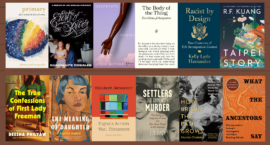
February 2026 Reads for the Rest of Us

Each month, Ms. provides readers with a list of new books being published by writers from historically excluded groups.

There are hundreds of books being released every month, and it is challenging to narrow down the titles to a manageable list of 20-ish. I pride myself on finding the hidden gems—the ones you may not hear about otherwise. That means that I sometimes forgo some of the most buzzy books for ones that haven’t gotten as much publicity, even though they deserve it.  

So all that said, here is February’s list of 28 books. It was one of those months where it was tough to decide—enjoy the extra titles!

‘I Needed to Know I Was Not the Only One’: Talking Honestly About Pregnancy Loss and Reproductive Grief

Award-winning cartoonist Chari Pere and award-winning author and psychologist Dr. Jessica Zucker are on a mission to normalize talking about the complexities of reproductive grief in order to help people feel less alone.

Reproductive grief encompasses the range of emotional, psychological and even physical responses that can follow experiences like miscarriage, stillbirth, infertility, termination for medical reasons or other disruptions in a person’s reproductive journey. It is a kind of loss that is often invisible to others but deeply felt—an ache shaped not only by what happened, but by what could have been. Despite how common it is, reproductive grief remains largely unspoken, shrouded in silence and shame.

The New Misogyny, Violent Extremism and What It Will Take to Stop It: RSVP for a Live Conversation (Online or in L.A.; Wednesday, Feb. 18)

Across ideologies, the clearest and most consistent predictor of mass shootings is not political extremism alone—it is rising gendered grievances, patriarchal backlash, and perpetrators’ histories of gender-based violence and misogyny.

That is the focus of Miller-Idriss’ groundbreaking new book, Man Up: The New Misogyny and the Rise of Violent Extremism.

On Feb. 18, 2026, Miller-Idriss and Ms. executive editor Kathy Spillar will explore how misogyny fuels radicalization, how gender-based grievances are weaponized by extremist movements, and why confronting patriarchy is essential to preventing future violence. Join us in person or online.

Reads for the Rest of Us: The Most Anticipated Feminist Books of 2026

Happy new year, feminist readers! I hope you’ll make it a goal to carve out time to read, and I’m here to share the top books we are excited about this year. 

We’ve scoured catalogs and websites, searched our favorite authors, kept up with socials and tried to get through as much email as we can to find the gems that we know Ms. readers will love and learn from. We look for feminist, queer, anti-racist, anti-colonial, original, radical and reflective books. Subversive books. Books that’ll make you think and feel.

It’s a lot of work, but as a librarian and Ms. Feminist Know-It-All, it’s what I do! And it’s labor I love. 

Here are the top 94 books we’re looking forward to in 2026. 

bell hooks Taught Us to Imagine Freedom. Universities Are Forcing Us to Fight for It.

On the day bell hooks became an ancestor, four years ago today, my beloved friend, comrade and co-conspirator Black feminist sociologist Shawn McGuffey and I were consoling one another over text when he wrote, “We should do something.” “Say less,” I replied.

We had institutional support from Northeastern University at a time when universities and other institutions were publicly and ceremoniously committing to funding DEI related initiatives in the tidal wave of so-called racial reckoning that occurred in the aftermath of George Floyd’s death. The first symposium took place two months later on a cold and clear February morning in 2022. This annual gathering became an important tradition that we looked forward to each year.

This week, we mark four years since the woman born Gloria Jean Watkins, a Black feminist writer, academic, professor and activist became an ancestor. But in 2026, there will be no bell hooks symposium at my university. Due to university wide fiscal austerity, we will not mark the anniversary this year in any official way. It is a tremendous loss, for our students and for our community locally, nationally and internationally.

As I grappled with my own grief over this loss, I had to also reflect deeply about what it means to be a Black feminist scholar in the academy today.