Weekend Reading on Women’s Representation is a compilation of stories about women’s representation in politics, on boards, in sports and entertainment, in judicial offices and in the private sector in the U.S. and around the world—with a little gardening and goodwill mixed in for refreshment!
This week’s Weekend Reading is a special edition from the desk of Peng Gao, communications fellow at RepresentWomen, as Weekend Reading’s columnist Cynthia Richie Terrell continues enjoying her summer sabbatical.
Birthdays: Marlee Beth Matlin, actor, author and activist; Nina Corin; Betsy Wright Hawkings, former chief of staff for four members of Congress; Susan Brooks, former member of the House of Representatives; Althea Gibson, author and professor at Rutgers; Anne Moses; Shauna Shames, author and professor at Rutgers; Elsa Walsh, journalist; Monica Worth, former executive director of Women’s Campaign Fund; Geraldine Ferraro, first woman VP nominee of a major political party; Katherine Johnson, NASA mathematician (1918); Annie Wittenmeyer, founder of the Women’s Christian Temperance Union (1874); Avril Haines, former Director of National Intelligence; Kathy Hochul, Governor of N.Y.; Katharine McCormick, suffragist and philanthropist who funded the development of the first oral contraceptive pill (1875); Gabrielle Fitzgerald, founder and CEO of Panorama Global; Pamela Evette, lieutenant governor of South Carolina; Lucy Hayes, former First Lady (1831); Sheryl Sandberg, author; Shalanda Young, director of the U.S. Office of Management and Budget; Susan Markham; Ellen Arthur, former first lady (1837); Sylvia Earle, marine biologist; Lisa Ling, journalist; Inna Vernikov, New York City Council member
Milestones: Ileana Ros-Lehtinen, first Latina member of Congress (1989); Sarah Palin announced as the first woman VP nominee for the Republican Party (2008); Women’s Equality Day was established in 1973 by a joint resolution in Congress:
“Resolved by the Senate and House of Representatives of the United States of America in Congress assembled, That August 26, 1973, is designated as ‘Women’s Equality Day’, and the President is authorized and requested to issue a proclamation in commemoration of that day in 1920 on which the women of America were first guaranteed the right to vote.”
In This Edition:

My Mother Was Told She Was Too Soft to Lead. She Wasn’t the Problem.

At RepresentWomen, we are celebrating Women’s Equality Day with a full week of joy. I am grateful for this opportunity to sit at the desk and draft this introduction, feeling the weight of standing, as a woman myself, on the foundation laid by generations of women before me. Women’s Equality Day is a celebration, but it’s also rooted in an insistent spirit born of protest. In 1970, women from all walks of life put down their work, took to the streets and gathered to demand equal rights in education and employment.
The march hasn’t ended; women today are still marching for healthcare, education and the rights over their own bodies. And most importantly, for a position at the leadership table, the one I recognize in a more personal way. This moment gives me a chance to think through and trace what has led me here, to the decision to advocate for women and amplify their voices.
It is not one person or one moment. It is a tightrope, invisible but constant, running through every woman’s life. I grew up in a small town in China. Politics was a throughline in my family; my grandparents and my parents are all working in the field. In my memory, my dad and grandpa seemed to have nailed how to be a qualified politician early in their careers, but my mom, as a woman who also tried to run for office, had a different side of the story that wasn’t all that glorifying.
My mother started in politics in her early thirties. Over the course of her career, she tried to run multiple times. But for one reason or another, it was never quite her turn. Eventually, she grew tired and decided not to pursue a political career anymore. She doesn’t talk much about the tightrope she has walked: staying patient enough to keep her place in line, without ever being guaranteed a turn. Neither of us has ever found the words for it. Whatever regrets, pity or unfairness she’s carried, she has simply accepted in silence, just like lots of other women I have encountered in my life.
She is a great mom and an excellent colleague who is diligent, hard-working, outspoken and warm to be around. Peers who have worked with her have always spoken highly of her: how much of a people person she is, and how attentive and caring she is.
However, the same qualities that made her beloved outside of work made her unelectable in office. “She is too soft,” “She seems like she’s not a good leader,” “She is a team collaborator, not a leader.”
As for those few women leaders she often looks up to, the discussion around them is centered on their personalities: too tough, too unlikable. Their marriages are put under public scrutiny, and the diagnosis, no doubt, is their “assertive” personality.
Generations of women like my mom have spent decades walking that same tightrope, one thread of judgment away from losing their footing. It’s not just what happened to her; 15 years have passed, and when we look at the peers she worked with, men stepped into higher positions centered on power, while women who started at the same level often fell short. I couldn’t help but wonder why it ended up this way, even though I know those women have great leadership and skills.
One random afternoon at home, I finally decided to ask her. She was in the middle of doing laundry when I asked her. She froze for a second, then continued loading the clothes into the washer and said, “Maybe because nobody trusts them to lead. Or maybe they all ended up becoming a mother, as I did.”
Many years later, I started working in the U.S. On the afternoon of my last day of my first internship, my manager Maura, who is one of the best women leaders I have ever seen in my life, sat with me in a restaurant and responded to my compliments of her great leadership by saying, “Sometimes people said I am too soft and too nice to be a manager.”
The moment I heard that, I was back that afternoon, watching my mother load clothes, decades and an ocean away.
I am looking for a type of leadership women should be leading, since I first understood what it meant to be a woman, through moving across the ocean and multiple countries, up to this moment. Along the way, I watched so many great women struggle to navigate it. Women, including myself, are walking a tightrope between the irreconcilable demands of meeting societal expectations for us, demonstrating characteristics like being compassionate, warm, communicative and collaborative, and the expectations for leaders, which are dominated by and designed by men as forceful, assertive and dominant. The tightrope is thin; assertive often means cold and aggressive, while warm reads as weak or unfit.
It is not just my mom or my manager, Maura; it is so many of them.
Men have held nearly all leadership positions and sat at the table for so long that their behavior has become the default template for leadership …

In 2016 and 2024, two women ran for president—the highest office in the United States.
Almost a decade has passed, and the country still isn’t ready for women’s leadership. During the campaign, we kept seeing and hearing the media repeatedly focus on their “leadership style” and “likability” in ways their male counterparts didn’t face. It’s from the bottom to the top, from one country to another.
Women are being placed, judged and scrutinized under a system not even built for or by them. Men have held nearly all leadership positions and sat at the table for so long that their behavior has become the default template for leadership, where people associate their image and traits with “good leadership.”
It’s the system’s fault, not women’s, that causes generations of women to second-guess their leadership style and land on the same quiet conclusion: “I am just not good enough.”
What is disheartening for me to see is how the system’s fault is causing women to lose confidence. My mom decided to quit running for office in the end, exhausted not only by the outside voice but also by the question from her inner self: “Am I really good enough?”
As Tamaya Dennard put it during the Substack live we hosted this week:
“Women lead with more empathy and compassion. Don’t let the world try to convince you that being like that will make you less successful.”

I wish more women would hear this. So here I am today, writing to advocate for women. I think of my mother, who still won’t say out loud what it cost her. I think of Maura, apologizing for being “too soft,” though she was one of the best leaders I had ever worked for. I think of Cynthia as a woman who leads with feminine qualities and never wavers in her integrity. Rather than let the unfair system change her, she works to change it instead.
That’s why I believe the answer isn’t teaching women to walk the tightrope more gracefully; it’s taking the tightrope down, so the next woman who wants to lead never has to learn to balance on one. That is the work I get to show up for now, for my mom, for Maura, for Cynthia, for every woman who lives in me.
The Constitution Excluded Women. Our Electoral System Still Does.

Wednesday was Women’s Equality Day, the anniversary of the 19th Amendment’s certification, and our team marked it by publishing the first piece on our new RepresentWomen Substack, reflecting on how far we have come and how much of the room we are still trying to get into was never built to let us all the way in.
In our Substack article, RepresentWomen’s communications director Alana Persson writes:
“One hundred and six years ago today, the 19th Amendment was officially certified, and women’s suffrage became the law of the land, for some women, decades before others. Congress marked the anniversary as Women’s Equality Day in 1971. On this day, I find myself thinking less about how far we have come and more about how the room we are still trying to get into was never built to let us all the way in.
This publication’s readers may remember the People’s Bill of Rights 250 from earlier this summer, when Alicia Keys began asking millions of followers whether they knew the Equal Rights Amendment still isn’t part of the Constitution. RepresentWomen has been part of that coalition from the start, and our Programs and Partnerships Manager, Tamaya Dennard, spoke again yesterday, hours before Women’s Equality Day, at a virtual gathering convened by Keys, with Kelly Rowland and Maren Morris alongside her. But the question of why our founding document still falls short isn’t new to us either.
At RepresentWomen’s Democracy Solutions Summit this past March, legal scholar Dr. Michele Goodwin walked our audience through just how young, and how unrevised, the U.S. Constitution actually is. The inequality built into it, she explained, was not an accident. The civil liberties the founding generation enshrined, due process, free speech, freedom from cruel and unusual punishment, were written for men. Women were property under the law, a reality especially stark for Black women and for Indigenous women whose land was already occupied, and later for immigrant women targeted by laws like the Page Act, which presumed Asian women entering the country to be sex workers. Goodwin explained how that exclusion did not end with the 19th Amendment in 1920: a “Jane Crow” persisted for decades after, one in which women could not open a bank account or a credit card in their own name until shockingly recently, and in which coercive sterilization, appallingly, still occurs today.
Goodwin put the country’s unfinished business plainly:
“We are a very young country, but we actually have a very old constitution. There are other countries that regularly update their constitution and have already baked sex equality into law, while we’re still grappling with a document that is inconsistent with the ways of the world.”
The article goes on to illustrate that RepresentWomen’s work asks a related, distinct question: Even with every constitutional right guaranteed on paper, would our electoral system actually produce a government where women hold their fair share of power?
Right now, the answer is no.
This year’s Gender Parity Index found that women’s share of political seats did not move at all this past year, even as more women ran for office than ever and campaign funding for women reached new highs.
The national parity score sits at 28 out of 100, a “C,” and internationally, the U.S. now ranks 84th in the world for the share of women in its national parliament.
That gap between effort and outcome isn’t a candidate problem, and it isn’t a funding problem—it’s structural.
The good news is that we know what breaks through it. In cities that use ranked-choice voting, women hold 55 percent of city council seats, nearly double the national rate. As Alana wrote, it is not a mystery. It is a design choice, and we are capable of making a different one.
Our team watched the energy of that truth in real time yesterday. When Tamaya shared where the country actually stands, a “C” grade at home, 84th in the world, the room did not deflate. It sharpened. As Maren Morris said on the call, every 250 years, an empire falls. That’s not a warning. It’s an invitation, if we’re willing to use this moment to choose what comes next, together.
Key Wins for Women in Primaries on Aug. 18 and 25 in Alaska, Florida, Oklahoma and More
Primaries in two southern states this month have resulted in both major parties nominating women for this November’s U.S. Senate elections in Florida and South Carolina—positioning women well for Senate elections in Alaska and Wyoming and for governor in Alaska.
The Center for American Women and Politics (CAWP) published its usual exceptionally helpful results for women candidates in the Aug. 18 primaries in Alaska, Florida and Wyoming. It will be followed by information on the Aug. 25 primaries in Georgia, Oklahoma and South Carolina. In addition to both major parties in Florida and South Carolina nominating women for the U.S. Senate, in Wyoming Republicans elevated Rep. Harriet Hageman as the heavy favorite to be elected to an open U.S. Senate seat, while women are positioned to win competitive elections in Alaska for U.S. Senate and governor. Here are highlights:
Alaska: Alaska has a pro-voter system of all-candidate primaries where the top four candidates advance to a November election decided by ranked-choice voting (RCV). The primaries provide clarity on where candidates stand going into the general election,
- U.S. Senate: Approaching half the primary vote with mail ballots still arriving, Democrat Mary Peltola has outpaced Republican incumbent Dan Sullivan in the U.S. Senate race by more than six percentage points. The grievance that Republicans are promoting about a second minor candidate named Dan Sullivan is silly, as RCV will avoid vote-splitting.
- Governor: The top Republican finisher Bernadette Wilson has a solid chance to win in November against two Democrats and a fellow Republican even though she would have been eliminated in a California-style “Top Two” primary. She was the top Republican vote-getter ahead of a fractured field of fellow Republicans. If Democrat Tom Begich wins, Julia Hnilicka will be lieutenant governor.
- Legislature: Both of Alaska’s state legislative chambers are run by cross-partisan coalitions where women play key roles and, with Top 4 RCV, hold 43 percent of seats, which is the highest among solidly Republican states in presidential elections. The general election will provide opportunities for increasing women’s leadership.
Florida:
- U.S. Senate: Appointed incumbent Ashley Moody (R) and state representative Angie Nixon (D) will face off this November in an all-woman general election. Nixon won easily despite being heavily outspent in her primary and will face a similar uphill challenge against Moody.
- U.S. House. From CAWP’s report: “Women are 19 of 52 (36.5%) major-party nominees for U.S. House in Florida, including 12 of 27 (44.4%) Democrats and 7 of 25 (28%) Republican…Of the 7 (3D, 4R) women House incumbents running for re-election, all but 1 (1D) are currently favored to win in November…Of the 12 (9D, 3R) non-incumbent women nominees for U.S. House, all but 2 (1D, 1R) are in contests that currently favor their opponents.”
- Statewide executive: Women fared less well. From CAWP: “Women are 1 of 8 (12.5%) major-party nominees for statewide elective executive office in Florida. Former state Senator Annette Taddeo (D) won the Democratic nomination for chief financial officer. She will challenge incumbent CFO Blaise Ingoglia (R) in November.”
Georgia:
- U.S House: Everton Blair defeated Marcye Scott, daughter of the late congressman David Scott, in a special election to fill Scott’s seat. Scott led 46 percent to 38 percent in the first round on July 28, but fell short in the runoff—a product in part of voter fatigue after three primary elections in three months.
Oklahoma:
- U.S. Senate: N’Kiyla Jasmine Thomas, a nurse, handily won a Democratic primary runoff. She faces an uphill contest in November.
South Carolina:
- U.S. Senate: Darlene Graham narrowly won a runoff and will be the Republican nominee in the wake of Lindsey Graham’s death facing off against Democrat Annie Andrews in November. The special election process to nominate a replacement Republican could be so fast in part because overseas votes in South Carolina cast RCV ballots, enabling a two-week runoff.
Wyoming:
- U.S. Senate: From CAWP: “Incumbent U.S. Representative Harriet Hageman (R) won the Republican nomination for U.S. Senate in Wyoming. She is strongly favored to replace current incumbent Senator Cynthia Lummis (R) in a general election contest.”
- Other offices: Democrats nominated women for Wyoming’s House seat and superintendent of public instruction, but only incumbent auditor Kristi Racines (R) is favored in November.
State Parties Defend States’ Right to Decide—Quietly Beating Back an Attempt to Ban Ranked-Choice Voting in the 2028 Primary
Most coverage of the DNC’s summer meeting in Austin this month focused on the party’s resolution on ICE and its new early-state primary calendar. But tucked into the proceedings was a quieter fight, one with real consequences for how future primaries get run, and one I wrote about back in August when it still hung in the balance.
In mid-August, the DNC was on the verge of finalizing a rule banning state parties from using ranked-choice voting to select delegates in the 2028 presidential primary, overriding laws that voters in Maine and Washington, D.C., had passed for themselves, and plans already underway in several other states.
As Cynthia Richie Terrell argued at the time in RealClearPolitics, it was easy to see why this got so little national attention: There’s a real temptation this year to wave off any DNC governance story as inside baseball, a distraction from the affordability fight that voters actually care about.
But this was never simply a story about party rules.
Ranked-choice voting exists to solve a specific, well-documented problem: vote-splitting in crowded fields, and the way sequential state primaries strand millions of votes for candidates who have already dropped out by the time later states weigh in. In 2020 alone, more than 3 million Democratic primary voters ended up having cast a ballot for a candidate no longer in the race.
RCV fixes that by letting a voter’s ballot move to their next choice instead of disappearing.
The polling backs up how far this is from a fringe concern. Research my organization conducted with Murmuration found that 78 percent of Americans, across party lines, said it’s more important for voters to have flexibility to support their preferred candidate than for parties to control who’s on the ballot. Maine Democrats support their state’s RCV law by 84 to 6 percent. D.C. Democrats back it by 74 to 16. And it was younger voters, the very voters the party says it needs to win back, who favored ranked-choice voting most strongly, while support dropped off sharply among the older voters who dominate the committee that was writing the ban.
I closed that piece with a simple choice for the DNC: Finalize the rule while nobody’s watching, or back off and let the states that want ranked-choice voting use it.
They chose to let the states decide. Writing afterward in the Washington Monthly, DNC member David Atkins described how it happened:
“One of Martin’s reforms (central to what DNC members like myself had sought in a new party chair) was to promise that all kinds of DNC members, from the ranks of national appointments, state party leaders, and members elected by state party grassroots, would have a bigger say instead of being a rubber stamp for decisions by leadership and those close to it.
Overturning the Ranked Choice Voting amendment serves as a good example. Partly due to reforms spearheaded by Martin, the membership of the Rules and Bylaws Committee was expanded to include members beyond those appointed by the chair. This resulted in a more diverse (and divided) committee. It adopted a rule preventing states from using ranked-choice voting in the 2028 primaries by a razor-thin margin, despite objections from many other members elected by state parties. The proposed rule was unpopular with the broader membership, which organized against it before it came to the floor.
Rather than put his thumb on the scale in either direction, Chair Martin oversaw the process. An agreement was ultimately reached: The proponents moved to strike out their own proposed ban, and the membership overwhelmingly voted in agreement through a transparent, democratic process. This is what a healthy, from-the-ground-up political culture looks like.
This is a far cry from the stereotype many progressives have of a top-down DNC that stymies progressives and ensures establishment moderates have an inside track. The current version of the DNC functions exactly as progressives have long wanted—with input from all stakeholders, and with the membership—mostly elected by state and local leaders—having the final say in a democratic process.”
It is a small story next to the headlines about ICE resolutions and primary calendars. But the rules parties set for themselves are never small. They decide who gets heard, who has a viable path to winning and whose votes actually count in a crowded field. That the DNC’s own members chose, this year, to protect ranked-choice voting rather than let it be closed off quietly is a reminder that these fights are winnable, and that ordinary organizing is still how the rules of democracy get written.
Aisha Wahab Becomes First-Ever Afghan American in Congress
In the wake of the resignation of California’s Eric Swalwell from Congress over allegations of sexual misconduct, Democrats Aisha Wahab and Melissa Hernandez advanced from a June election to replace him.
Overcoming more than $6 million in late super PAC money, Wahab won last week and will complete Swalwell’s term. She and Hernandez will face again in November for a full term.
Already the first Muslim woman and first Afghan American to serve in the California state senate, Wahab is the first Afghan American to serve in Congress. The Guardian reports:
“Wahab, a state senator, was widely considered the frontrunner in the district in California’s East Bay and had the backing of the state Democratic party as well as Our Revolution, labor unions, local officials and the state’s attorney general, Rob Bonta.
She won the primary for the special election for the final months of Swalwell’s term by more than 20 points over Melissa Hernandez, the president of the board of directors for the Bay Area Rapid Transit (Bart) agency While Wahab held a major lead throughout the race, Hernandez’s campaign received a significant boost as Super Pacs connected to the American Israel Public Affairs Committee (Aipac) poured money into the race.
With 95% of votes counted on Thursday afternoon, Wahab led Hernandez by just over six points in Tuesday’s election to fill the remainder of Swalwell’s term – a much closer race than expected. Earlier this month, it emerged that Super Pacs had spent more than $5m in a matter of weeks on pro-Hernandez ads and Wahab attack ads. Track Aipac, which monitors the group’s funding of US politicians, recently reported that the lobby had spent nearly $6.4m to support Hernandez.”
Minnesota First to Have Four Women as Major Party Nominees for Governor and U.S. Senate
Minnesota had an exciting first earlier this month: Women swept the nominations for open seats for governor and U.S. Senate in their primaries. Minnesota Public Radio has more:
“Minnesota voters made history this week advancing women as nominees in two big ballot races. The primary resulted in nominations of female candidates from both major parties for governor and U.S. senator.
Amy Klobuchar will face Republican Lisa Demuth in the governor’s race. Republican Michele Tafoya is up against Democrat Peggy Flanagan for an open Senate seat. …
Whomever wins the election for governor will be the first woman to hold that office. The only way it wouldn’t happen is if one of the nominees leaves the ticket due to an unforeseen scandal, serious health issue or death. There is also an extremely longshot chance that the Green Party’s Steven Young could prevail or a write-in campaign gains steam.
Minnesota is among 18 states to never elect a woman as governor, a list that includes neighboring Wisconsin and North Dakota. Utah also shares that distinction, but the state has had a woman as governor through succession. In the Senate race, there are two more women whose names will be on the ballot: Libertarian Rebecca Whiting and independent Marisa Simonetti.”
Benson Leads First-Ever All-Women Ticket for Governor in Michigan
For generations, all-male tickets for governor and lieutenant governor were the norm in Michigan and other states. This year, the Republican ticket, again, is all male. But Democratic nominee Jocelyn Benson has selected Winnie Brinks as her running mate in a state first: an all-women ticket. Bridge Michigan reports:
“Democratic gubernatorial nominee Jocelyn Benson has selected Senate Majority Leader Winnie Brinks of Grand Rapids as her running mate and potential lieutenant governor, she announced Wednesday. To enact her agenda, “I need a governing partner who has a track record for getting things done,” Benson said in a speech to supporters in Grand Rapids, predicting “together with all of you, she and I will make Michigan history.”
Brinks adds a west Michigan connection to the campaign for Benson, who lives in Detroit, and brings significant legislative experience to the ticket. In her acceptance speech, Brinks promised to be “right by (Benson’s) side, every step of the way, fighting for a Michigan we can all afford.”
Brinks became the state’s first female Senate majority leader in 2023, when she and fellow Democrats used their first government trifecta in four decades to pass a sweeping set of new laws. That included new “red flag” gun restrictions, anti-discrimination protections for LGBTQ residents, a clean energy mandate and repeal of the state’s Right-to-Work law and so-called senior tax on retirement income.
The pick means Democrats will have two women at the top of the ticket in November opposite Republicans, who did not nominate a female candidate for any of the top statewide offices for the first time in nearly 50 years. Brinks said the historic nature of the ticket — the first with women running together for governor and lieutenant governor — matters.
“I think that we’ve got the best ticket, regardless of whether we’re men or women on the Democratic side,” Brinks said. “I like to see representation in the highest offices of our land and in our state.”
Tressie McMillan Cottom: “Is Ocasio-Cortez Ready for the Glass Cliff?”
U.S. Rep. Alexandra Ocasio-Cortez tops the latest Polymarket odds on being the Democratic nominee for president. New York Times columnist Tressie McMillan Cotton wrote about her chances as a woman candidate:
“To be a viable potential presidential candidate is no small feat for any woman, much less a young, attractive woman without a political dynasty. Were she to formally declare a presidential bid, she would be one of the youngest and most progressive people to do it. She can run. But can she win?
To say women haven’t had an easy path to presidential power would be an understatement.
Hillary Clinton was both too unfathomable (a first lady who wanted more) and too well known (saddled with her husband’s scandals and positions). Kamala Harris was, alternately, too novel (a mixed-race Black woman) and too much like the same old (a capitalist hawk). They each were condemned as too uncharismatic to overcome a culture that is supremely suspicious of women who want, pursue and hold power. The ambition that brought them within reach of the presidency was a trap that ensured they couldn’t win it.
That is the gist of years of women’s political ambitions—a woman who wants the top job must be assertive but not aggressive, nurturing but not weak. She has to be the epitome of a mother and the epitome of a boss. It is an impossible needle to thread, and any woman who contorts herself to do so comes off as disingenuous at best and a liar at worst. This likability trap has hindered every qualified woman who has run for president.
But these are different times. Ocasio-Cortez is a different woman, and Americans love to turn to women when the house is burning down. Social scientists call it the glass cliff—the phenomenon in which women are recruited to lead failing companies. President Trump’s businessman brand of governance has many Americans feeling this nation is failing. I suppose the dumpster fire of climate denialism, political corruption and general scamminess of, well, everything would be dire enough circumstances to make a female president possible.”
Ranked-Choice Voting on the November Ballot in Major Cities
Major city campaigns for ranked-choice voting on the November ballot are taking shape, which we applaud for helping to level the electoral playing field for women. Even with some near misses in places like Los Angeles (where a charter commission recommended RCV, but the council delayed consideration) and Albuquerque (where the council nearly put RCV on the ballot), three major localities are voting on RCV.
Here’s more:
Honolulu, Hawaii: With a county population of nearly 1 million, Honolulu may become the third-largest jurisdiction to adopt RCV after New York City and Maine. FairVote reported on the 10-3 vote of a charter commission to put RCV on the November ballot. Common Cause Hawaii is among local backers, and the Honolulu Star-Advertiser editorially supported RCV this month.
Irvine, Calif.: With a population of close to 320,000, Irvine is the second-largest city to be voting on RCV this November. The local campaign has a website, a Facebook group and an Instagram account.
Longmont, Colo.: With a population over 100,000, Longmont will be voting on going to single-office RCV for mayor and district council seats, and proportional RCV for the council’s at-large seats. Yellow Scene covered the recent 6-1 city council vote to put it on the ballot. Find out more from Ranked Choice Voting for Longmont.
Rest in Power: Nancy Kassebaum, Trailblazing U.S. Senator from Kansas
Nancy Kassebaum, the first woman elected to a full U.S. Senate term without succeeding her husband, has died. Politico reports:
“The daughter of the 1936 Republican presidential nominee, Kassebaum in 1978 became the first woman ever elected to a full term in the U.S. Senate without succeeding her husband in Washington. Before arriving in Washington at the end of that year, Kassebaum had only been elected to one public office, a school board in a suburb of Wichita.
“If ever there was a dark horse in the political stables, Nancy Landon Kassebaum would seem to qualify,” the Topeka Capital-Journal wrote of her at the end of 1978. “And so, suddenly, she became one of the brightest stars in the GOP firmament when in rapid succession she emerged triumphant from a nine-way primary fight and soundly whipped the toughest Senate candidate the Democrats could find.”
When she took office, she was the only woman in the U.S. Senate and merely the 14th in Senate history. (Of the 13 that preceded her, only three had served as much as a full year.) During her three Senate terms, she rose to chair of the Senate
Pete Hegseth Is Suppressing Women’s Leadership in Military
The New York Times has a shocking analysis of the cumulative effect of Defense Secretary Pete Hegseth’s domestic war on women’s leadership in the military—one that is bad for women’s equality both in the short term and over time, as military service is often an avenue to elected office and other civilian leadership opportunities.
Here are excerpts from The Times:
“Defense Secretary Pete Hegseth’s blocking of promotions for high-ranking women in the military has contributed to the lowest percentage of such nominations for women in at least 25 years, according to a New York Times analysis. Eight of 201 candidates for high-ranking posts this year have been women, or 4 percent—less than half the average percentage of the past 10 years…
The proportion of female nominees would be higher in 2026 if not for Mr. Hegseth’s actions. He has blocked at least 40 high-ranking promotions from reaching the Senate in recent months—some for white men, but about half for women and people of color, The Times has reported…
Mr. Hegseth has not disclosed his reasons for blocking promotions, but he has argued that the Pentagon’s past diversity efforts have degraded the military.
“For too long, we’ve promoted too many uniform leaders for the wrong reasons,” he said in a speech to military leaders last September. “Based on their race, based on gender quotas, based on historic so-called firsts.”
These high-level promotions, however, are extremely competitive. For one- and two-star ranks, selection boards across branches conduct an in-depth review to vet a candidate’s experience and record, in addition to the needs of the military at the time.”
Afghan Women Erased From Public Life in Five Years of Taliban Rule
In a poignant contrast to Aisha Wahab’s trailblazing win for Congress, The New York Times has a deeply sad story about the loss of women’s power in Afghanistan. Here’s how it starts:
“The Taliban regained control of Afghanistan five years ago this week, returning to power after two decades and restoring an Islamic government that had severely restricted women’s rights.In those few years, women and girls have been systematically erased from most public life, experts say. And, some add, the limitations imposed on half the population could hobble Afghanistan far into the future.
The harsh restrictions on women and girls are a return to conditions that prevailed the previous time the Taliban controlled Afghanistan, in the late 1990s. More than 160 decrees have been issued targeting women and girls, barring them from secondary and higher education and restricting their employment, movement, dress, speech and decision-making.
“No other country in modern times has dismantled the rights of half its population through law, policy and practice to the same extent,” the United Nations agency on women said on Wednesday. “At the same time, overlapping humanitarian and economic crises and deepening poverty are also having a disproportionate impact on women and girls.”
Before I Go…
During RepresentWomen’s summer restoration last week, I went to Yellowstone National Park, crossing off the items on my travel list! We hiked along the river, past the geyser, through the valley, near the falls and on the snowy mountain. It was a wonderful week, going off the grid, just being with nature!

*
A note from Ms. editors: We want to hear from you for The Majority, a new campaign collecting stories about how reproductive freedom has enabled readers to build the lives they want and need.
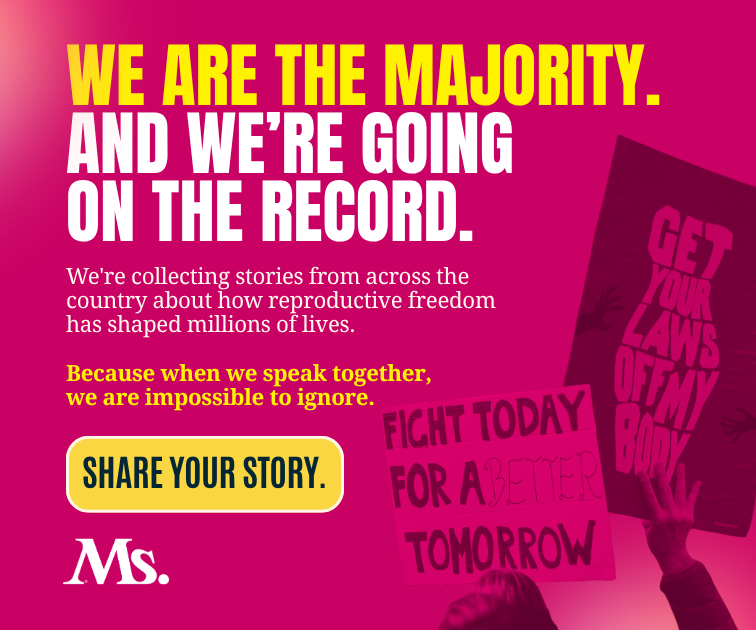
Poll after poll shows a majority of Americans support reproductive healthcare access. Yet public debate overlooks the lives shaped by abortion access, contraception, IVF, miscarriage care, maternal healthcare or comprehensive sex education—countless women who chose to pursue an education, have children, not have children, protect their health and chart their own future. What’s your reproductive freedom story? Add your voice. Together, these stories will help show not only why reproductive freedom remains a majority value, but also what it makes possible.